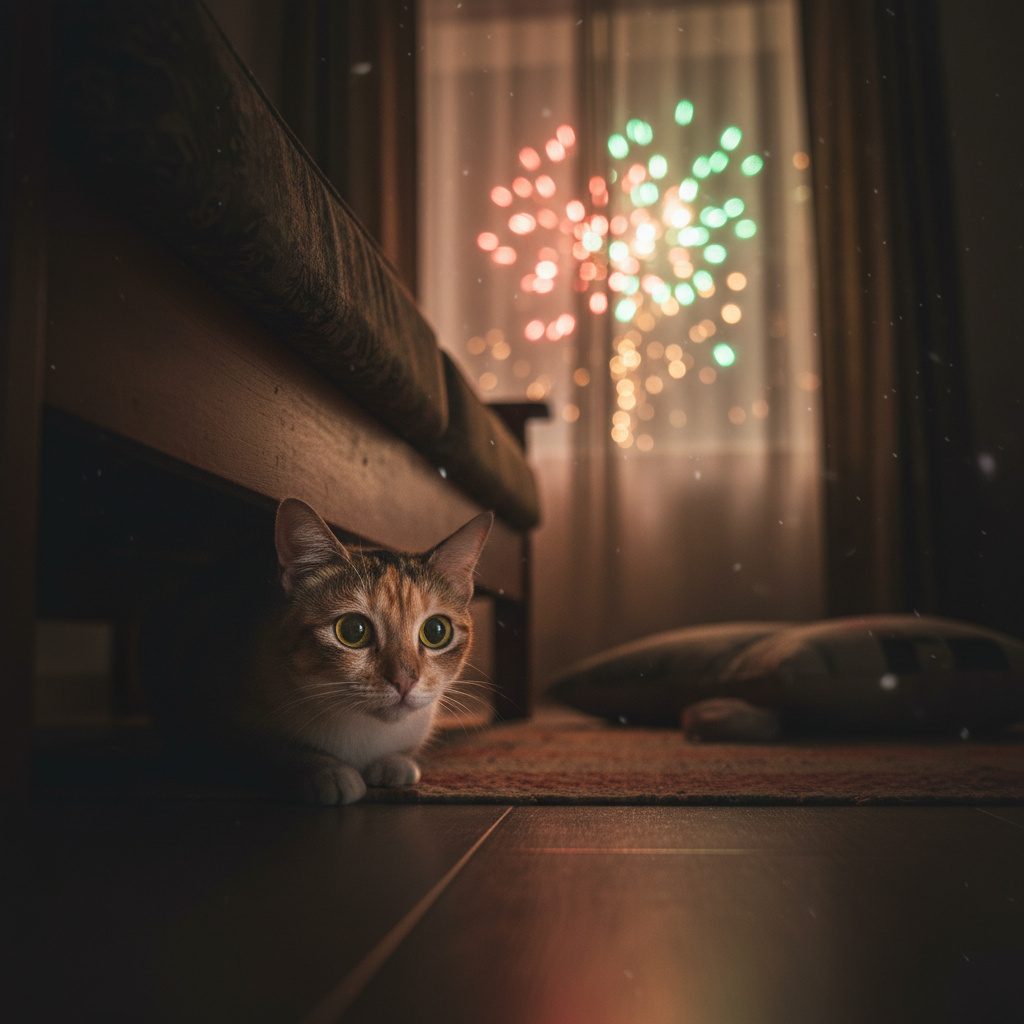
For us, fireworks are a few minutes of pretty lights and a loud 'wah, cantik.' For your cat, they're an inexplicable bombardment that sounds like the world is ending. And in Malaysia, this isn't a once-a-year problem — between Chinese New Year, Hari Raya, Deepavali, Merdeka, and the neighbour who just likes mercun, the bangs come around all year. If your cat vanishes under the bed every festive season, this guide explains why, and exactly how to help. We've ridden out plenty of noisy nights with Tiger, Lion, Ping'An and Lucky — here's what actually helps.
Why Fireworks Terrify Cats
It's not that your cat is being dramatic. Fireworks are genuinely, physically overwhelming for a cat, for two reasons.
First, their hearing is on another level. A cat's hearing range stretches to roughly 63Hz all the way up to 79kHz — far beyond what humans can detect. They hear higher frequencies, fainter sounds, and pick up the full sharp crack of an explosion in a way we simply don't. A firework that's merely loud to you can be physically painful and disorienting to a cat. And the stress is measurable: noise above about 85 decibels significantly raises a cat's breathing rate and cortisol (stress hormone). Fireworks blow well past that.
Second, it triggers deep prey-animal instinct. Cats are both predator and prey, and a sudden, unpredictable, earth-shaking BANG reads to their nervous system as a mortal threat. They can't rationalise it as 'just Deepavali' — there's no warning, no pattern, no escape they understand. The only instinct that fires is: hide, now. Understanding this reframes everything: your cat isn't being silly, it's terrified, and your job is to make terror survivable, not to 'toughen it up.'
Spotting Fear: How a Scared Cat Behaves
Cats show fear differently from dogs — often quietly. Know the signs so you don't mistake a frightened cat for a sulking one:
- Hiding — under the bed, behind the sofa, on top of a wardrobe, in a cupboard. This is the number-one response and it's healthy coping, not a problem to fix.
- Freezing — going flat and still, pupils huge, ears flattened sideways or back.
- Bolting — a sudden panicked dash, which is dangerous if a door or window is open (a terrified cat can escape and get lost).
- Body language: crouched low, tail tucked, whiskers pinned back, rapid breathing or panting (panting in a cat is a serious stress sign).
- After-effects: some cats are off their food, clingy, or skittish for a day or two afterward, or have a litter box accident from sheer stress.
That last point matters: fear-driven stress can cause a normally tidy cat to pee outside the box, and it's also a known trigger for stress cystitis. Don't scold it — it's a fear response, not bad behaviour. If accidents happen, our cat pee solver helps you confirm it's stress rather than something medical.
Before the Bang: Prep a Safe Hideaway
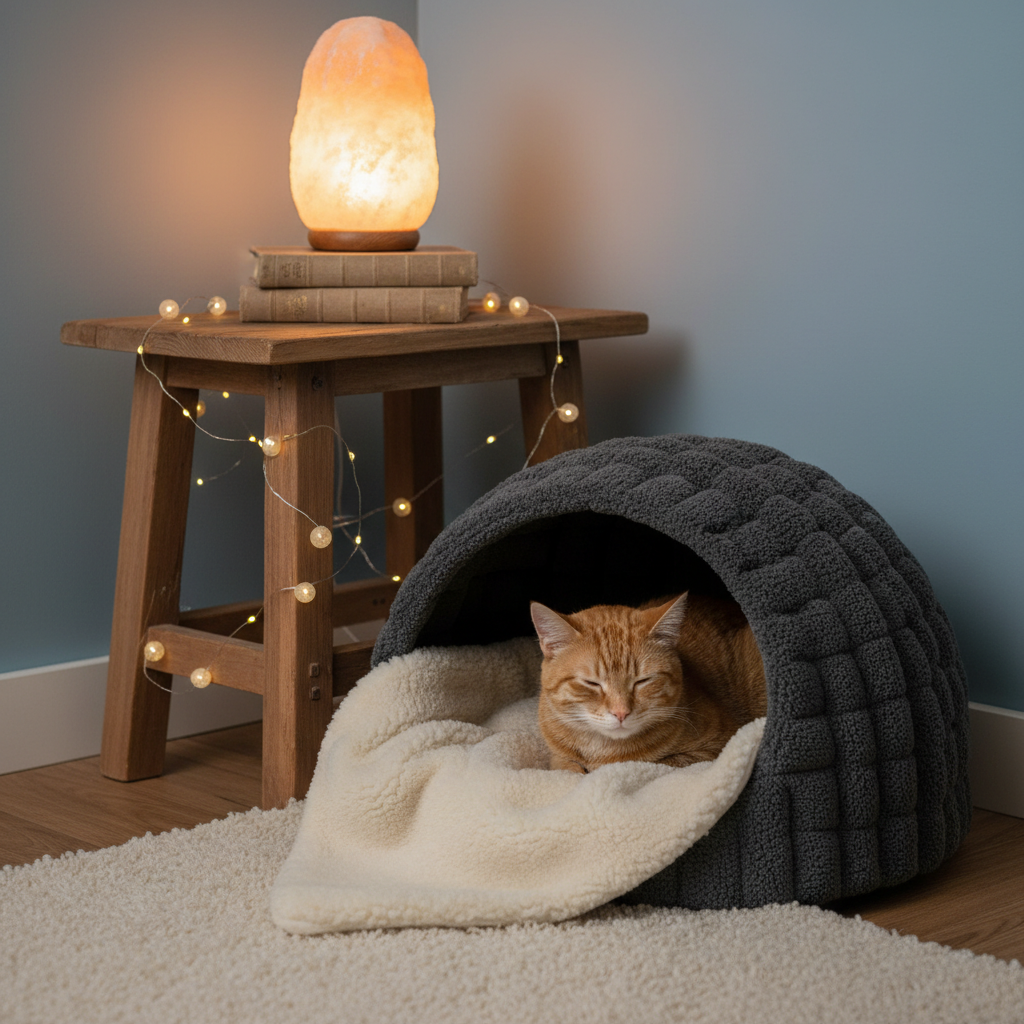
The single best thing you can do is prepare a safe space before the festive night, while your cat is still calm. Cats cope with fear by hiding, so the goal is to give them the best possible place to do it. Research on stressed cats found that simply providing a hiding box dramatically lowers their stress levels — so lean into the instinct, don't fight it.
Set up a 'bunker' in the quietest, most interior room (away from windows):
- Enclosed hiding spots: a covered cat bed, an open carrier with a blanket, a cardboard box on its side, or simply leaving the wardrobe open. Give choices.
- Familiar bedding that smells of home and of your cat.
- The essentials inside the room: water, and a litter box, so a hiding cat never has to choose between safety and a wee.
- Vertical options too — some cats feel safest up high. As Battersea notes, nervous cats gain confidence from vertical space and enclosed hiding spots.
Then dampen the assault on the senses: close windows and curtains to muffle the noise and block the flashes, and put on a buffer of steady sound — a fan, aircon, the TV, or calm music — to take the edge off the sudden cracks. A plug-in feline facial pheromone diffuser (the synthetic version of the F3 'safe environment' pheromone cats deposit by face-rubbing) in that room, started a day or two before, can help signal 'this place is safe.' And critically: make sure all windows, doors and balcony grilles are secure, so a bolting cat can't escape.
During the Fireworks: Staying Calm and Comforting Right
When the banging starts, how you behave matters more than you'd think:
- Stay calm and act normal. Cats read your energy. If you rush around anxiously checking on them, you confirm that something is wrong. Project boring, unbothered normality.
- Let them hide. Do not drag them out. Pulling a terrified cat out of its hiding spot to 'comfort' it only adds the stress of being restrained — and full-body restraint actually heightens a cat's fear. Let the hideaway do its job.
- Comfort only if they come to you. If your cat chooses to climb into your lap, absolutely soothe it with a calm voice and gentle strokes — quiet reassurance is fine and helpful. Just let the cat set the terms.
- Never punish. Not for hiding, not for an accident, not for clinginess. Punishment during fear is deeply counterproductive.
- Don't force food or play. A frightened cat won't be interested; just keep the environment safe and let it ride out the noise.
The Malaysian Festive Calendar: Bangs All Year Round
Here's what makes this a uniquely Malaysian challenge: we don't have one fireworks night, we have a rolling calendar of them. Chinese New Year is the big one — days of firecrackers, not just one evening. Then Hari Raya, Deepavali, Merdeka, New Year's Eve, the odd wedding or open house, and neighbourhood kids with mercun whenever the mood strikes. For a noise-sensitive cat, that's a lot of bad nights spread across the year.
The practical implication: don't treat this as a once-a-year scramble. If you know your cat is firework-phobic, keep the 'bunker' easy to set up, keep a pheromone diffuser on hand, and watch the calendar. The week before CNY or Deepavali, get the safe room ready in advance rather than improvising when the first cracker goes off. A cat that already has its safe routine in place copes far better than one ambushed by the noise. The same calm, predictable home that helps an anxious or low-mood cat day to day pays off double on festive nights.
When Fear Is Severe: Vet Help and Desensitising
For most cats, a good hideaway and a calm owner are enough. But some cats are so severely phobic they hurt themselves trying to escape, refuse to eat for days, or are clearly suffering. Don't just accept that as 'how she is' — there's real help:
- Talk to your vet, ideally well before the festive season. For severe noise phobia, vets can prescribe situational anti-anxiety medication — options like gabapentin are used in cats for both anxiety and stress relief. Given an hour or two before the expected fireworks, it can take a cat from blind panic to merely sleepy and calm. This is a vet decision, never a self-prescribed or 'borrow a human pill' one.
- Long-term desensitisation. Outside festive season, some cats can be gradually desensitised by playing firework sounds at very low volume during pleasant activities (meals, play) and slowly increasing it over weeks. It takes patience but can genuinely lower the baseline fear.
- Rule out a medical layer. If stress is causing repeated litter accidents or a cat seems unwell after, get it checked — stress cystitis and other issues can ride along with anxiety.
Fireworks season in Malaysia isn't going anywhere, but a terrified cat under the bed isn't something you just have to accept. Give your cat a safe, enclosed place to hide, muffle the noise, stay calm yourself, and plan ahead for the festive calendar — and for the truly phobic, loop in your vet early. Do that, and even the loudest CNY becomes something your cat simply sleeps through in its bunker, rather than a yearly ordeal.