
You call your cat's name and it... slowly blinks at you and carries on. So does it actually know its name, or is it just ignoring you? Both, honestly. Cats really can learn their names — there's solid science proving it — but they're under no obligation to come running like a dog. The good news is that name recognition is a trainable skill, and teaching it properly makes daily life — feeding, vet trips, and the occasional "where on earth has it gone" panic — far easier and safer.
This is the how-to anchor of our cat-naming series. If you're still choosing, start with how to name your cat; here we cover how to make whatever name you picked actually stick.
Do Cats Really Know Their Names? The Science
For years this was just something cat owners assumed. Then a landmark 2019 study in Scientific Reports, led by Atsuko Saito, gave us proof. Reported widely including by the American Institute of Physics, the team tested 78 cats using a "habituation-dishabituation" method: they played a recording of four ordinary nouns (so the cat got bored and stopped reacting), then the cat's own name.
The result: most cats showed a clear "rebound" reaction — an ear twitch, a head turn — specifically to their own name, even when a total stranger spoke it. This held up across 78 cats and four separate experiments. Cats in normal homes could even tell their own name apart from their feline housemates' names. (Interesting exception: cats in a cat cafe reacted to all the names, because in that chaos any name might mean a treat is coming — a neat clue about how the learning actually works.)
How Cats Learn a Name (It's Not What You Think)
Here's the key insight: your cat doesn't think of its name as "me." As Saito herself noted, there's no evidence cats attach meaning to words the way we do. Instead, they learn through associative conditioning — the specific bundle of sounds in the name reliably predicts something, so it becomes a "special" sound worth reacting to. As International Cat Care and other behaviour experts explain, two mechanisms are at play:
- Classical conditioning: name said → treat/fuss appears. Repeated enough, the name itself becomes a pleasant cue.
- Operant conditioning: cat hears name → turns toward you → gets rewarded → learns that responding pays off.
So the name isn't magic — what you pair it with is. A name followed by good things becomes a word your cat wants to respond to. A name followed by nothing (or worse, by something nasty) becomes background noise. Cats are, as behaviour scientist Monique Udell summarised the research in Psychology Today, paying close attention to what you say and do, and learning from it.
There's even evidence cats track more than the sound itself. A Kyoto University study led by Saho Takagi found cats appeared surprised when their owner's voice suddenly came from a different room than expected — suggesting they hold a mental map of where you are based on your voice alone. Your cat isn't aloof; it's quietly modelling your whole household in its head.
Choose a Name That's Easy to Learn
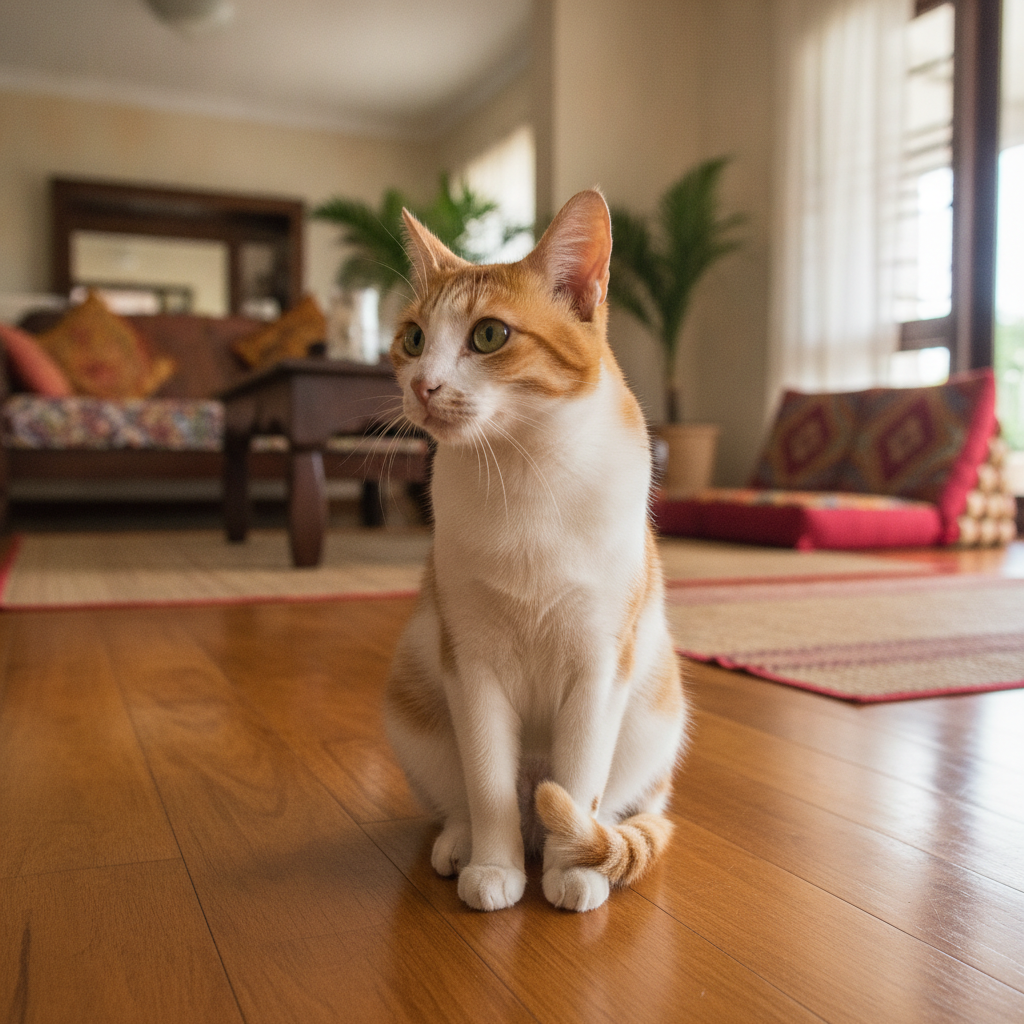
If you haven't locked in a name yet, you can stack the odds. Research on huge pet-name databases plus advice from vets points to a few sound-based rules:
- One or two syllables. Short names cut through the noise. "Lancelot" gets ignored; "Lancey" gets a head-turn.
- End on a high "ee" sound. Cats' ears evolved to catch the high-pitched squeaks of prey, so names like Misty, Zoe or Kiwi land better. Vet Dr Uri Burstyn notes cats respond to high-pitched sounds far more reliably than low ones.
- Open with a crisp consonant — C, B or M are clear and common; cats pick them out easily.
- Avoid command clashes. "Kit" sounds like "sit," "Bo" like "no." Keep the name distinct from words your cat will hear in training.
You don't have to sacrifice a name you love — just give a long formal name a short, bright nickname for everyday calling. For more on picking by gender or theme, see our popular cat names guide.
Step-by-Step: Teaching the Name
The method is simple, and it's pure positive reinforcement:
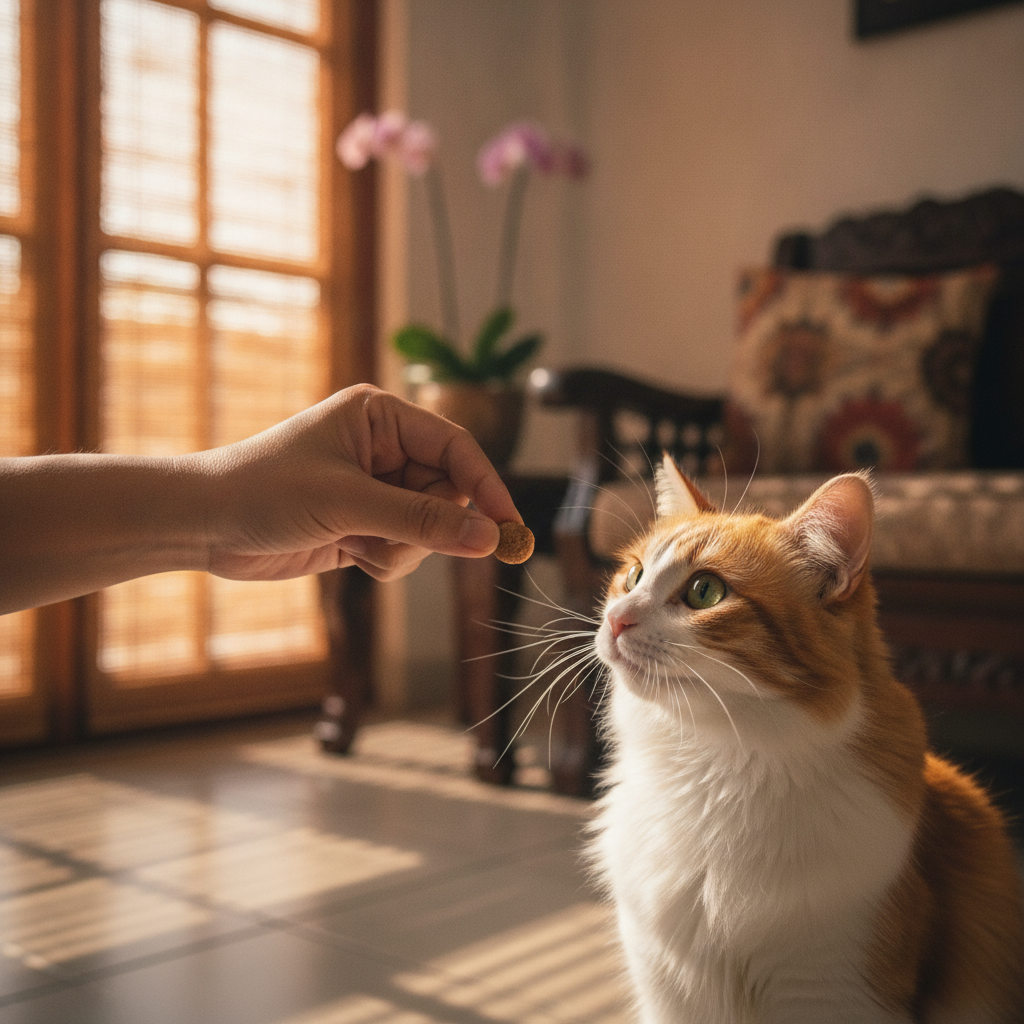
- Arm yourself with high-value treats your cat goes mad for (a lickable puree, tiny bits of cooked chicken or steamed fish) — ordinary kibble usually isn't tempting enough to compete for attention.
- Say the name once, clearly and in a happy, slightly high tone, when your cat is calm and near you.
- The instant it looks at you — even a glance or an ear flick — mark it and reward immediately. Timing is everything; the treat must follow within a second or two.
- Repeat 5-10 times, then stop. Short sessions (a few minutes) several times a day beat one long boring drill.
- Raise the difficulty gradually: more distance, then another room, then with mild distractions around.
Prefer clicker training? It works beautifully here — click the moment the cat responds, then treat. The click becomes a precise "yes!" marker that bridges the tiny gap between the good behaviour and the reward, which is exactly why veterinary trainers lean on it. Mealtimes are a brilliant built-in opportunity: say the name right before you put the bowl down, every single time, and your cat does half the learning for you. Keep a few treats in a pocket so you can reward spontaneous responses throughout the day, not just in formal sessions.
The #1 Mistake: Poisoning the Name
This is where most people accidentally sabotage themselves. Behaviourists call it "poisoning the cue": if the name gets used in bad moments — shouted during a scolding, said right before the dreaded carrier, or paired with a pill — your cat quietly learns that its name predicts something unpleasant, and the smart response is to hide or ignore it.
So protect the name fiercely. It should only ever mean good things: food, play, cuddles, treats. When you need to interrupt bad behaviour, use a different sound (a clap, a "psst") — never the name. Keep the name 100% positive and it stays a word your cat is happy to answer. This is also why the cat-cafe cats in the Saito study were less precise: when dozens of strangers call every name all day, no single name reliably predicts a reward for any one cat, so the association blurs. Consistency from one or two people is what makes a name sharp and meaningful.
Realistic Expectations: Cats Aren't Dogs
Manage your expectations and you won't be disappointed. Recognition in cats usually shows up as a subtle signal — an ear rotating toward you, a head turn, a pause, a tail flick — not a gleeful sprint across the room. As PetMD notes, a cat that knows its name perfectly well may still choose not to come, especially if it's comfortable or unmotivated. That's not failure; that's just being a cat.
Most cats start showing recognition within a couple of weeks of consistent practice, though it varies. In multi-cat homes, train each cat separately so each name keeps its own clear meaning. And if you've adopted an adult with a name you'd like to change — go ahead; with steady positive pairing, cats transition to a new name comfortably, usually within a few weeks. The trick is simply to retire the old name entirely and only ever reward the new one. Don't take a quiet cat as a stubborn one, either: a kitten, a nervous newcomer, or an older cat with fading hearing may all respond more slowly, and that's normal. Patience and consistency win every time.
Name Learned? Build On It
A reliable name response is a foundation, not the finish line. It makes vet trips, recall, and general communication smoother, and it pairs naturally with other gentle, reward-based training — the same kind that makes life calmer all round (our guide to cat behaviour goes deeper). A cat that happily comes to its name is also easier to guide to the right spots in your home — its bed, its scratching post, its litter box.
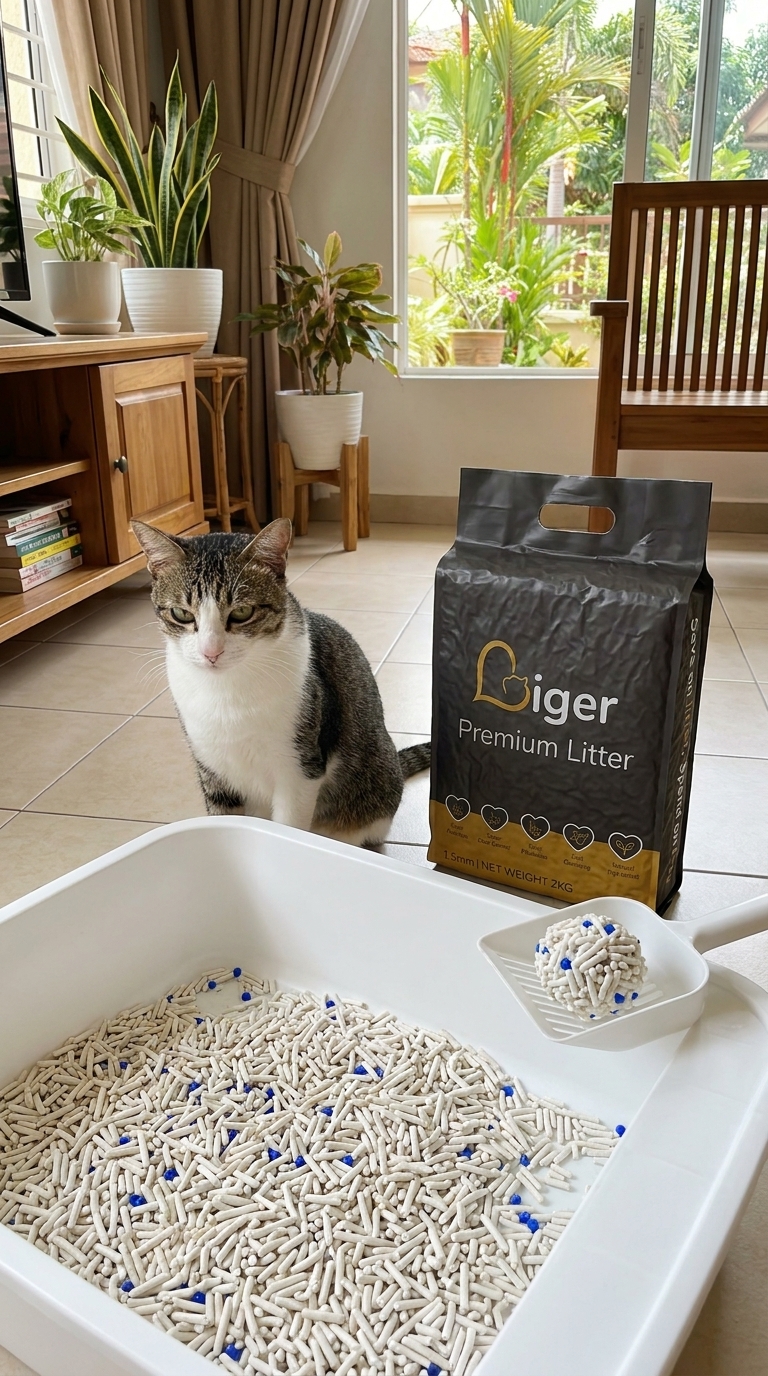
Speaking of which, settling a newly named cat is much easier with a calm, clean setup. A low-dust, lightly scented litter helps a cat feel comfortable using its box from day one — which is what Liger Premium Tofu Cat Litter is built for, with food-grade soy fibre, fast clumping, and flushability in small amounts. Current Liger pricing (as of May 2026) is RM21.90 for a single 2kg pack, RM53.90 for 3 packs, RM89 for 5 packs and RM169 for 10 packs (RM8.45/kg), free shipping across Peninsular Malaysia. Get set up with our new cat owner checklist and the litter calculator. Teach the name with patience and kindness, keep it tied only to good things, and you'll end up with a cat that doesn't just hear you — it chooses to answer.