Cats can associate words with objects after just four 9-second exposures.
They recognize their own names even when spoken by strangers.
Ignoring you is an evolutionary strategy called 'low-intensity response.'
High-pitched 'baby talk' (CDS) is physically easier for cats to hear.
Your cat is faster than a human baby. No, I’m not talking about their 3 AM zoomies. Recent research from 2024 shows that cats can associate human words with images in just four brief exposures. That’s nearly four times faster than a 14-month-old human infant.
So, the next time you’re pouring heart out to your feline roommate while they stare blankly at a wall, know this: they probably hear you. They might even understand you. They’ve just decided that your conversation isn’t worth the energy required to flick a tail. It’s not a bug; it’s a feature of the feline brain.
The Acoustic Radar: Why 'Baby Talk' Works
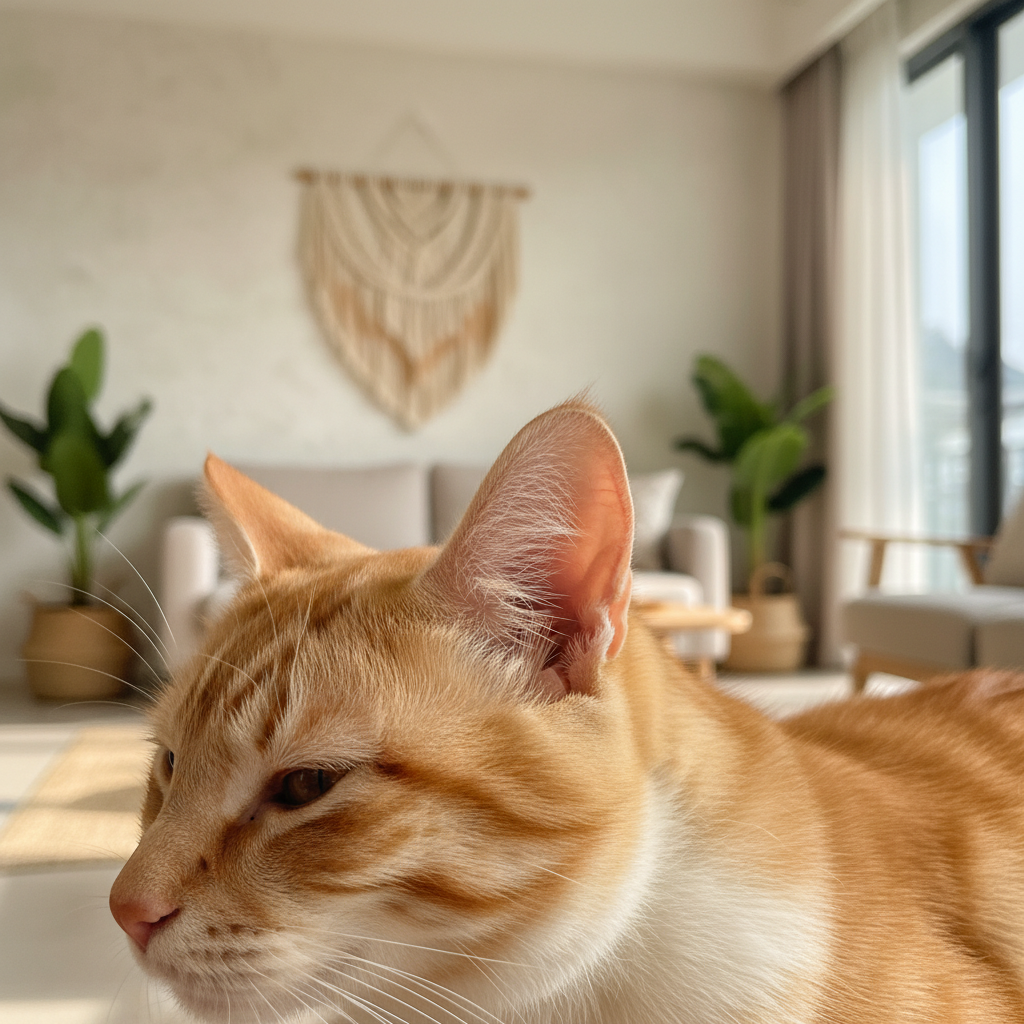
Have you ever noticed yourself instinctively using a high-pitched voice when calling your cat? There’s a biological reason for that. Cats have an incredible hearing range—up to 64,000 Hz—which helps them detect the tiny squeaks of rodents. Human men’s voices often sit at the lower end of their comfort zone, sounding muffled or even threatening.
When we switch to 'Cat-Directed Speech' (CDS) or what we call the 'tweety voice' in Malaysia, the frequency hits their sweet spot. It cuts through the background noise of the TV or the ceiling fan. If you want to know if they're listening, watch their ears. A tiny ear flick or a rotation toward you is the feline equivalent of a 'seen' blue tick on WhatsApp. They’ve received the message; they just haven’t typed a reply.
They Know Their Names (And Your Housemates')
A landmark 2019 study confirmed that 家猫将自己的名字与其他词汇区分开来. In multi-cat households, they can even distinguish their own name from their 'siblings'. Our clean-freak cat, Lion, will perk up the moment he hears his name, especially if it's followed by the sound of a fresh litter bag. On the other hand, Lucky usually needs a visual cue because he's too busy getting into mischief.
I Thought My Cat Was Deaf
I’ll be honest—I spent a good few hundred Ringgit at the vet because I thought my cat was losing his hearing. I’d call him, scream his name, even clap my hands right behind him. Nothing. He wouldn't even turn his head. I felt rejected. I thought we had no bond.
The vet did a simple test: he crinkled a plastic treat bag from across the room. My cat, who had been 'deaf' for three weeks, teleported to the vet's feet in seconds. That was my 'aha' moment. He wasn't deaf; he was just filtering me out like spam email. It turns out, cats use a 'low-intensity response strategy'. They hear the signal, evaluate the reward (Is there food? No? Okay, back to sleep), and decide whether to move. It's a pragmatic wisdom that we could honestly learn from.
| Test Scenario (Stimulus) | Selective Ignoring (Behavioral Ignoring) | Deafness (Auditory Impairment) |
|---|---|---|
| High-value sounds (e.g., can opening, treat bag rustle) | Instant reaction, may wake from sleep, pupils dilate, runs over immediately. | No reaction unless seeing your movement or smelling the scent. |
| Environmental noise (e.g., vacuum cleaner, doorbell) | Shows aversion, alertness, attempts to escape or hide. | No reaction, may even sleep peacefully next to a running vacuum cleaner. |
| Clapping hands in sleep (out of sight, 1-2 meters away) | Ear twitch (pinna reflex), may open eyes displeasedly, or adjust sleeping position. | Ears remain still, no startle reflex in body. |
| Everyday calling (normal speaking tone for name) | Slight ear turn (radar mode), body remains still, may accompanied by a slight tail flick. | No ear movement, appears completely oblivious. |
| Owner returning home (door opening sound) | May greet at the door (based on biological clock or hearing), or ears twitch slightly. | Often startled violently when you touch them from behind (because they didn't hear you enter). |
| Cat's own meows (Vocalization) | Normal meow volume, varies with situation. | Meows are often unusually loud (due to inability to monitor their own vocal feedback). |
The 2024 Breakthrough: Faster Than a Baby?

The latest science from Saho Takagi's team suggests that cats are elite associative learners. In the study, 猫体内图片-词汇关联的快速形成 was observed after only brief exposures. While a human baby needs multiple repetitions and clear social cues, a cat just needs to see the object and hear the sound. This is likely an evolutionary carryover from their days as solitary hunters—they had to quickly learn that 'rustle in grass = mouse' to survive.
In a home setting, this means they've likely mapped out half your vocabulary. Words like 'makan', 'treats', or even the 'click' of the aircon remote are high-value signals. If you want to improve your communication, try taking our 猫咪性格测试 to see if your cat is a 'Human Cat' who values social interaction or a 'Hunter' who only cares about the prize.
The Myth: Cats are Just Less Intelligent Than Dogs
People often equate 'obedience' with 'intelligence'. Dogs were bred for 30,000 years to work with us, so their brains are wired to please. Cats, however, are 'self-domesticated'. They moved into our homes for the mice, not the job. They don't have a 'boss' in their social hierarchy.
When a cat ignores you, it’s not because they don't understand; it's because they've performed a cost-benefit analysis and decided the benefit is zero. This independent thinking is actually a sign of high cognitive functioning. They aren't tools; they are roommates. If you want a better response, you need to provide a better incentive. Even our sensitive Ping'An, who sneezes at everything, becomes a genius the moment she hears the specific crinkle of the food bag.
Cats aren't ignoring you because they're rude; they're just being efficiently feline. They have the hardware to hear your whispers and the software to learn your language—they just choose to use it on their own terms. Understanding this shift from 'master and pet' to 'mutually beneficial roommates' is the key to a happier home.
Your Monday Morning Action: Tomorrow, try calling your cat’s name using three different tones: your normal speaking voice, a low whisper, and a high-pitched 'baby talk' voice. Don't look at their face. Instead, keep your eyes on their ears. Which tone gets the biggest flick? That's your 'secret frequency' for communication.
| Trait | Cats | Human Babies (14 months) | Dogs |
|---|---|---|---|
| Word-Object Association Speed | Rapid (4 exposures, 9s each), faster than babies | Slower (more exposures, longer duration, social cues) | Strong, but not directly compared for this specific task |
| Primary Motivation for Response | Cost-benefit analysis, high-value rewards (food, safety, petting) | Social interaction, parental approval, exploration | To please owner, social bonding, rewards |
| Social Referencing | Very low; prefer independent problem-solving | High; look to caregivers for cues in ambiguous situations | High; instinctively look to humans for help and cues |
| Evolutionary Path | Self-domesticated (9,000 years), solitary hunters | N/A (human development) | Cooperatively domesticated (30,000 years), pack animals, hunting partners |