The litter that worked for your cat at age 3 will quietly turn into a problem at age 8. We didn't realise this until our rescue Ping'An started hesitating at the box edge — that pause, that little look back at us, was the first sign her joints were complaining.
Senior cats (7+ years per Cornell Feline Health Center) deal with a stack of changes that hit the litter box directly: arthritis in roughly 90% of cats over 12, chronic kidney disease in 30-50% of cats over 10, cognitive decline in over half of cats 15+, and a rising risk of urinary infections (NIH/PMC review on senior feline UTIs). Pick the wrong litter or the wrong box and you're not just inconveniencing the cat — you're causing pain.
We're Liger, a Malaysian tofu cat litter brand. Between our four cats and the older rescues we've fostered before adopting Tiger, Lion, Ping'An and Lucky, we've watched what works and what fails for older cats in our climate. This guide is the practical version: which litters are senior-friendly, which box setups stop pain at the door, and how to read your senior cat's litter habits as a health monitor.
What Changes at 7+ That Affects Litter Choice

Senior cat care isn't about premium-branded litter. It's about removing physical obstacles and protecting four systems that get fragile with age:
- Joints (arthritis). Around 90% of cats over age 12 show radiographic evidence of osteoarthritis. Tall box walls and hard pellets become daily pain triggers.
- Vision and cognition. Over 50% of cats aged 15+ show signs of feline cognitive dysfunction per BSAVA clinical guidance. They forget where the box is, misjudge the entry, or get "stuck" inside.
- Bladder and kidneys. 30-50% of cats over 10 develop chronic kidney disease, which means more urine volume and more bathroom trips (PetPlace clinical overview).
- Respiratory system. Older airways are more reactive. Dusty litters can trigger or worsen feline asthma and chronic bronchitis (Cornell on feline asthma).
None of this is theoretical. The signs show up at the litter box first — long before your vet notices anything on a routine exam. That's actually the silver lining: a well-chosen litter setup is also a daily diagnostic tool.
The 4 Senior-Cat Changes That Decide Your Setup

1. Arthritis: Why High-Wall Boxes Become Torture
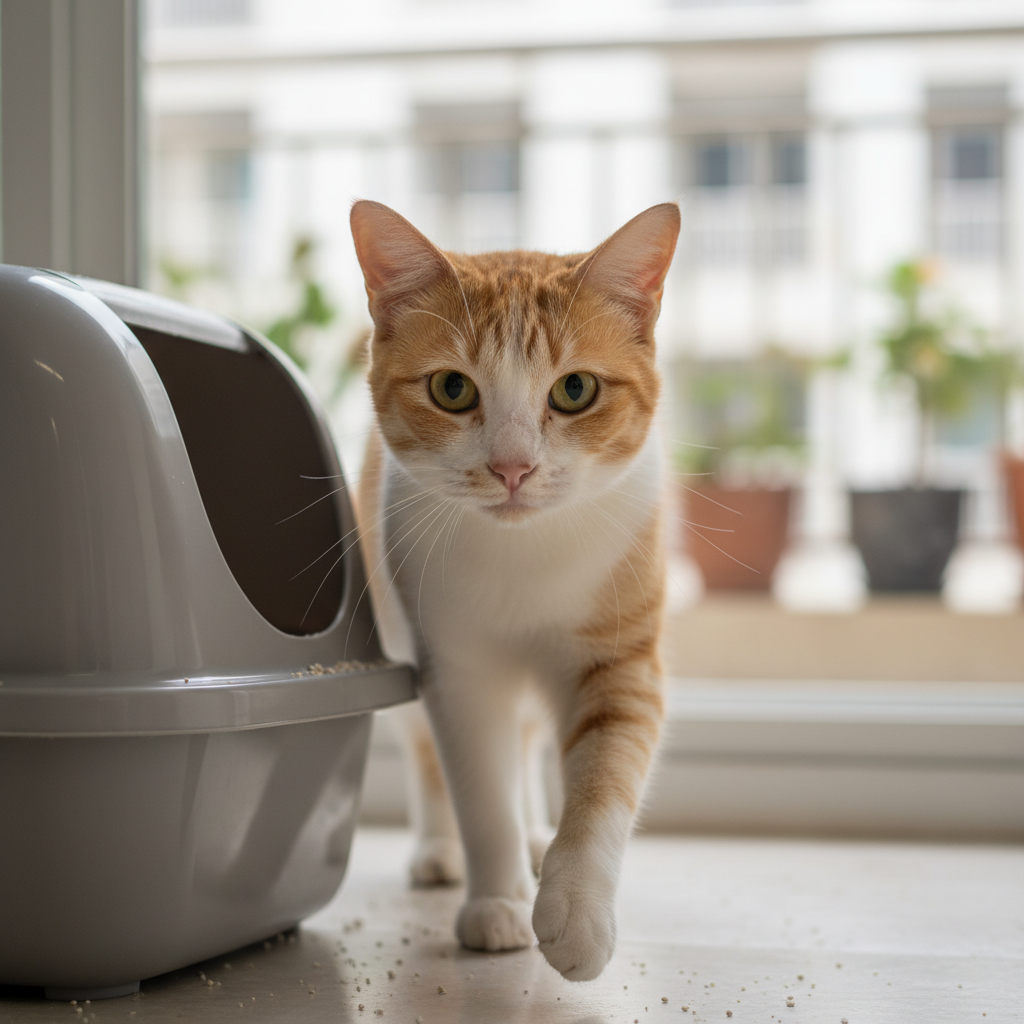
Cats don't limp the way dogs do. Instead they stop jumping, groom less, and start eliminating next to the litter box instead of inside it. That "right next to the box" pattern is the classic arthritis signal per Central Kentucky Vet's arthritis review — the cat knows where to go, but the box wall hurts too much to climb.
Fix: drop the entry height to 3-6 inches (7.6-15.2 cm), get rid of any covered/top-entry boxes, and place the box on a non-slip mat so old paws don't skid on tile.
2. Cognitive Decline: When the Box "Disappears"
If a 12+ year old cat suddenly pees in a random corner — not next to the box, not on the bed for spite, but a totally new spot — think dementia, not behaviour. iCatCare's clinical brief describes cats that wander past their own litter box because spatial memory is failing.
Fix: add a second box on every floor the cat uses, keep box locations consistent (don't move it to a new spot to solve the problem — that makes it worse), and use a soft nightlight near the box if your condo is dark at night.
3. Urinary Issues: The Frequency Tells You Everything
Healthy adult cats urinate 2-4 times per day. Seniors with CKD often hit 4-6 times, and cats with feline lower urinary tract disease (FLUTD) might visit the box 10+ times producing barely a drop — that's the medical emergency called stranguria (Cornell FLUTD reference).
Fix: use a light-coloured, well-clumping litter so you can see clump size and count daily clumps. Our free cat urinary health checker tool takes the urination pattern you observe and tells you when to call a vet.
4. Weight Shifts: Both Directions Are Warnings
Some seniors get heavier (less activity, slower metabolism). Some lose weight fast (CKD, hyperthyroidism, dental pain). Both make the litter box harder. An overweight senior can't fit in a standard box; an underweight senior may not have the strength to dig through heavy bentonite. Track weight monthly with our cat weight calculator — a 10% drop or gain in 3 months is a vet visit, full stop.
Box Ergonomics: The Real Senior Upgrade

You can buy the gentlest litter on the market — if the box itself hurts to use, none of it matters. The AAFP/ISFM guidelines (AAFP 2024 environmental needs guidelines) lay out three non-negotiables for senior cats:
- Low entry, ideally 3-6 inches (7.6-15.2 cm). A 15-year-old arthritic cat won't lift her leg over an 8-inch wall reliably. Cut down one side of a storage container if commercial boxes are too tall.
- Generously sized — at least 1.5x the cat's nose-to-tail-base length. Roughly 22-26 inches long, 16-20 inches wide. Most off-the-shelf trays are too small for an adult cat, let alone a stiff senior who needs room to turn slowly.
- Open top, never covered. Older cats with weaker eyesight need to scan the room while toileting. Hooded boxes also trap ammonia in Malaysia's humidity, which is bad for senior airways.
Add a non-slip yoga mat or rubber mat under the box. Senior cats are wobbly. A box that slides under their weight will scare them away after one bad experience.
Not sure what size fits your cat? Try our free litter box size calculator — it uses the vet-recommended 1.5x rule and gives you a target dimension to look for.
Litter Texture: Why Hard Bentonite Hurts Old Paws

Healthy young cats happily walk on coarse bentonite or sharp silica crystals. Senior cats with thinning paw pads and arthritis in their toes don't. The shift is so consistent that sensitive-paw litter reviews all converge on three winners: fine tofu, recycled paper, and softened pine (broken down from pellets).
Two things matter:
- Granule size. Aim for fine, sand-like, or soft-spongy textures. Avoid large angular silica crystals and hard pine pellets.
- Depth. Senior cats can't dig through 4 inches of dense bentonite. Keep depth at 1-2 inches max — easier to scratch through, easier to step in and out of.
Litter Weight Matters More Than You'd Think
Bentonite clay is heavy — and that heaviness matters in two places. First, every dig motion costs joint effort. A senior cat who'd happily kick bentonite at age 3 will half-heartedly scratch at it at age 12 and leave waste uncovered. Second, you (the human) have to lug bags and clean a heavy box. Tofu litter weighs roughly 40-50% less per litre than bentonite, which translates to less work for the cat per scratch.
That's part of why we built our brand around tofu — but to be fair, paper-pellet litter is even lighter, and silica beads are the lightest of all. For seniors, lighter is genuinely better at the litter box itself, but watch out: ultra-light litters track everywhere if your cat does the "flick-out" thing on exit. Pair lightweight litter with a high-pile mat outside the box.
Dust-Free Is Non-Negotiable for Older Lungs
Feline asthma and chronic bronchitis are markedly more common in older cats, and dust is a documented trigger (Pennard Vets clinical overview). Traditional bentonite — including "low dust" formulations — releases crystalline silica particles when the cat digs (Boxiecat technical breakdown). For seniors in sealed Malaysian condos, that's a daily inhalation event.
Lowest-dust options, ranked roughly: tofu > paper > silica gel > pine pellet > bentonite. If you must use bentonite for monitoring reasons, pour gently against the inside box wall rather than dumping from height, and scoop without dropping clumps back into the box.
The 5 Litter Types Ranked for Senior Cats

1. Tofu Litter — Best All-Round
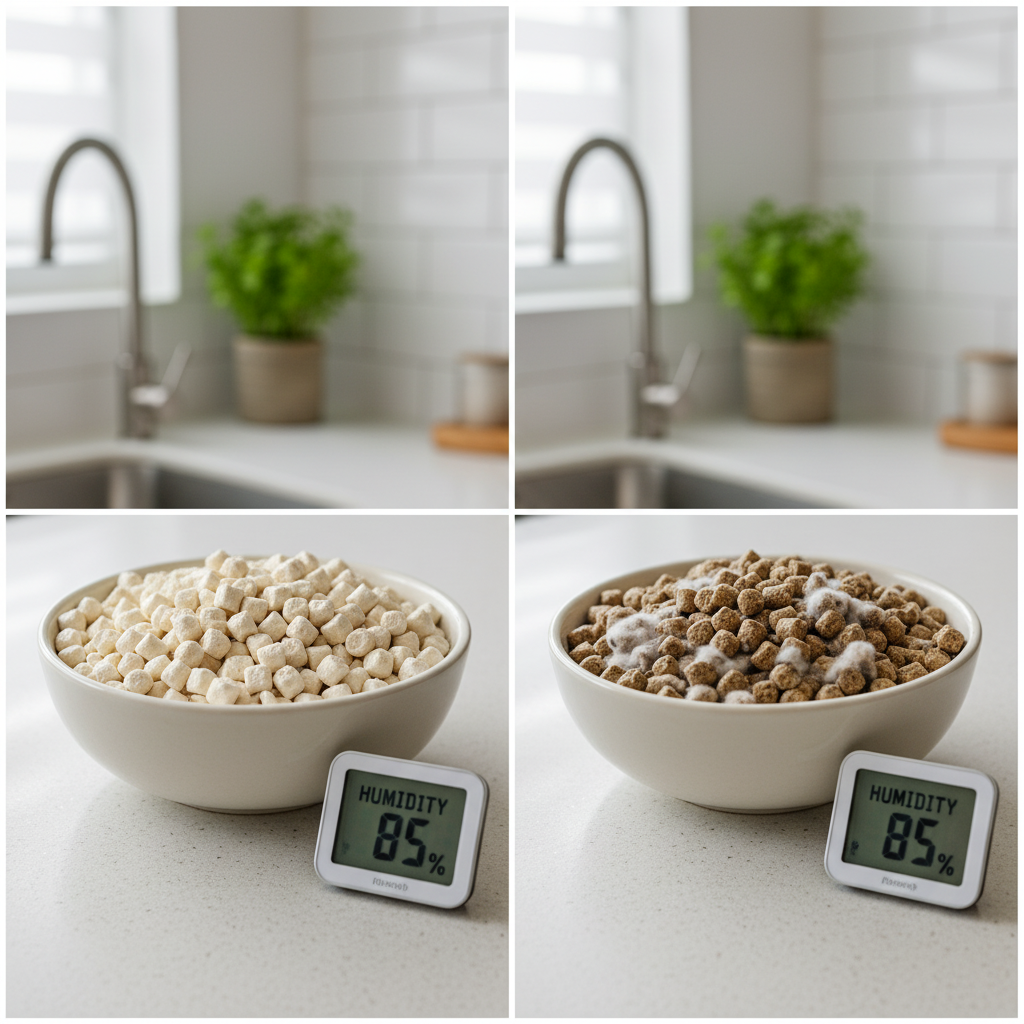
Soft, low-dust, low-weight, gentle on paws, clumps well. The main weakness is mould risk in Malaysia's humidity if you let it sit damp — solved by daily scooping and full change every 2-3 weeks. This is what we use for Ping'An, our oldest, and it's why the brand exists.
2. Recycled Paper Pellet — Best for Severe Asthma
Nearly zero dust, very soft when wet, light. Doesn't clump in the satisfying way bentonite does (you have to swap the whole tray more often), and odor control is weaker. But for a senior with diagnosed asthma, paper is the safest substrate.
3. Silica Gel Crystal — Best for Urinary Monitoring
Crystals change colour with urine pH and are exceptionally absorbent. Brands like PrettyLitter use this for health monitoring (PrettyLitter colour key). Downside: crystals can feel coarse on arthritic paws. Best as a secondary monitoring box, not the primary toilet.
4. Pine Pellet — Good Odor, Risky Texture
Naturally odor-neutralising, very low dust, biodegradable. The pellet form is rough on sensitive paws though — only choose pine if your cat will accept the broken-down sawdust version. Test before committing a full tray.
5. Traditional Bentonite Clay — Use With Caution
The cheapest and most familiar, but the worst on dust and weight. Use only if your senior cat refuses every alternative, and even then switch to a fine-grain low-dust formula, keep depth at 1.5 inches max, and pair with a low-entry box.
| Litter | Dust | Paw Comfort | Weight | Urinary Monitoring |
|---|---|---|---|---|
| Tofu | Very Low | Excellent | Light | Good (light colour) |
| Paper | Very Low | Excellent | Very Light | Good |
| Silica | Low | Fair (coarse) | Very Light | Best (colour-changing) |
| Pine pellet | Low | Poor (hard pellets) | Medium | Fair |
| Bentonite | High | Fair (if fine) | Heavy | Fair |
Scoop Frequency: Twice a Day Now, Not Once
Younger cats tolerate once-a-day scooping. Seniors don't, for two reasons. First, they urinate more often (CKD, FLUTD), so the box fills faster. Second, an older cat with sharper smell sensitivity will refuse a soiled box, hold it in, and develop a UTI from urine retention — exactly the wrong feedback loop.
The protocol we use: scoop morning and evening, full litter change every 2-3 weeks, full box wash with unscented soap monthly. In Malaysia's heat, never skip the monthly wash — bacterial breakdown of urea happens fast in 28-32°C ambient temps, and odor will drive the cat to find a new toilet (your sofa).
Ping'An's Setup: What Actually Worked for Our Family

Ping'An came to us as a rescue mom with three kittens. She's our "elder stateswoman" — calmer, slower, and more particular than the kittens we adopted around her. As she's aged, we've watched her habits shift, and her setup now looks nothing like what works for Tiger and Lion (who are 2 and full of chaos).
For her specifically:
- Open-top storage container box. 24 inches long, 18 wide, with the front wall cut down to 4 inches. Sandpapered edges so no sharp plastic.
- Tofu litter at 1.5 inches deep. Shallow enough she doesn't have to dig much, fine enough her paws are happy.
- Yoga mat underneath. Stops the box sliding when she enters with her wobbly back legs.
- Same corner of the spare bedroom, never moved. Consistency matters more as cats age — moving the box "to clean a stain" once cost us two weeks of accidents.
- Twice-daily scoop, weekly hose-down. Her urine output has stayed steady, but we'd notice fast if it didn't.
The single change that mattered most: cutting down the box wall. Within three days of switching from her old high-walled tray to the low-entry version, the "hesitation pause" disappeared. That tells you everything about how much the standard pet-shop box was costing her.
Decision Flowchart: Match Litter to Your Senior's Health Profile

- Does your cat have diagnosed asthma or chronic bronchitis? → Paper pellet. No exceptions.
- Diagnosed CKD or recurring UTI? → Tofu primary box + silica monitoring box. Track clump count daily.
- Visible arthritis (hesitates at box, accidents next to box)? → Tofu or paper, depth 1-2 inches, low-entry box mandatory.
- Healthy 7-10 year old with no symptoms yet? → Switch to tofu or fine bentonite now, get the box ergonomics right, you're future-proofing.
- Cognitive decline signs (random elimination, night-time wandering)? → Multiple boxes, one per floor, consistent placement, nightlight nearby. Litter type matters less than location and visibility.
When to Call the Vet (Don't Wait)
Any of these in a senior cat is a same-week vet visit:
- Sudden refusal to use the box despite a clean setup
- Straining with no output, or vocalising in the box (urinary blockage is a 24-48 hour emergency)
- Blood in urine — even a faint pink tinge
- Dramatic increase in drinking AND urinating (classic CKD presentation)
- Weight loss of 10%+ within a few months
- Confusion at the box — pawing at the wall, sitting in the box without urinating, getting "stuck"
In Malaysia, geriatric vet services are well-established in KL (Animal Medical Centre, Pusat Veterinar Healing Pets) and Penang (Windsor Animal Hospital's Senior Pet Wellness Programme). Don't tough it out hoping the cat will "get over it" — by the time toileting behaviour changes, the underlying condition has usually been brewing for weeks.
Bottom Line
The right senior cat litter setup isn't a single product — it's a system. Soft, low-dust substrate at shallow depth, oversized low-entry open box, twice-daily scooping, and a consistent location. Get those four pieces right and you remove the daily pain points that drive 99% of senior litter aversion. Get them wrong and the cat slowly stops using the box, you blame "old age," and the underlying medical signal goes missed.
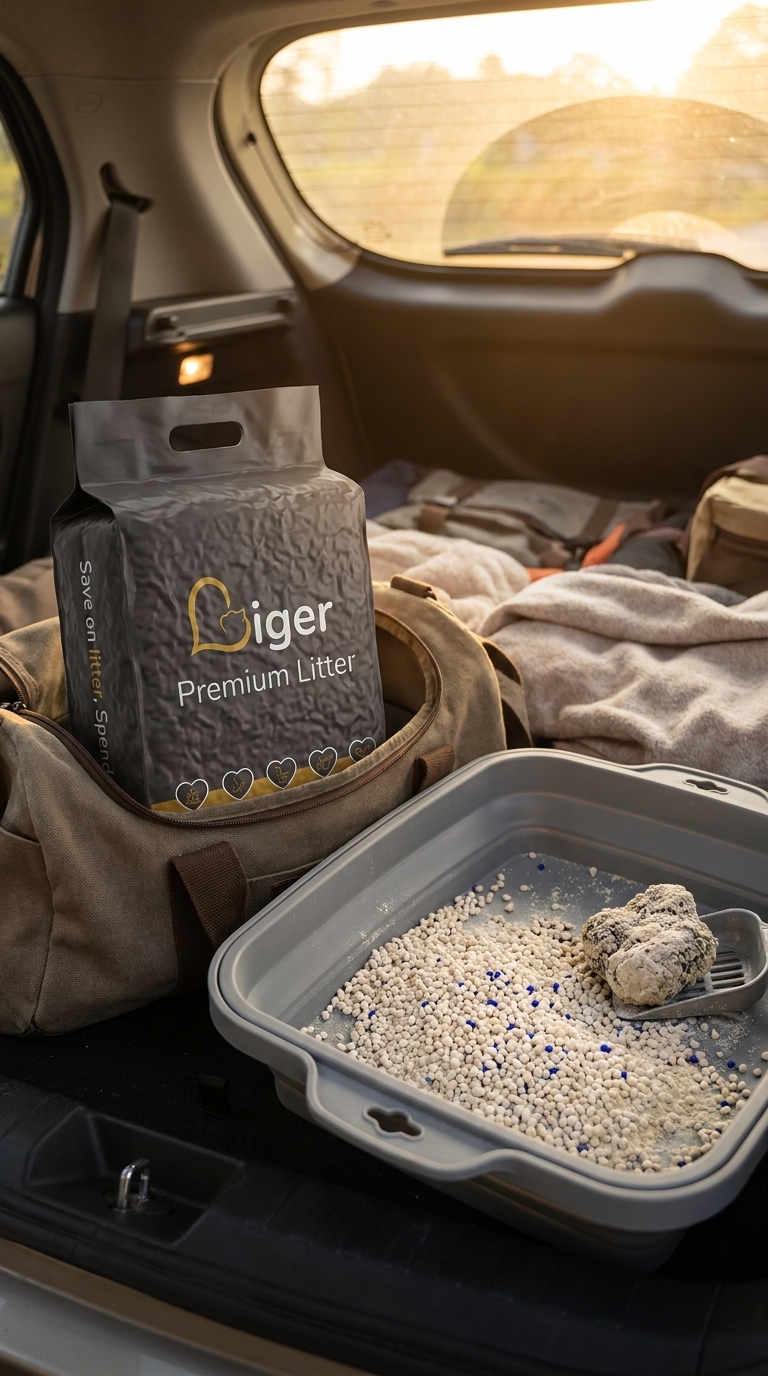
If you're switching litter for a senior cat, our milk-scented tofu cat litter is purpose-built for this: ultra-low dust, soft on old paws, light enough for arthritic digging, and we ship free across West Malaysia. But more important than which brand you pick — fix the box ergonomics first, then change the litter. In that order.