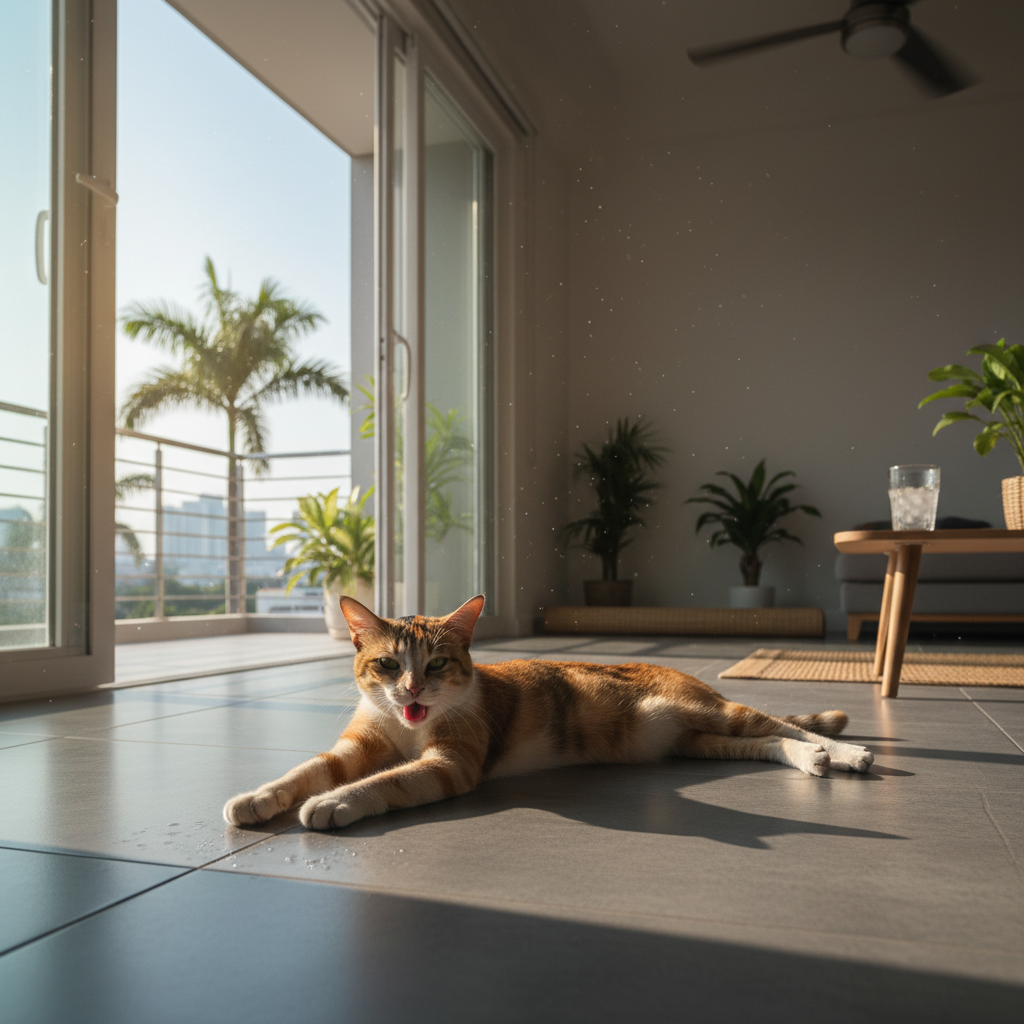
It hits 35°C outside, the aircon's off because nobody's home, and your cat is flat on the kitchen tiles like a furry puddle. Cute? Maybe. But Malaysia's relentless heat and humidity are genuinely dangerous for cats, and heatstroke can turn from "a bit sluggish" to life-threatening frighteningly fast. The cruel part: cats are masters at hiding discomfort, so by the time something looks obviously wrong, it's often an emergency. Here's what every Malaysian cat parent needs to know to spot it, stop it, and prevent it. We've sweated through plenty of hot afternoons with Tiger, Lion, Ping'An and Lucky — this is what keeps them safe.
Why Malaysia's Heat Is Uniquely Dangerous for Cats
Cats are built for a comfortable range that's actually warmer than ours — their thermoneutral zone sits around 30°C to 38°C, and their normal body temperature is a toasty 38°C to 39°C. That sounds like they'd love our weather — and they tolerate warmth better than we do. The problem is what happens at the top of that range. Once the environment climbs past their comfort ceiling, cats are poorly equipped to shed heat. They don't sweat through their skin like we do; they rely on limited panting, grooming saliva onto their fur, and seeking cool surfaces. In a humid country, all three break down.
Humidity is the silent multiplier here. When the air is already saturated — and Malaysia routinely sits above 80% relative humidity — evaporation barely works, so a cat's main cooling tricks fail. Worse, a damp coat in high humidity can act like a wet blanket that traps heat instead of releasing it. Add a sealed, un-airconditioned condo, a parked car, or a sun-trap balcony, and the temperature around your cat can spike past anything it can cope with. The cats most at risk: flat-faced breeds like Persians and exotics (their short noses make panting even less effective), overweight cats, kittens, seniors, and any cat with heart or breathing problems.
The Warning Signs: Spotting Heatstroke Early
Heatstroke is a progression, and catching it early is everything. The single most important sign: open-mouth panting. In dogs, panting is normal cooling. In cats, it is almost never normal — panting in a cat signals extreme stress, overheating, or an underlying heart problem. If your cat is panting like a dog and hasn't just finished a wild play session, take it seriously.
Watch for this rough progression, from early to emergency:
- Early: restlessness, seeking cool tiles, grooming excessively, mild panting, faster breathing. A healthy cat's resting breathing rate is about 15–30 breaths a minute — noticeably faster is a flag.
- Worsening: heavy open-mouth panting, drooling, bright red or very pale gums, lethargy, stumbling or wobbliness, vomiting or diarrhoea.
- Emergency: collapse, tremors or seizures, unresponsiveness. This is a race-to-the-vet situation.
If your cat is showing the early signs, act now — don't "wait and see." Heatstroke escalates much faster than people expect, and a cat that's merely warm and panting can tip into collapse within minutes if the heat source isn't removed.
First Response: What to Do If Your Cat Overheats
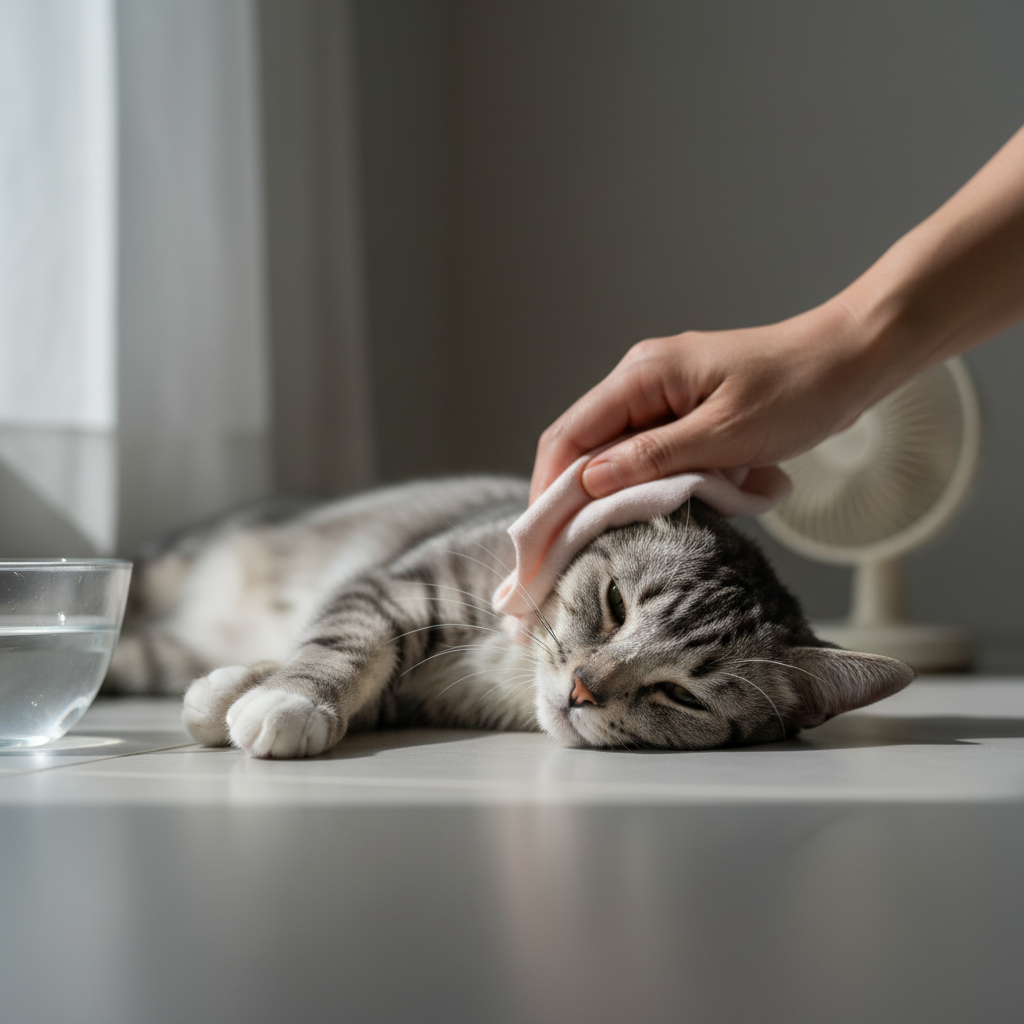
If you suspect heatstroke, your job is to start cooling immediately and get to a vet — both, not one or the other. Here's the safe sequence:
- 1. Move to cool air. Get your cat into the shade, in front of a fan, or into an air-conditioned room straight away.
- 2. Wet with cool — not ice-cold — water. Dampen the fur with cool or lukewarm water, focusing on the belly, paws, armpits and groin. Do not use ice or ice-cold water. It sounds counterintuitive, but extreme cold makes surface blood vessels clamp shut, trapping heat in the core and causing dangerous shivering. Cool, steady, gentle is the rule.
- 3. Encourage small sips of water. Offer cool fresh water but never force it down the throat — a distressed cat can inhale it.
- 4. Get to the vet — even if they perk up. Call your vet or the nearest emergency clinic and go. Heatstroke can cause internal organ damage that isn't visible from the outside, so a cat that "seems fine again" still needs checking. On the way, keep the car cool and the cat damp.
Don't waste time trying to take a rectal temperature at home if it delays cooling and transport — getting heat off the cat and getting to professional care matter more.
The Cooling-Mat Trap and Other Myths
Here's something that surprises a lot of owners: some of the products marketed to keep your cat cool can hurt or kill it. The big one is cheap gel cooling mats. Many contain ethylene glycol — the same compound as antifreeze — and it is lethal to cats in tiny amounts. Cats lick and chew, and a punctured or gnawed gel mat is a poisoning waiting to happen. If you use a cooling mat at all, choose a pet-safe, non-toxic, chew-resistant one — and honestly, a plain ceramic tile, a damp towel, or a frozen water bottle wrapped in cloth does the job with zero risk.
A couple of other myths worth busting:
- "Shaving my cat will keep it cool." Usually not, and it can backfire. A cat's coat actually insulates against heat and protects skin from sunburn. Outside of matting or medical reasons, leave the fur on — regular brushing to remove loose undercoat is the better move.
- "Cats will always move somewhere cooler on their own." Not if they're trapped — in a closed room, a carrier, or a car. The danger is almost always a cat that can't escape the heat.
- "A bowl of water is enough." In a hot, dry-aired condo, hydration needs go up. More on that next.
Prevention: Keeping Your Cat Cool All Year
Malaysia doesn't have a "hot season" — it's just hot, all the time — so cooling isn't seasonal, it's daily. The good news is prevention is simple:
- Always-available shade and cool spots. Make sure your cat can always reach a shaded, well-ventilated area. Cool floor tiles, a spot under the bed, or a cross-breeze hallway are feline favourites.
- Airflow matters as much as temperature. A fan, an open window with a breeze, or aircon during the hottest hours. Never leave a cat in a sealed, sun-facing room with no airflow.
- Water, everywhere. Multiple bowls around the house, refreshed often. Many cats drink more from a flowing fountain. Hydration is your first line of defence — work out how much your cat actually needs with our cat hydration calculator, and our hydration guide has tricks for fussy drinkers.
- Never, ever leave a cat in a parked car. Not for five minutes. The interior becomes an oven shockingly fast, even with windows cracked.
- Time the travel. If you must transport your cat, avoid the midday peak, keep the carrier ventilated and out of direct sun, and never put it in a hot boot.
- Add cool textures. A damp towel on their favourite resting spot or a ceramic tile in the shade gives them a safe place to dump heat.
When It's More Than Heat: Vet Red Flags
Sometimes what looks like heatstroke is — or becomes — something more serious, and some signs always warrant a vet regardless of the weather. Don't wait it out if you see:
- Persistent panting or laboured breathing, especially open-mouth breathing that doesn't settle once the cat is cool and calm. A sustained resting breathing rate above 40 breaths a minute is a red flag for respiratory or heart trouble.
- Gums that stay pale, blue-ish, or brick-red after cooling.
- Collapse, tremors, seizures, or disorientation.
- Vomiting, diarrhoea, or refusing water that continues after the cat has cooled down.
Heatstroke is one of those problems where five minutes of knowledge genuinely saves lives. Cats won't tell you they're overheating — they'll just quietly struggle until they can't. So keep them cool, keep water everywhere, skip the dodgy gel mats, and treat panting as the warning it is. Do that, and your cat can lounge through even the most brutal Malaysian afternoon in safe, sploot-on-the-tiles comfort.