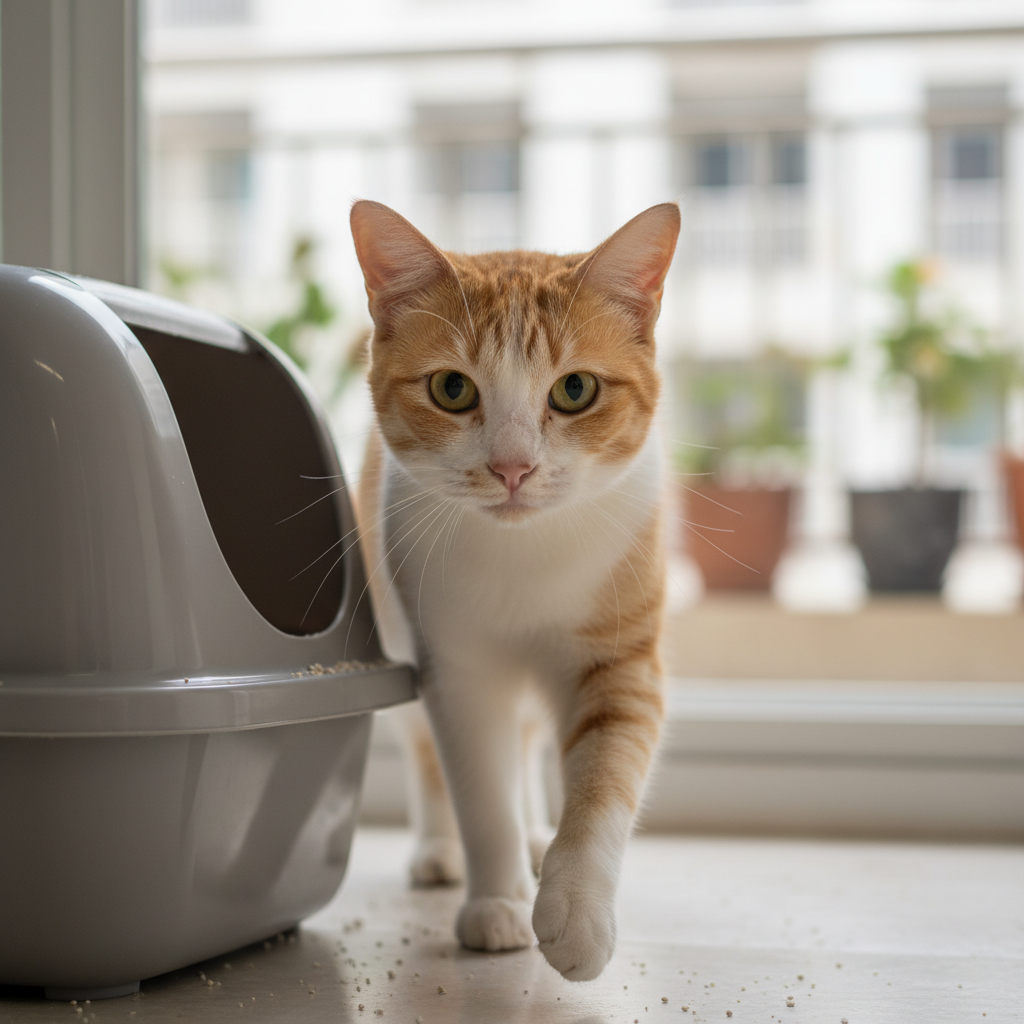
If you've ever stepped on a stray litter granule at 2am while walking to the kitchen for water, this guide is for you. Our 1-year-old kitten Lucky (born 13 September 2024) is the reigning champion litter-flinger of our four-cat household. He doesn't just bury his business — he excavates like he's looking for buried treasure. Litter ends up on the parquet, in the bathroom, sometimes three metres from the box. Sound familiar?
This is the most common annoyance Malaysian condo cat parents message us about. Limited floor space + hardwood/tile + a vigorously-digging cat = constant cleanup. Good news: it's almost always fixable once you understand why your cat is doing it.
Why Cats Kick Litter in the First Place

Before we fix it, we need to understand the instinct. Burying waste is hard-wired into your cat's DNA from millions of years of evolution. In the wild, the smell of urine and faeces was a beacon — to bigger predators looking for a meal, and to prey animals avoiding the area. Burying their waste kept domestic cats' ancestors alive. According to PetMD's behavioural overview, even safe indoor cats with zero predator threats still feel this drive every time they squat.
There's a second layer: scent communication. Cats have scent glands in their paws. When Lucky digs furiously, he's not just burying — he's stamping his "Lucky was here" signature into the substrate. In a multi-cat household like ours (4 cats sharing 5 boxes), this paw-stamping is partly territorial. Confident cats sometimes leave waste uncovered as a flex; subordinate cats bury obsessively.
So a normal amount of kicking is healthy. The problem is when "normal" becomes "litter trail down the hallway."
6 Root Causes of Excessive Kicking

1. The Box Is Too Small
This is the single biggest cause we see in Malaysian condos, and it's the cause cat parents almost never suspect. The American Association of Feline Practitioners (AAFP) guidelines recommend a box at least 1.5 times the length of your cat from nose to base of tail. Most boxes sold at Malaysian pet shops are roughly 45cm × 35cm — fine for a 3kg kitten, cramped for a 5kg adult. When the box is too small, your cat can't turn around comfortably, so the digging spills over the edge instead of staying inside.
Quick check: lay a ruler next to your cat while she's lying down. Nose to tail base. Multiply by 1.5. That's your minimum interior length. Use our litter box size calculator if maths isn't your thing.
2. The Sides Are Too Low
Standard boxes have 10–13cm walls. For an enthusiastic kicker like Lucky, that's nothing — a vigorous back-kick easily launches granules over the rim. dvm360's litter box best-practice guide recommends walls of at least 15–18cm for adult cats. For chronic flingers, 20cm+ is better.
3. The Litter Texture Feels Wrong
Cats' paw pads are extremely sensitive. Sharp crystals, hard pellets the wrong size, or scented litter that overwhelms their nose can trigger frantic kicking as the cat tries to push the offending material aside. Veterinary behaviour resources at the ASPCA consistently recommend unscented, fine-particle substrates. Most cats prefer something soft and sand-like underfoot.
4. Not Enough Litter (or Too Much)
Too shallow and your cat can't actually bury anything, so she digs harder and harder. Too deep and the surface becomes unstable, encouraging "kick to find solid ground" behaviour. The sweet spot is 5–7cm (about 2–3 inches). The McGowan et al. ethogram study on litter box behaviour documents how depth directly shapes digging vigour.
5. Boredom and Misplaced Play
For young cats — Lucky is exhibit A — a freshly-filled litter box looks like a sandbox playground. The cool, granular texture feels good on tired paws. Lucky has been caught literally rolling in clean tofu litter at 11pm. This is a stimulation problem, not a litter problem. More play sessions during the day help. Boredom-driven kicking usually happens within 5 minutes of a litter refill, not at actual elimination time.
6. Medical Discomfort
This is the one you must rule out. A cat that suddenly starts kicking more — especially with vocalising, straining, or going outside the box — could be in pain. Causes include urinary tract infection, bladder stones, FLUTD, constipation, or arthritis (research cited by Cornell Feline Health Center suggests up to 90% of cats over 10 have radiological evidence of joint disease). Painful posturing causes frantic, prolonged digging. If kicking is new, sudden, or paired with other changes, see your vet first. Behaviour fixes won't solve a medical problem.
The Malaysian Condo Angle

Why do we get more complaints from condo parents than landed-house parents? Three reasons:
- Hard floors everywhere. Tile, vinyl, parquet — every granule shows. In a carpeted UK house, you'd never notice. In a Mont Kiara high-rise with bamboo flooring, every kick leaves visible evidence.
- Tight floor plans. The box often sits in a service yard or bathroom corner. Limited approach angles mean cats are exiting straight onto hard floor with litter-coated paws.
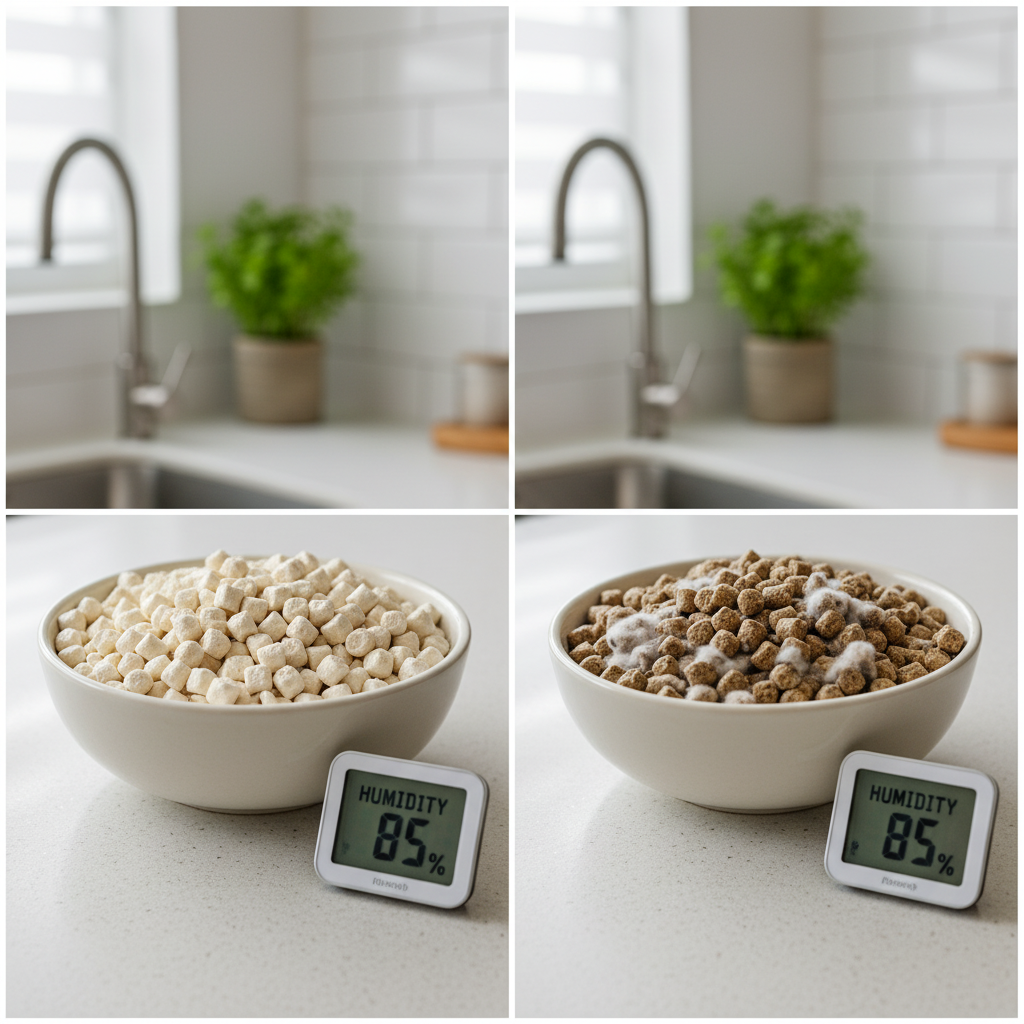
- Humidity sticks litter to paws. Malaysian humidity averages 75–85%. Damp paw pads grab fine granules more aggressively than dry ones. This makes tracking (litter carried out on paws) worse than scattering (litter physically kicked).
So your condo isn't dirty because your cat is weird. Your condo amplifies a problem that would be invisible in a different climate or floor type.
The Top 5 Fixes (Ranked by Effectiveness)

Fix 1: Upgrade Box Size (Biggest Win)
Single highest-impact change. If your current box is under 50cm long, replace it. The cheapest trick most Malaysian cat parents don't know: a plastic storage tub from IKEA or Daiso works better than 90% of commercial cat boxes. The 65L Samla bin (78cm × 56cm × 18cm walls) is what we use for Tiger and Lion. Cost: under RM 50. Cut a U-shaped entry on one short side if needed.
Fix 2: Switch to a High-Sided or Top-Entry Box
If size isn't your issue but kicking still is, raise the walls. High-sided boxes (15–20cm walls) trap kicked granules at the source. Top-entry boxes — where the cat jumps in through a hole in the lid — are even more effective because the grated lid scrapes paws on exit. Caveat: top-entry doesn't work for kittens, seniors, or arthritic cats. Lucky's older "auntie" Ping'An refuses top-entry, so we keep one open box just for her.
Fix 3: Add a Proper Litter Mat
A flimsy carpet square does nothing. The two genuinely effective designs are:
- Honeycomb dual-layer mats — top layer has holes; granules fall through and collect on a solid bottom layer. Pour them back into the box. Best for tofu pellets and pine.
- Silicone spike mats — soft rubber spikes scrape paws as cats walk over. Best for fine bentonite clay.
Place the mat directly outside the exit, minimum 60cm wide so the cat has to take 2-3 steps on it.
Fix 4: Re-think Your Litter Type
This matters more than most parents realise. See the next section.
Fix 5: Daily Scooping + Weekly Wash
A dirty box makes cats dig more frantically to find a clean patch. Scoop once a day minimum (twice if you have multiple cats). Empty and wash the whole box weekly. Boring advice, but it works. Resources at VCA Hospitals consistently rank cleanliness as the top behavioural driver of healthy litter habits.
Litter Type Matters: Tofu vs Bentonite vs Pine

Here's where we get specific. Different substrates behave very differently when kicked.
Bentonite Clay (Most Common in Malaysia)
Heavy, but the granules are tiny and sand-like. They don't fly far when kicked, but they track terribly — fine clay dust clings to fur and paws, especially in our humid climate. Also abrasive — it can dull and scratch laminate flooring over years. Pros: cheap, strong clumping. Cons: dusty, tracks badly, scratches hard floors.
Pine Pellets
Large, heavy pellets that mostly stay put when kicked. Low tracking. Cons: many cats reject the texture (too coarse), and the wood scent can be off-putting. Clumping is weaker than clay.
Tofu Pellets (What We Make)
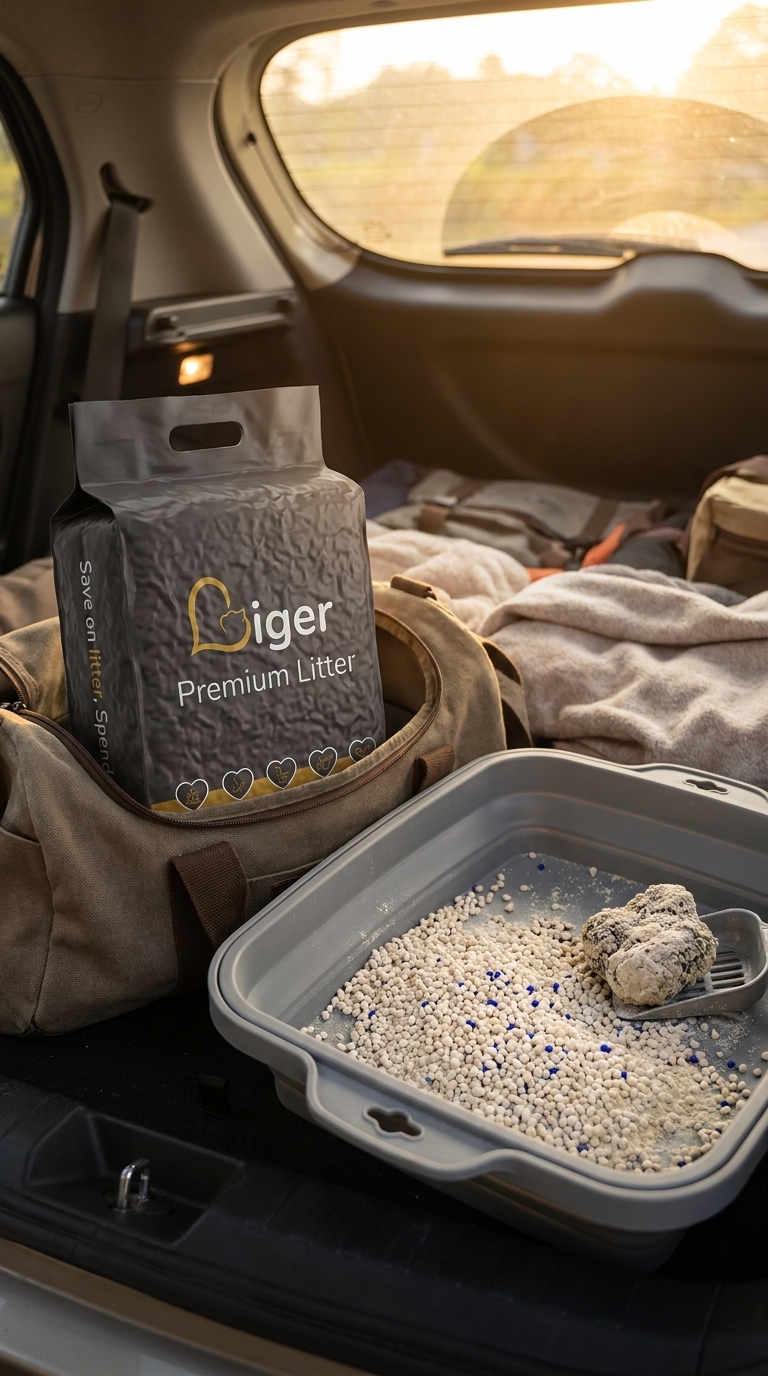
Pea-sized pellets made from compressed soy fibre. Light enough to clump quickly, large enough to resist tracking, soft enough that most cats accept them readily. In our 4-cat dust-level comparison test, tofu produced 70% less airborne dust than bentonite. The pellets are also flushable in small amounts (verify with your condo management — IWK approval varies by building).
For a chronic kicker like Lucky, tofu hits the sweet spot: he can still satisfy his digging instinct, but when granules do land outside the box, they're easy to sweep up — no dust cloud, no scratching of the parquet. We've timed it: cleanup time around Lucky's box dropped from 8 minutes/day on bentonite to under 2 minutes on tofu.
If you want to estimate your monthly usage, our litter calculator will run the numbers for your specific cat count.
The Liger 4-Cat Test: Who Kicks Most?

We track this stuff so you don't have to. Here's what 6 months of observation gave us:
- Lucky (1 year, male, 4.2kg) — the chaos goblin. Kicks litter on roughly 80% of visits. Vigorous, prolonged digging. Frequently rolls in clean litter. Solution: top-entry box + tofu pellets cut his scatter by ~75%.
- Tiger (2 years, male, 5.1kg, the kitten brothers' alpha) — moderate kicker, 40% of visits. Quick, efficient burying. Doesn't linger.
- Lion (2 years, male, 4.8kg) — minimal kicker. Buries delicately, sometimes barely covers. Probably the most submissive of our four.
- Ping'An (~6 years, female, 4.5kg, rescue mum) — almost never kicks. Mature cats often dig less than youngsters. Refuses top-entry boxes (likely arthritic hips — we monitor).
Pattern we see consistently in multi-cat households we coach: young males kick the most. They're the ones still figuring out territory, still burning energy, still treating the litter box as a sensory experience. If your worst offender fits that profile, you're not alone.
When Kicking Signals Something Worse

Watch for these red flags. Any of them = vet visit:
- Vocalising (crying, growling, meowing in the box)
- Straining without producing waste
- Frequent trips to the box with little output
- Blood in urine or stool
- Eliminating outside the box (especially on cool surfaces like tile)
- Sudden change in kicking intensity, especially in cats over 8 years old
- Lingering in the box for unusually long sessions
The International Cat Care multi-cat household guide notes that stress-related kicking often appears alongside other displacement behaviours — over-grooming, hiding, hostility to housemates. Look at the whole picture, not just the box.
The 7-Day Fix Plan

You don't need to do everything at once. Here's our recommended sequence:
- Day 1: Measure your cat. Measure your box. If box length < cat length × 1.5, order a larger one (or grab a Samla bin from IKEA). This alone solves about 40% of cases.
- Day 2: Audit litter depth. Top up to 5-7cm. Scoop the box.
- Day 3: Install a proper mat (honeycomb if you'll switch to tofu/pine; silicone if you're staying on bentonite).
- Day 4–5: Begin transitioning litter type if needed. Mix 25% new litter into 75% old litter, increase by 25% every 2 days. Sudden changes cause refusal.
- Day 6: Add play sessions — two 10-minute wand-toy sessions daily. Drains the energy that fuels boredom-kicking.
- Day 7: Reassess. Take a "litter trail photo" daily and compare. Most homes see 60-80% reduction within a week if the root cause was environmental.
If you've followed all this and your cat is still flinging litter like she's auditioning for a baking show, two final things: (1) check medical — schedule a vet visit, (2) message us. We've helped a lot of Malaysian cat parents through this, and Lucky has personally beta-tested every solution in this guide.
Your floors will recover. Your sanity will recover. Promise.