You scoop the litter box morning and night, but by 6pm your KL condo still smells like a public toilet. You're not imagining it, and you're not a bad cat parent. The reason is sitting outside your window: Malaysia's 80% average humidity and 30C heat are running an ammonia factory inside your cat's litter box, 24 hours a day.
I've been there with my four cats Tiger, Lion, Ping'An and Lucky. After Lucky knocked the box over during the monsoon last year, our whole laundry corner stank for three days even after a deep clean. So I went down the rabbit hole on the actual chemistry of why cat pee smells worse here than in Singapore (slightly) or Sydney (a lot), and what to do about it.
This guide pulls together veterinary research, Malaysian climate data, and a real 7-day reset plan. By the end you'll know exactly what's making the smell, whether your cat might have a UTI, and which litter actually performs in a tropical condo.
Why Malaysia's Climate Makes Your Litter Box Smell Worse
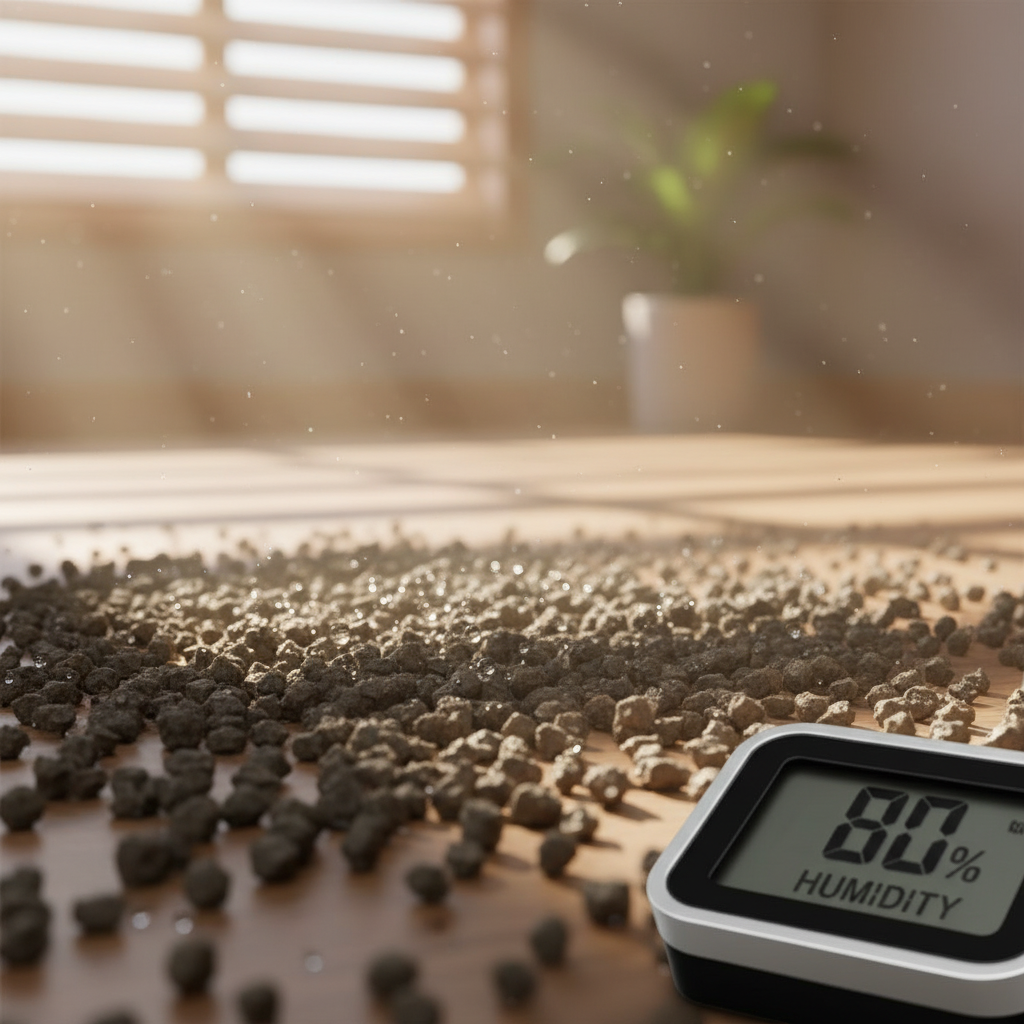
The pungent kick that hits you when you walk past the box is mostly one chemical: ammonia (NH3). Cats pee out urea, and bacteria living in the litter use an enzyme called urease to chop urea into ammonia gas plus carbon dioxide. That reaction needs three ingredients to go fast: warmth, moisture, and time.
Malaysia provides two of them on tap.
The temperature multiplier
Chemical reactions roughly double in speed for every 10C rise in temperature. Field research on urea nitrogen loss shows the practical impact: at 15C, only about 10% of urea converts to ammonia over 10 days. At 24C the figure jumps to 14%. At 32C (a normal afternoon in Penang or JB) it hits 20% or more. Translation: a box that would smell mildly unpleasant in a London flat becomes a chemical weapon in a Cheras apartment over the same 8 hours.
The humidity accelerator
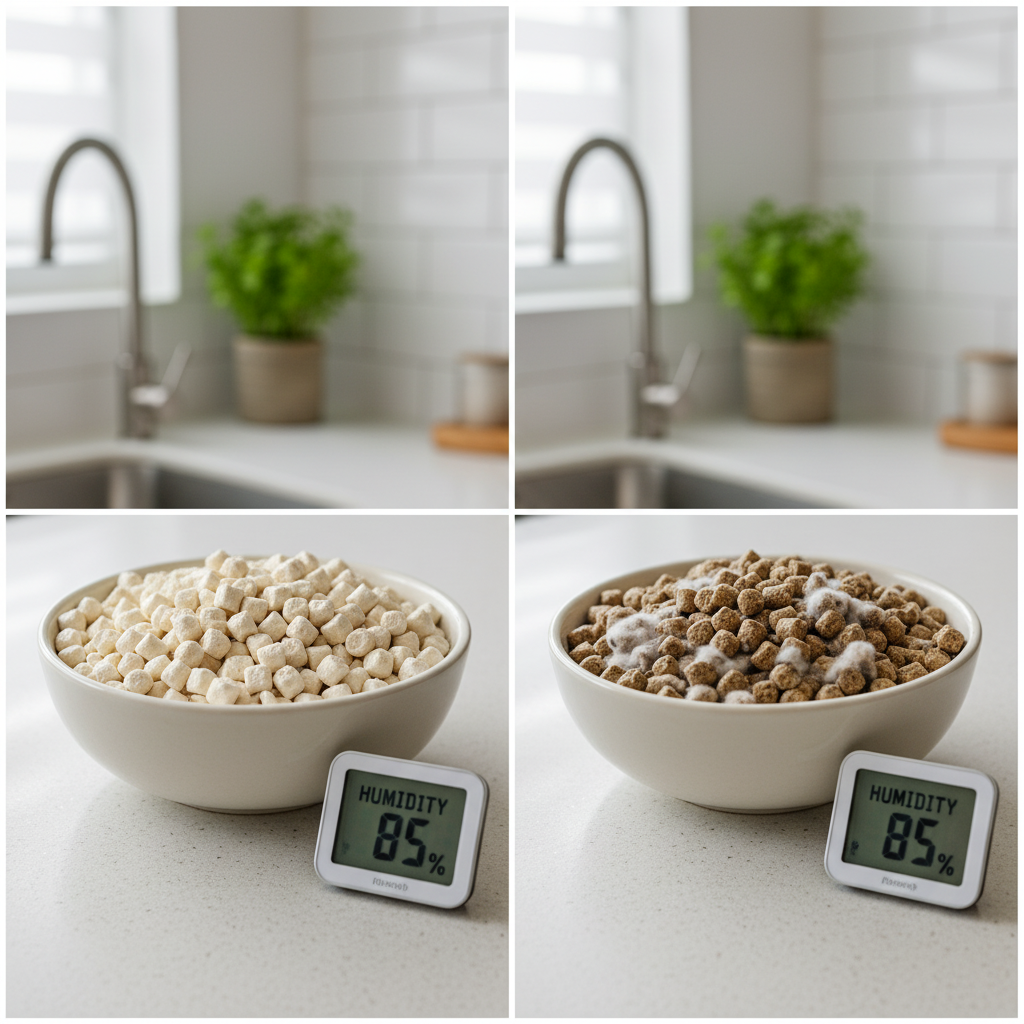
Urease cannot work on dry urea. It needs water, and humidity above 60% provides exactly the damp medium bacteria love. Malaysia averages 80% relative humidity year-round, climbing past 90% during the Northeast Monsoon (November to March) and the Southwest Monsoon (May to September). Moisture also helps ammonia molecules stay airborne longer, which is why the smell seems to hang in the room.
The condo trap
Most of us live in apartments where windows stay shut against heat, haze, or rain, and the air conditioner just recirculates the same indoor air. Split units cool but don't ventilate. The result is a sealed box of warm, humid air with no escape route for ammonia. Cat noses have around 200 million scent receptors versus our 5 million, so what smells "a bit funky" to you may be physically irritating to your cat, and irritated cats start avoiding the box, peeing on rugs, and getting urinary problems. The cycle feeds itself.
4 Hidden Causes Most Cat Parents Miss
If you're already scooping twice a day and the smell still wins, the problem isn't laziness. It's usually one of these four issues.
1. The depth deficit (you're using too little litter)
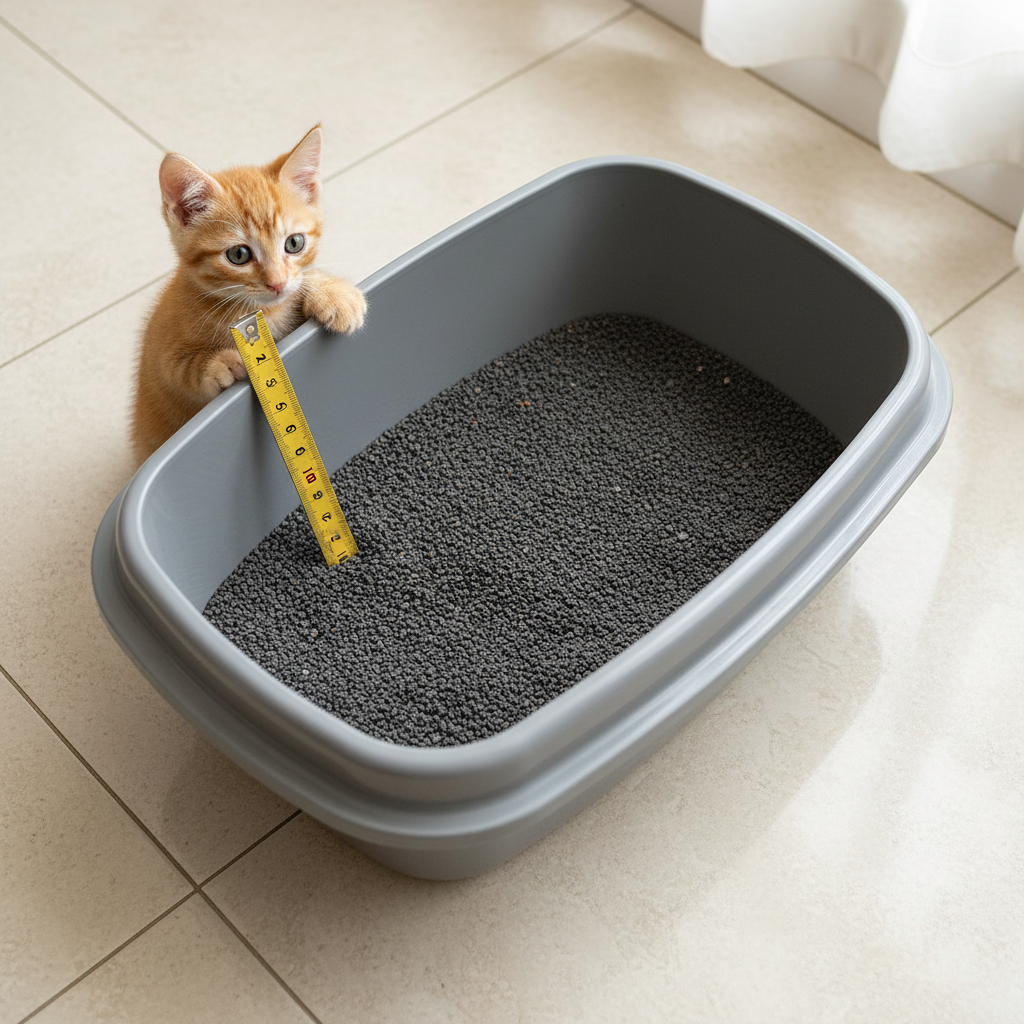
Owners trying to save money often fill the box only 1 to 2 inches deep. The Cornell Feline Health Center and most veterinary behaviorists recommend 3 to 4 inches of clumping litter. Why? Urine needs enough material above and below it to form a complete clump before reaching the plastic floor. When the litter is shallow, pee pools at the bottom and creates a sticky, ammonia-leaching sludge that no scoop can remove. You're scooping the top while the floor of the box is essentially soaked in concentrated urine.
2. The wrong litter for the climate
A cheap clumping clay that performs fine in a dry Hong Kong winter can fail spectacularly in a Klang Valley July. Low-grade bentonite absorbs moisture from the humid air itself, pre-clumping into a sad lump before your cat even uses it. Heavily scented litters are worse, because the perfume just masks ammonia for two to four hours while bacteria keep multiplying underneath. Your cat's nose detects the ammonia regardless and may start avoiding the box.
3. Your cat is mildly dehydrated
This one is sneaky. Cats descend from desert ancestors and have a famously weak thirst drive. In Malaysian heat, especially if your cat eats only dry kibble, urine becomes concentrated, which means each pee carries more urea per millilitre, which means more raw material for bacteria to turn into ammonia. The same cat fed mostly wet food (70 to 80% moisture) produces a larger volume of more dilute pee that smells significantly milder. Hydration is an odor strategy, not just a health one. Run your cat's numbers through our cat hydration calculator to see if you're underwatering.
4. A UTI brewing in the bladder
Here's the one that scared me into writing this article. In a healthy cat, ammonia forms slowly in the litter as environmental bacteria meet urea. But if your cat has a urinary tract infection caused by urease-producing bacteria (Staphylococcus, Proteus, certain E. coli strains), the conversion is happening inside the bladder itself. The pee comes out already smelling sharply of ammonia. If you noticed a sudden, dramatic shift in odor over a few days, that is not normal aging of the box, that is a vet visit. Watch for frequent trips to the box, straining, blood-tinged urine, or peeing in unusual places (the bathmat is the classic). Our cat pee problem solver walks through symptoms by pattern.
Litter Type Showdown: Which Actually Controls Odor in Malaysia
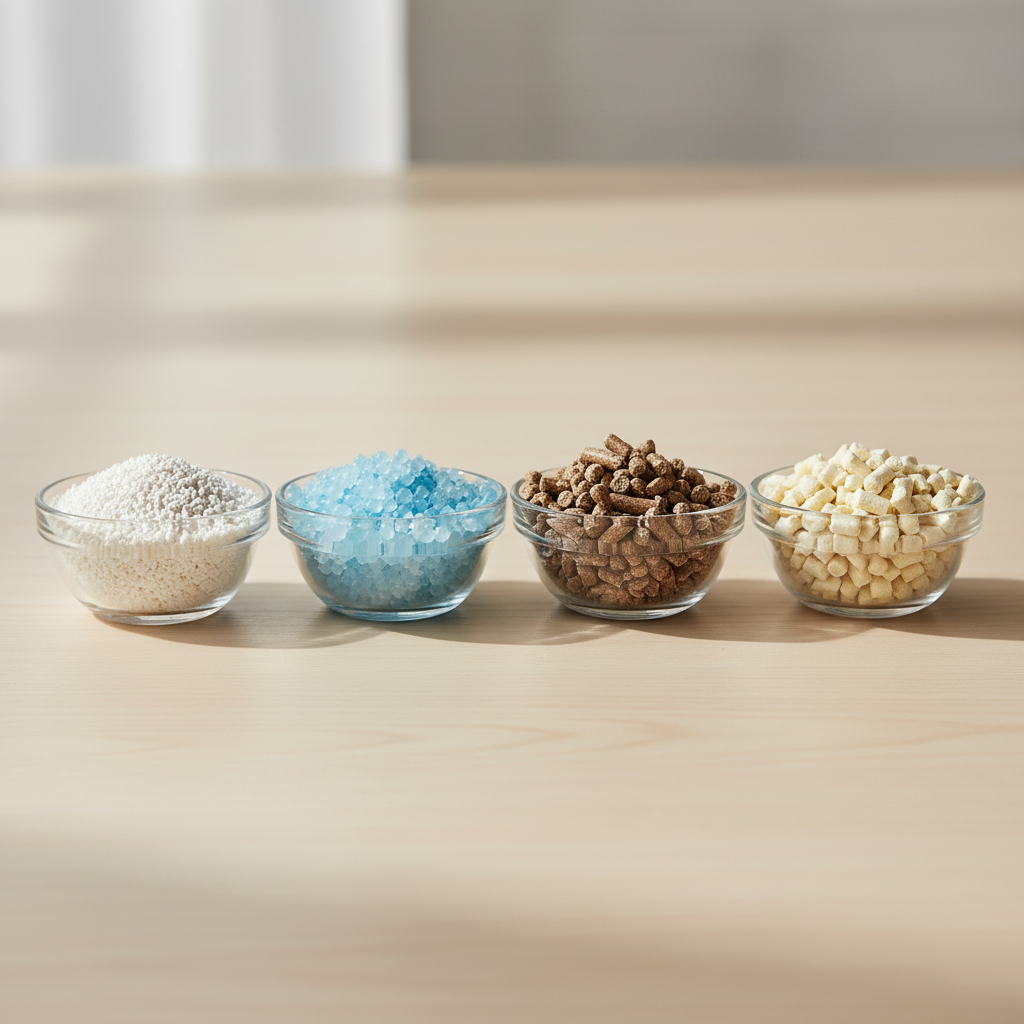
I tested all four common types in our flat over six months. Here's how they compare on the metrics that matter in our climate. (For prices I checked Shopee, Lazada and PetGalaxy in May 2026.)
| Feature | Bentonite Clay | Silica Crystal | Pine Pellets | Tofu Starch |
|---|---|---|---|---|
| Absorbency | High, hard clumps | Up to 40x weight | Turns to sawdust | 3-4x weight |
| Ammonia control | OK if scooped daily | Excellent (locks in pores) | Natural pine masks well | Effective, plant-based neutralization |
| Dust level | High (bad for asthma) | Very low | Very low | Up to 99.5% dust-free |
| Tracks on paws | Heavy | Moderate (sharp) | Low | Low |
| Flushable | Never | Never | Some brands | Yes, water-soluble |
| Price (per kg) | RM 1.40-2.20 | RM 4-7 | RM 2.00-3.50 | RM 5.50-6.50 |
Bentonite clay: budget choice, struggles in humidity
The default in Malaysia and still the cheapest. Forms hard clumps that can trap up to 94% of ammonia, but the dust is genuinely bad for cats with respiratory issues, and it can over-absorb humidity from the air. Works if you're scooping twice daily and live in a well-ventilated terrace house. Struggles in sealed condos during monsoon.
Silica crystal: technical winner, mixed cat acceptance
The white or blue beads. Best raw absorbency on the market. The downside is texture; many cats dislike walking on sharp crystals, and they can scatter further than clay. Also non-biodegradable. Strong choice for single-cat homes where the cat already accepts it.
Pine pellets: natural odor masker, transition needed
The wood's natural phenols neutralize ammonia smells, and pine pellets can absorb up to 500% of their weight in liquid, and pine breaks down to soft sawdust when wet. Some cats refuse the hard pellet texture; you may need a sifting litter box. Cheap if you buy 20kg bags, and lightweight.
Tofu starch: best all-rounder for tropical condos
This is what we use, and full disclosure, we make milk-scented tofu litter at Liger. The plant-based starch absorbs liquid and the starch itself helps neutralize ammonia chemically rather than just masking it with perfume. Near-zero dust matters in a sealed condo where dust just recirculates. Water-soluble so you can flush small amounts. The trade-off is price (roughly 3x clay per kg), though tofu typically lasts longer per fill, so cost-per-week is closer than the per-kg number suggests. Light scenting (we use milk) is gentle enough that most cats accept it without aversion.
Compare your current choice against alternatives in our litter comparison tool.
The Hydration Angle Most Articles Miss
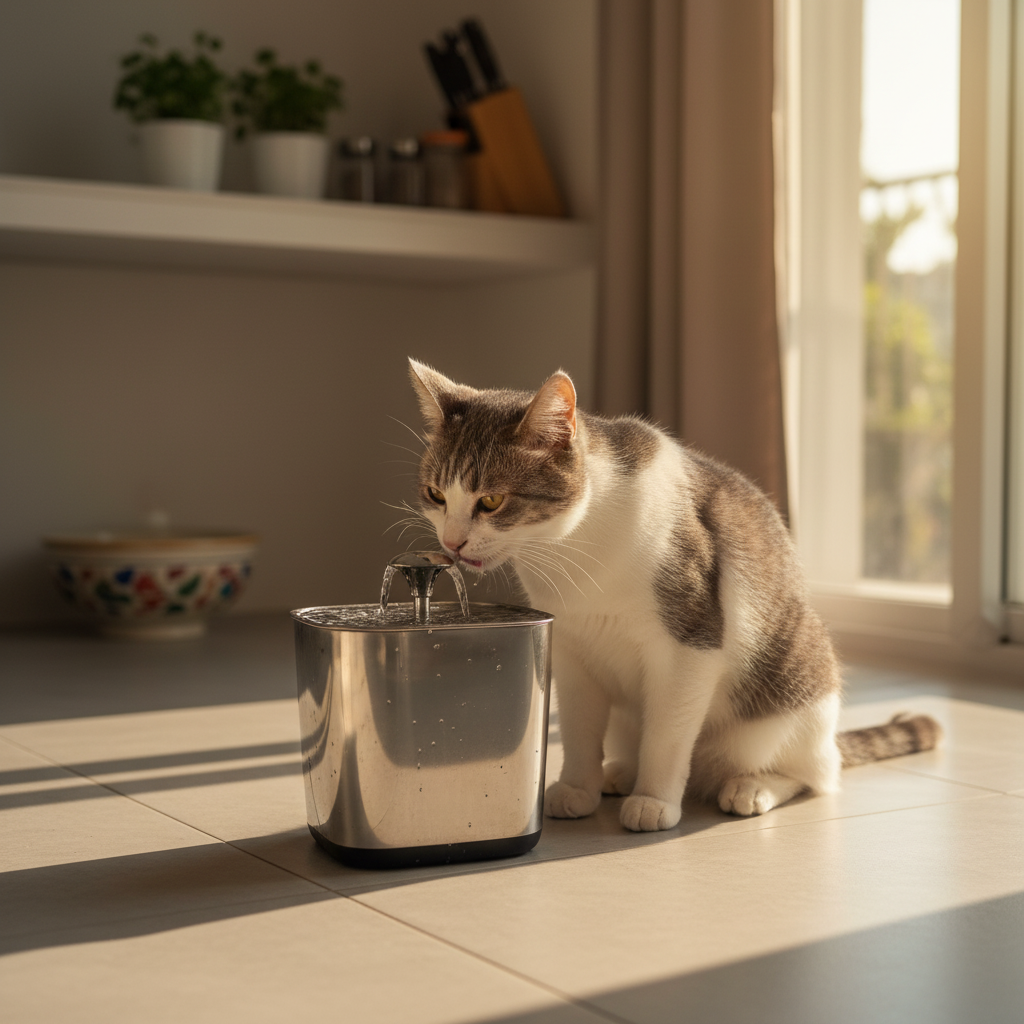
Cat owners obsess about litter brands and skip the upstream fix: what your cat drinks (and eats) directly controls how strong the pee smells when it comes out. A dehydrated cat in a Malaysian heat wave produces urine that is roughly twice as concentrated in urea as a well-hydrated one. Same cat, same litter, double the ammonia substrate.
The fastest way to dilute urine is wet food. Canned or fresh food is 70 to 80% water. Dry kibble is 8 to 12%. A cat eating 100g of wet food gets about 75ml of water from the meal alone, which is most of their daily requirement. A cat eating the equivalent in dry kibble gets maybe 10ml and has to make up the rest at the bowl, which most cats won't do.
Practical hydration moves
- Switch to at least 50% wet food if you currently feed dry-only. Even one wet meal a day moves the needle.
- Get a fountain. Moving water attracts cats and they typically drink 30 to 50% more from a fountain than a still bowl.
- Multiple wide bowls, placed away from food and the litter box. Cats dislike contamination near their water.
- Change water daily, especially in our climate where bacterial growth in standing water is fast.
- Add water or low-sodium broth to wet food to push moisture even higher.
To check whether your cat is getting enough water for their weight and diet, plug their stats into our cat hydration calculator.
When the Smell Is Actually a Vet Issue
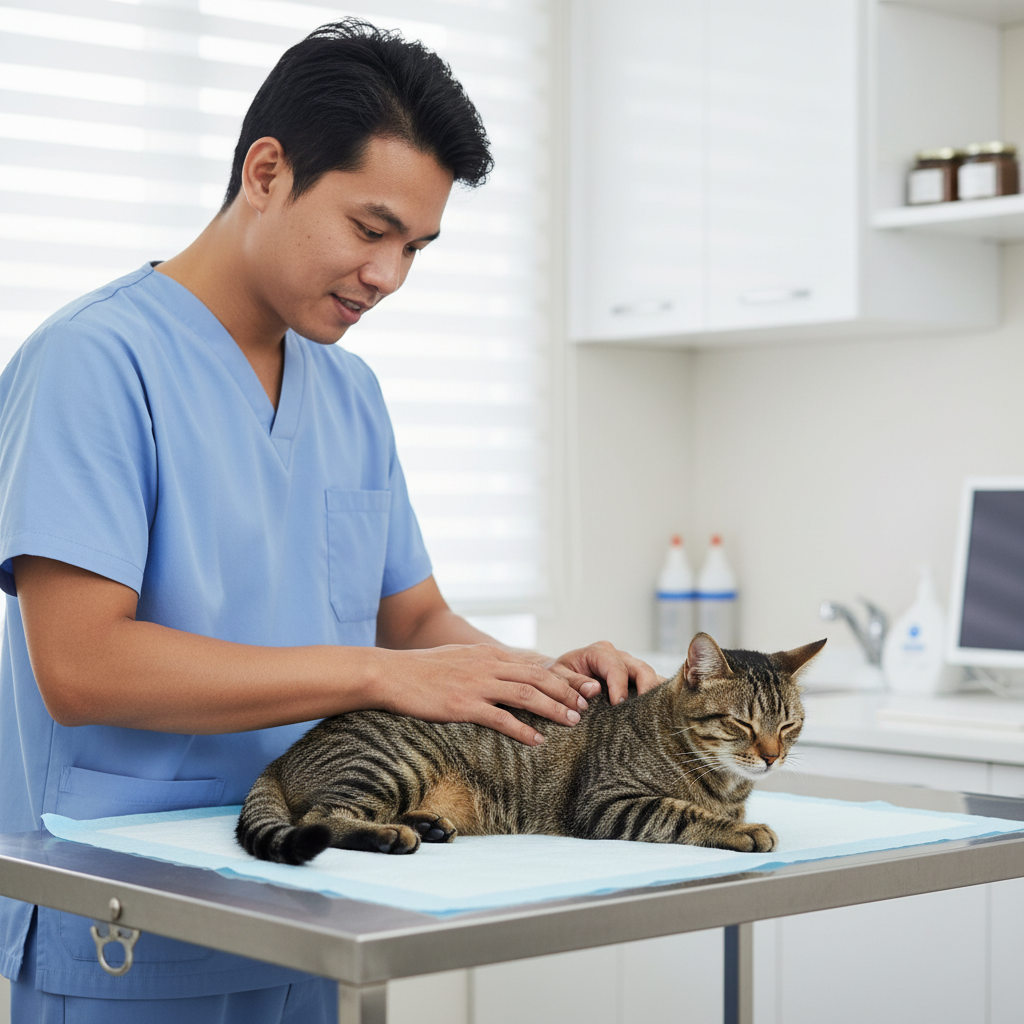
Most odor problems are environmental. But a sudden, distinctly different smell can be the first symptom of feline lower urinary tract disease (FLUTD), which is unfortunately common in Malaysian cats. A UPM University Veterinary Hospital study found that urinary tract issues are among the most frequent presentations in their feline patients, driven partly by heat-induced dehydration and indoor stress in apartment cats.
The odor warning signs
- Sharp ammonia smell immediately after fresh urination (not after sitting). Suggests urease-producing bacteria in the bladder.
- Sweet or fruity smell. Possible diabetes; the kidneys are spilling glucose.
- Metallic or blood-tinged smell. Possible urinary crystals, stones, or bladder inflammation.
- Strong, putrid, unfamiliar odor. Possible UTI with anaerobic bacteria.
Behavioral warning signs to combine with the smell
- Going to the box repeatedly but producing only small amounts
- Vocalizing, straining, or hunching while urinating
- Blood spots in the clumps
- Peeing outside the box (especially on cool tile or in sinks)
- Excessive licking of the genital area
- Lethargy or loss of appetite
If you tick two or more of these alongside the odor change, call your vet within 24 hours. Male cats are particularly at risk because urinary blockages can become fatal within 48 hours. Run a quick symptom check through our urinary health checker if you're unsure whether to book in.
The 7-Day Litter Box Reset Protocol
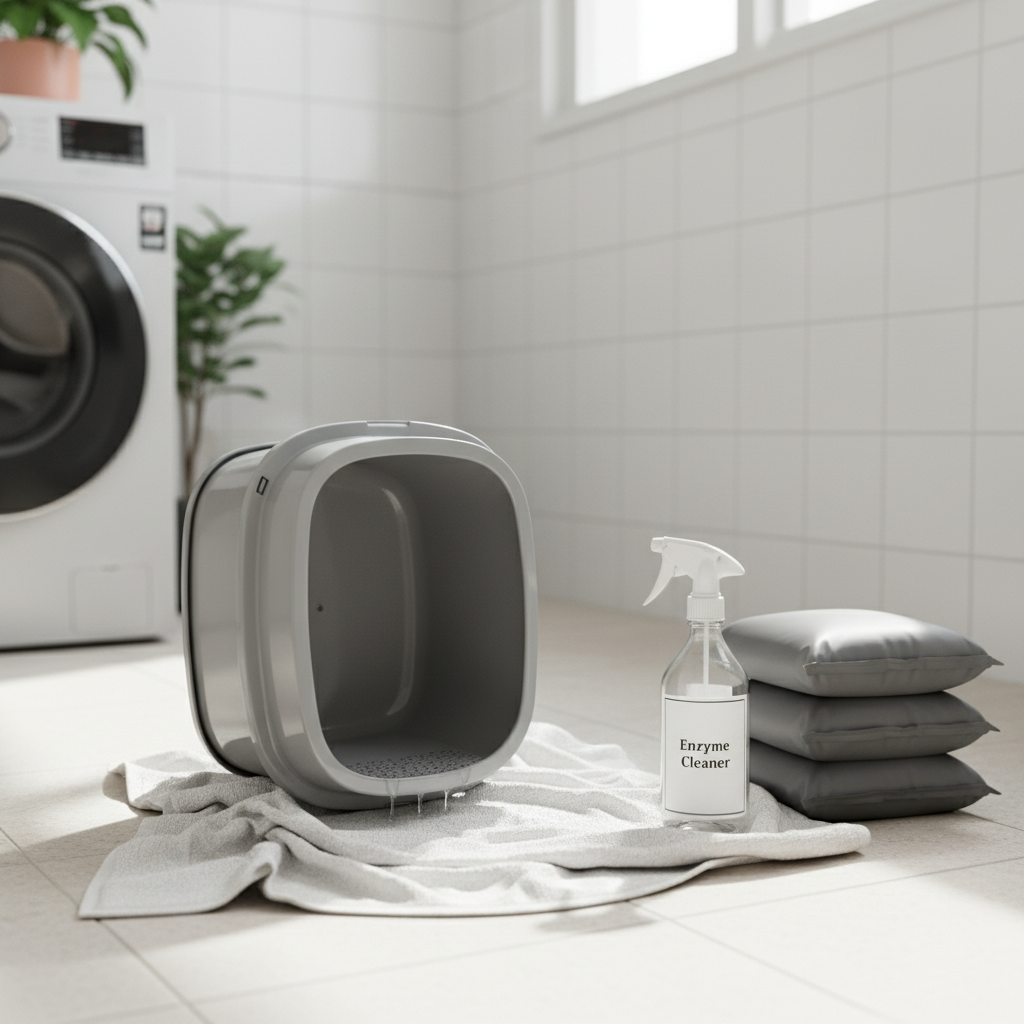
Here's the actual sequence that fixed our stink problem after the monsoon disaster. Follow it in order; don't skip Day 1.
Day 1: The deep reset
Dump every grain of old litter. Wash the box with warm water and a mild unscented dish soap, scrubbing every corner and any plastic scratches where biofilm hides. The single most important step: saturate the inside with an enzyme cleaner (Nature's Miracle, Simple Solution, or a Malaysian equivalent from PetWorld). Enzymes break down uric acid crystals, which are not water-soluble and which most regular cleaners just spread around. Let the enzyme sit 10 to 15 minutes, rinse, and dry completely with a towel; in our humidity, air-drying takes too long and a wet box mildews. Refill with your cat's existing litter for tonight so they aren't surprised at bedtime.
Day 2: Start the transition (25% new)
If you're switching to a better-performing litter (tofu or silica for most readers), mix the new with the old at roughly 25% new, 75% old. Cats are creatures of habit and a 100% switch overnight often triggers protest peeing. Mix it visibly; don't just layer them.
Days 3 and 4: 50/50 mix
Scoop both morning and evening. Watch your cat's behavior. If they're using the box normally, proceed. If they're hesitating, sniffing and walking off, slow the transition by adding back 10% old litter.
Days 5 and 6: 75% new litter
By now your cat should be comfortable. This is also when you'll notice the smell starting to drop dramatically, especially with tofu or silica.
Day 7: Full transition and new routine
Empty the mixed litter and fill with 100% new litter at 3 to 4 inches deep. Your new sustainable routine:
- Scoop twice daily. Non-negotiable in Malaysian climate.
- Top up litter every 2 to 3 days to maintain depth.
- Complete change every 2 to 3 weeks for single-cat homes, weekly for multi-cat.
- Deep enzyme clean once a month.
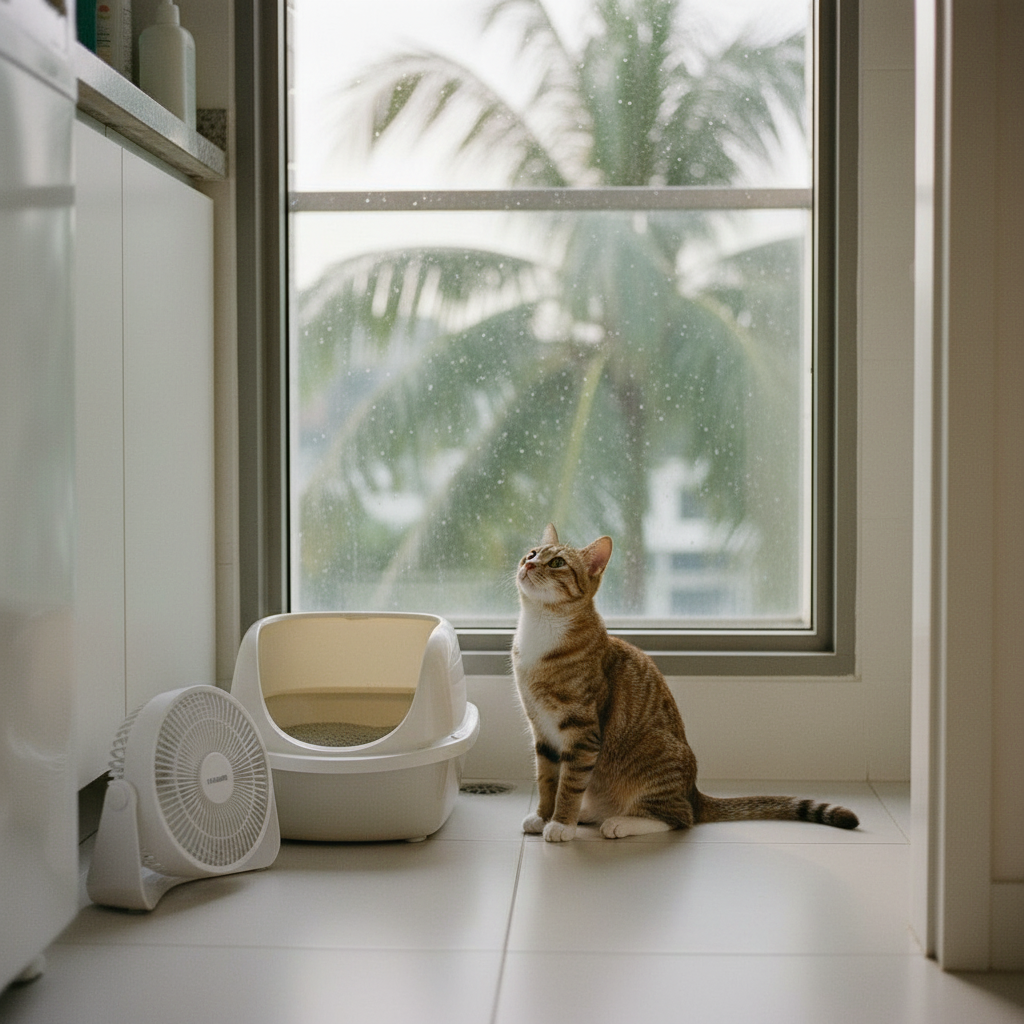
- Move the box if it's in a sealed bathroom or closet. Aim for a ventilated corner with airflow (near a window or a small fan helps enormously).
- Track your cat's water intake and consider wet food if they're on dry-only.
Bonus: cheap upgrades
- Sprinkle a thin layer of baking soda on the clean box base before adding litter. Cheap ammonia neutralizer.
- An activated charcoal sachet (the same kind sold for fridges) placed near, not in, the box absorbs airborne ammonia.
- A small clip fan or rotating fan in the laundry corner cuts perceived smell within hours by moving humid, ammonia-laden air away.
Stop Masking, Start Solving
Litter box odor in Malaysia is not a cleaning problem; it is a climate plus chemistry plus health problem. The cheap perfumed sprays sold at every pet shop are masking ammonia for two hours while bacteria keep working. Real solutions address the moisture source (your cat's hydration), the substrate (a litter that actually neutralizes rather than perfumes), the box itself (depth, location, enzyme cleaning), and any underlying health issue your cat might be silently developing.
Run the 7-day protocol. Check your cat's hydration. Watch for the warning signs. If the smell still wins after 14 days of disciplined effort, the next call is to your vet, not a stronger spray.
Tiger, Lion, Ping'An and Lucky thank you for taking this seriously.