15%-20% of cats with 'chronic hairballs' actually have asthma.
The 'Orthopneic Posture' (head down, neck extended) is a major red flag.
Dusty clay litter and essential oils are primary environmental triggers.
If your cat's respiratory rate exceeds 60 breaths per minute, it's an emergency.
Your cat is hunched over the floor. Their neck is stretched out long, chin almost touching the tiles, and they’re making that rhythmic, hacking sound. You wait for the wet splat of a hairball on your rug. But nothing comes up. Just a dry, hollow wheeze.
Think it’s just a 'stubborn' hairball? Think again. In many cases, what looks like a digestive struggle is actually a battle for air. Statistics show that approximately 15%-20% of cases reported as 'frequent hairballs' are eventually diagnosed as feline asthma. While our four cats at Liger—Tiger, Lion, Ping'An, and Lucky—don’t suffer from asthma, Ping'An's sensitive nose has taught us exactly how much air quality matters. If your cat is 'coughing' but nothing is appearing, you might be looking at an invisible lung killer.
The Biomechanics of the 'Asthmatic Crouch'
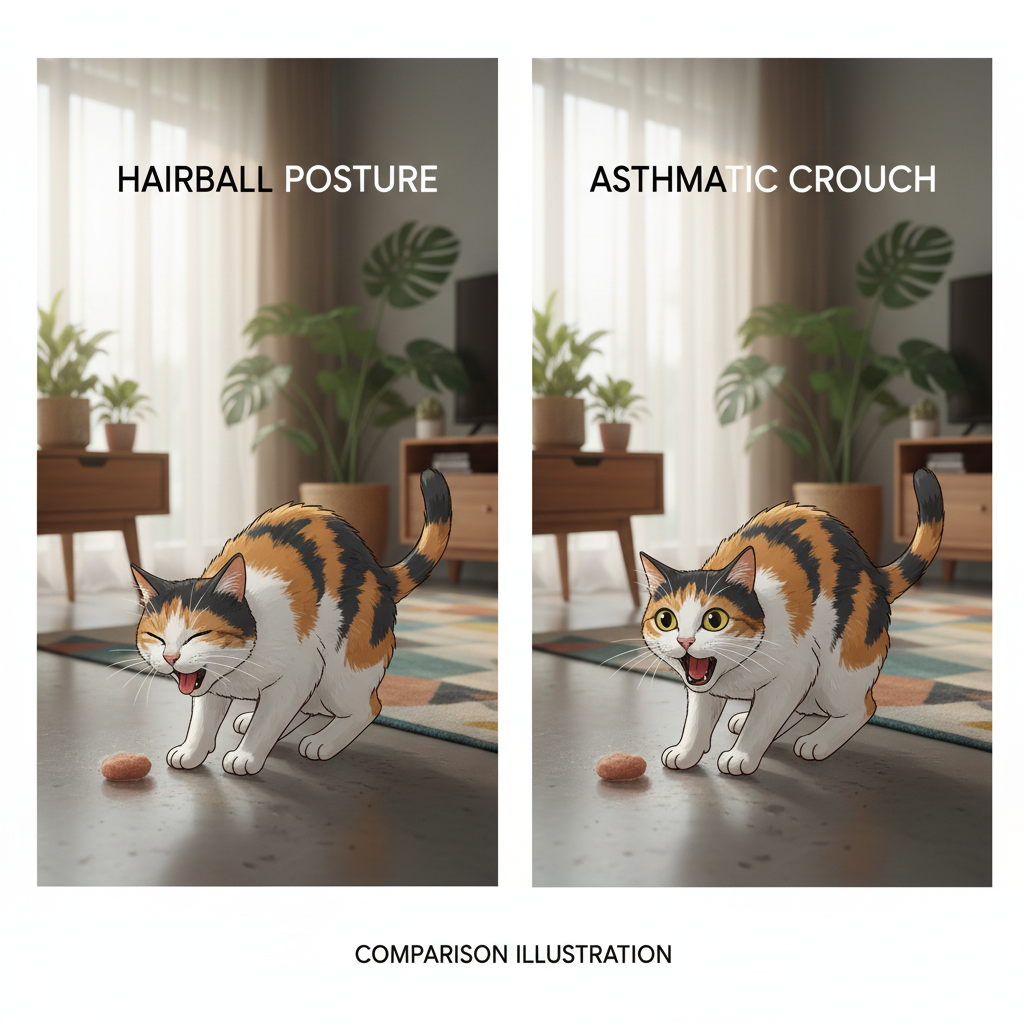
To tell the difference, you have to look at the body. A cat trying to eject a hairball usually has a Kyphosis posture—the back is arched high like a mountain, and the head points straight down. It’s a digestive push. Gravity is the helper here.
Asthma is different. This is about Bronchoconstriction. The cat takes on an Orthopneic Posture: they squat low to the ground, elbows out (abducted), and extend their neck forward in a straight line. They are trying to straighten their airway to minimize turbulence. Basically, they are suffocating and trying to find the path of least resistance for oxygen. You can read more about distinguishing hairballs from real sickness in our deep dive guide.
Sound: Asthma is a dry 'wheeze' or 'hacking' (like a heavy smoker). Hairballs sound 'wet' and end with a 'Kack' or 'Gag'.
Product: Asthma produces nothing (maybe a tiny bit of white foam). Hairballs produce... well, hair.
Frequency: If it happens more than once or twice a month, it's rarely 'just' hair.
| Feature | Asthma Cough | Hairball/Vomiting |
|---|---|---|
| Core Posture | Crouch, elbows abducted, low center of gravity | Kyphosis (arched back), standing, severe abdominal contraction |
| Neck State | Extremely extended, chin to ground, like a turtle's head, trying to straighten airway | Head down, towards the floor, at a vertical angle, using gravity |
| Sound Nature | Dry "Wheeze" or "Hacking" (huffing, dry cough) | Wet "Gagging" or "Retching" (gurgling, retching sound) |
| Tongue Color | Possibly purple/blue in severe cases (Cyanosis) | Usually normal pink |
| Product | None (Non-productive), or only small amount of white foam/mucus | Yes (Productive), hairball, yellow water, undigested food |
| Post-episode State | May appear normal, or open-mouth breathing, weak | Usually relieved after vomiting |
| Biomechanics Purpose | To inhale air (Air Hunger) | To empty the stomach (Gastric Emptying) |
The Silent Killers: Dust and Fragrance
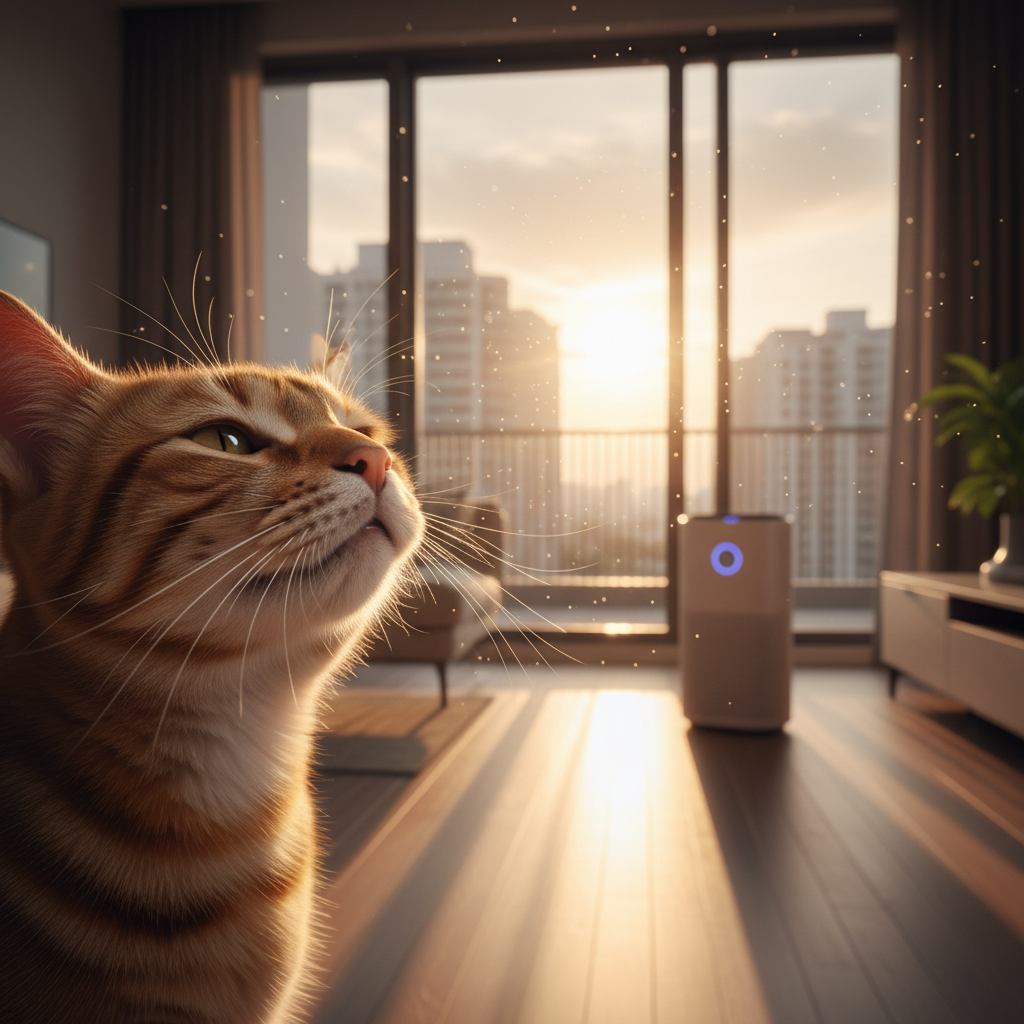
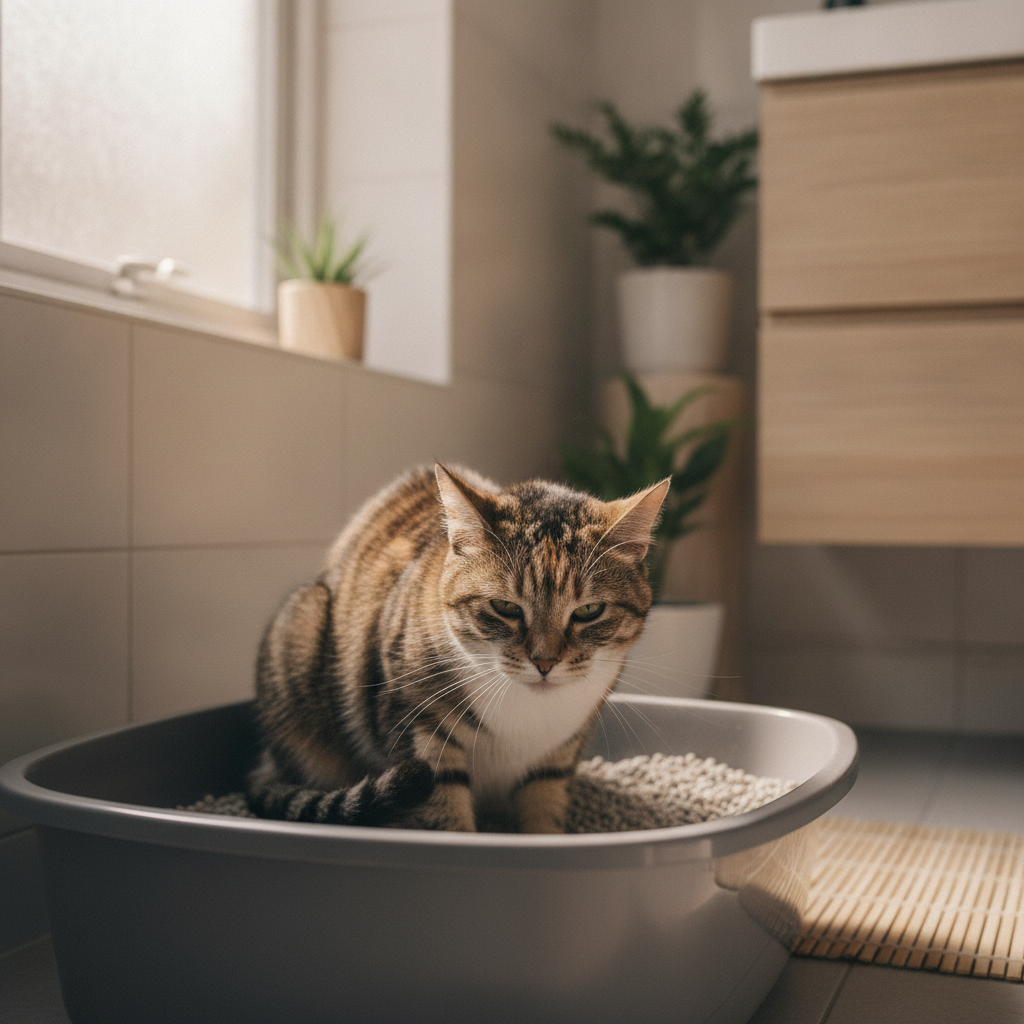
If your cat does have sensitive lungs, your home environment is either the medicine or the poison. The biggest culprit? Your litter box. Traditional clay litters contain sodium bentonite and crystalline silica, which create a 'dust cloud' every time your cat digs. When inhaled, these micro-particles can trigger instant bronchospasms.
Then there’s the 'Malaysian factor.' During haze season (jerebu), indoor air quality drops significantly. If you’re using plug-in air fresheners or essential oil diffusers, you might be making it worse. Cats lack specific liver enzymes to process oils like tea tree or citrus. To them, those 'soothing' scents are chemical irritants. You can compare dust levels of different litters to see how much of an impact this has on your cat's breathing zone.
Why Tofu Litter is a Breath of Fresh Air
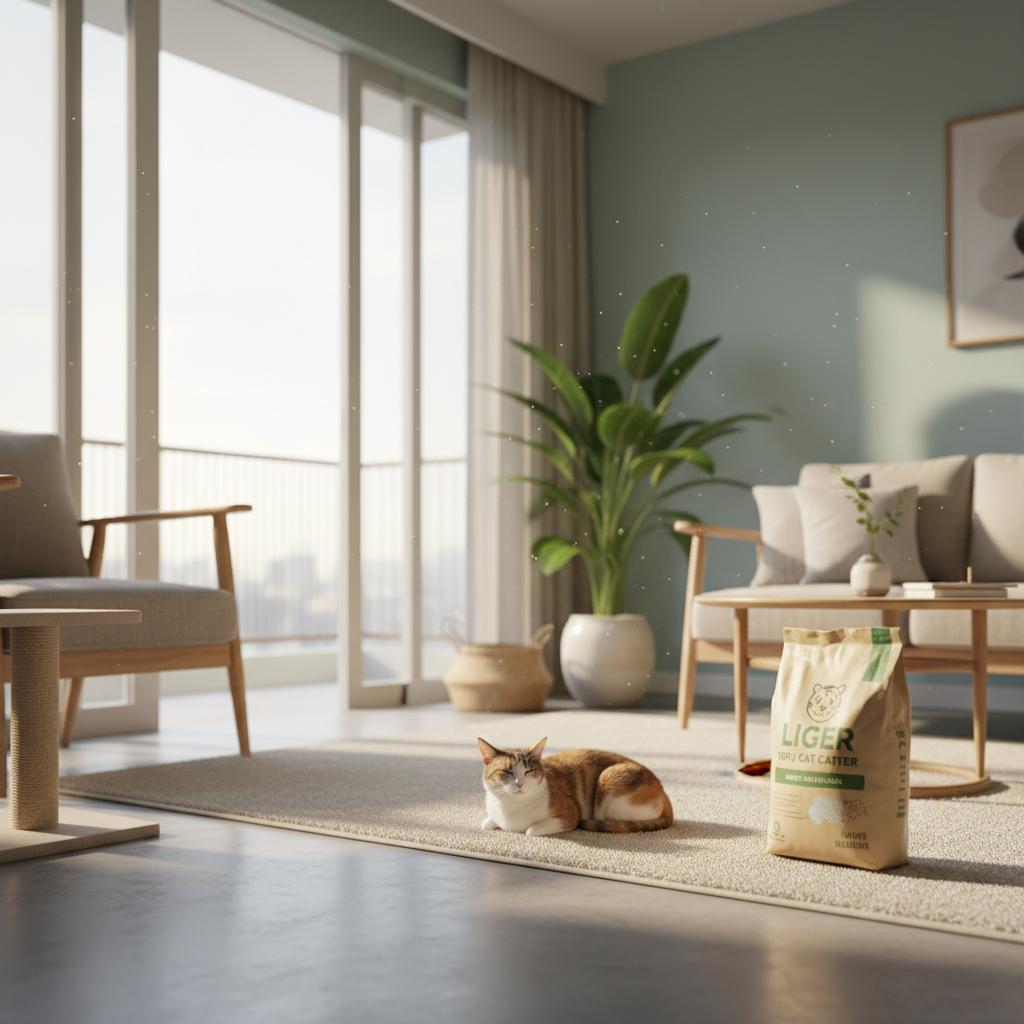
When we designed Liger Tofu Cat Litter, we obsessed over dust because of cats like Ping'An. She doesn't have asthma, but she sneezes the moment a 'dust cloud' hits her face. By using vacuum-sealed, high-pressure compressed pea fibers, we keep dust levels near zero. Plus, we use a natural milk fragrance instead of artificial perfumes, because your cat's nose is 14 times more sensitive than yours. It’s about creating a safe 'breathing zone' right where they spend most of their time.
| Item | Potential Trigger | Liger Recommended Solution | Expert Note |
|---|---|---|---|
| Litter Choice | Bentonite/clay litter, crystal litter, cheap pine litter | Switch to Liger Dust-Free Original Tofu Litter | Thoroughly clean litter box to remove old dust. Gradual transition is okay, but switch completely ASAP. |
| Litter Box Type | Enclosed/top-entry litter boxes | Switch to Open Litter Box | Enclosed boxes trap dust and ammonia, creating a high-concentration "toxic gas chamber" fatal for asthmatic cats. |
| Air Purification | PM2.5, haze, dust mites, pollen | Install HEPA filter air purifier | Place in rooms where cats sleep most frequently and near litter boxes. Replace filters regularly. |
| Cleaning Habits | Sweeping, feather duster | Use vacuum cleaner (HEPA filter) or wet mopping | Sweeping stirs up settled dust, re-suspending allergens in the air. |
| Fragrance Management | Scented diffusers, incense sticks, perfumes, disinfectants | Completely discontinue use | Aim for a "fragrance-free" home. Use F10 or cat-safe, unscented disinfectants for cleaning. |
| Fabric Management | Carpets, plush cat beds | Regular 60℃ hot wash | Kills dust mites (most common biological asthma allergen). Minimize carpet use. |
| Smoking Control | Cigarettes, e-cigarettes | Strictly no indoor smoking | Nicotine settles on cat fur (third-hand smoke); cats ingest and inhale it during grooming, highly dangerous. |
The Time I Ignored the Signs
I'll be honest—I used to be that owner. I saw a cat 'coughing' and just thought, 'Oh, he's just clearing his throat.' I even made jokes about it. It wasn't until I saw a friend's cat end up in an oxygen tank at the ER that I realized my mistake. We often mistake 'chronic' for 'normal.' If a cat does it every week, it's not normal. It’s a struggle. I learned the hard way that prevention—changing the litter, ditching the scented candles—is much cheaper than a midnight vet bill for an emergency inhaler.
Myth: 'Natural' Essential Oils are Safe for Cats
Many parents think if it's 'organic' or 'natural' lavender/tea tree oil, it must be fine. Wrong. Cats lack the enzyme glucuronosyltransferase in their liver. This makes them highly sensitive to essential oils. Inhaling these can trigger an asthma attack just as fast as cigarette smoke. 'Natural' doesn't mean 'safe' in the feline world.
Asthma isn't a death sentence, but ignoring it is a gamble. By switching to low-dust options and keeping your home air clean, you're giving your cat years of extra life.
Your Monday Morning Action: Tomorrow morning, while your cat is fast asleep, count their breaths for 60 seconds. A healthy cat should be under 30 breaths per minute. If it's consistently above 40-60 while resting, book a vet appointment immediately.