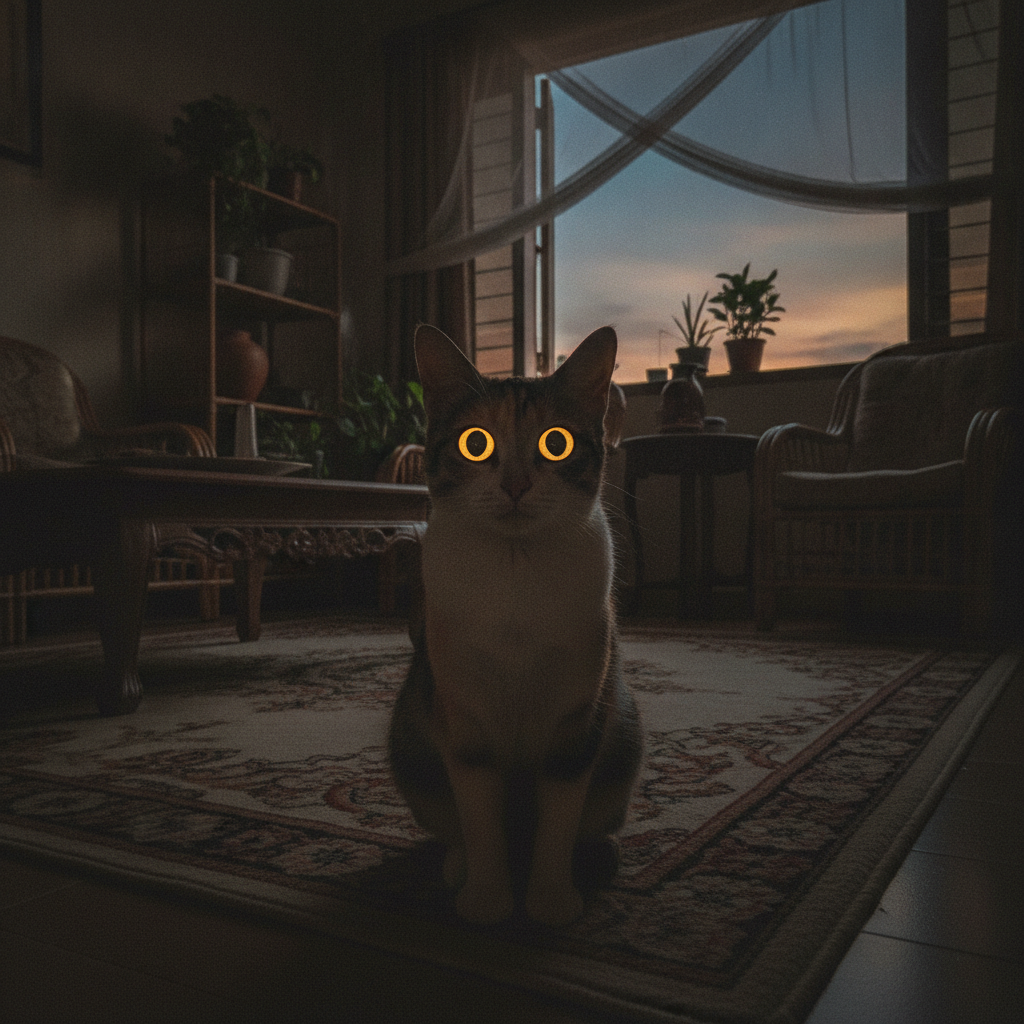
You walk into a dark room, flick on the light, and for half a second two glowing discs stare back at you from under the sofa. It's just Lucky, unbothered, watching you fumble for the switch he never needed. That eerie eyeshine is the most visible clue to a simple truth: your cat's eyes are built for a completely different world than yours.
This is part of our How Cats Work science hub, where we dig into the actual biology of cats rather than guessing at their moods. Here we're staying strictly with the eye itself — the hardware. (For how cats use their nose, ears and whiskers, see our companion guide on cat senses.) So: how does a cat actually see?
Why Your Cat's Eyes Glow in the Dark
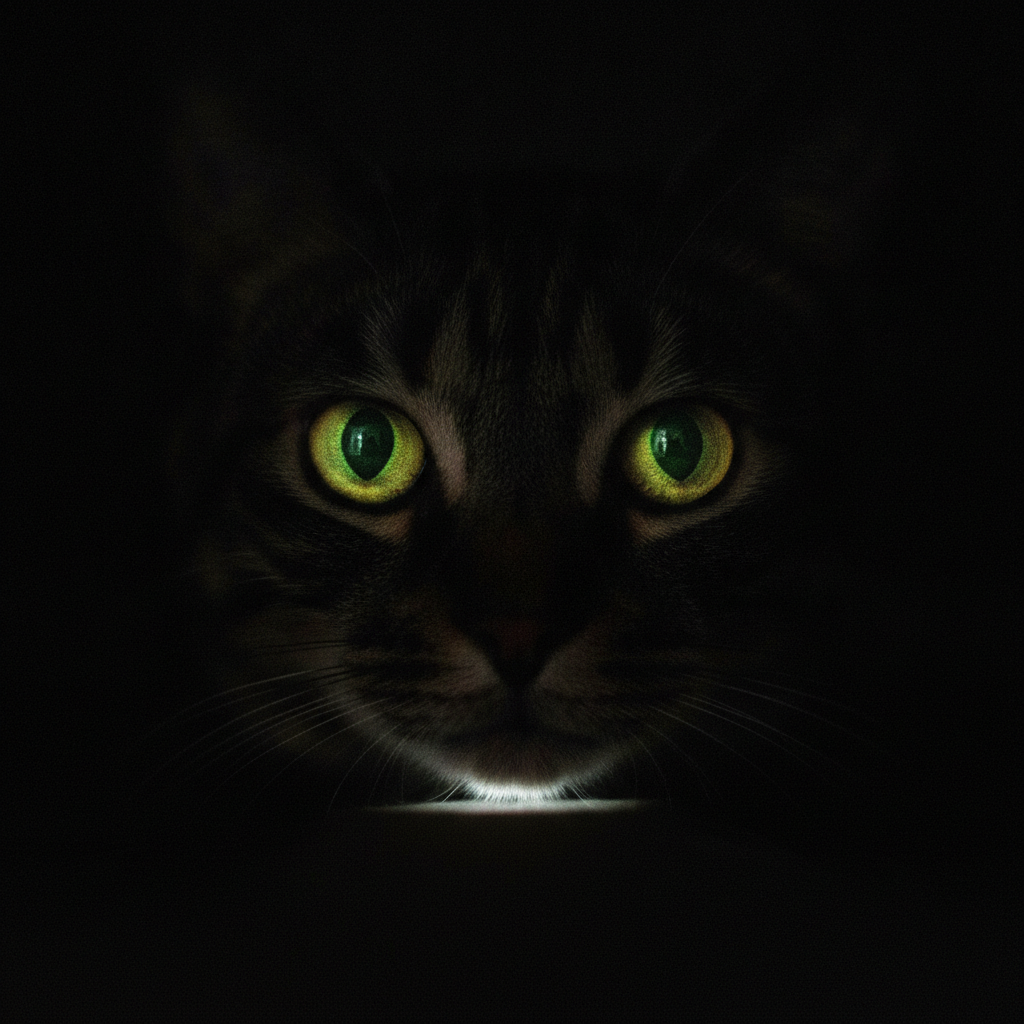
That glow has a name: the tapetum lucidum, a mirror-like layer sitting right behind the retina. When light enters the eye, anything the retina misses on the first pass hits this reflective sheet and bounces back for a second chance at being detected. As wild-cat researchers at Panthera explain, this clever bit of recycling boosts the available light to the photoreceptors by close to 40%. The leftover light that escapes back out is the eyeshine you see — and its colour (green, gold, sometimes a faint red) varies with the minerals packed into that reflective layer, which is why Tiger and Lion can flash slightly different shades in the same torchlight.
The payoff is dramatic: a cat can see in light levels roughly six to eight times dimmer than what you need. That said, cats are not superheroes — they cannot see in total darkness. With zero light, there's nothing for the tapetum to recycle, and your cat is as blind as you are. It just needs far less light than we do to get by.
Built for the Dark: The Rod-Heavy Retina
The second half of the night-vision story is in the retina's wiring. Cat retinas are packed with rod cells — the photoreceptors that handle dim light and motion — at densities reaching around 460,000 per square millimetre, against far fewer colour-detecting cones. That works out to roughly a 17-to-1 rod-to-cone ratio in the densest areas, the mirror image of the human eye, which is built around a cone-rich centre for sharp daytime detail.
This is a classic evolutionary trade-off. All those extra rods make a cat exquisitely sensitive to faint light and the smallest twitch of movement, which is exactly what an ambush hunter active at dawn and dusk needs. The cost is sharpness: bouncing light back through the retina scatters it slightly, so the image is grainier. Your cat trades crisp detail for the ability to see a moth move in near-darkness — a deal any predator would take.
There's an open question scientists are still chasing, too: some research suggests cats may pick up a little ultraviolet light that's completely invisible to us. If true, it could mean familiar surfaces — including urine traces left by other animals — quietly "light up" for a cat in ways we'll never directly experience. It's a good reminder that we're only ever guessing at the edges of how rich their visual world really is.
Do Cats See in Colour? The Blue-and-Yellow World
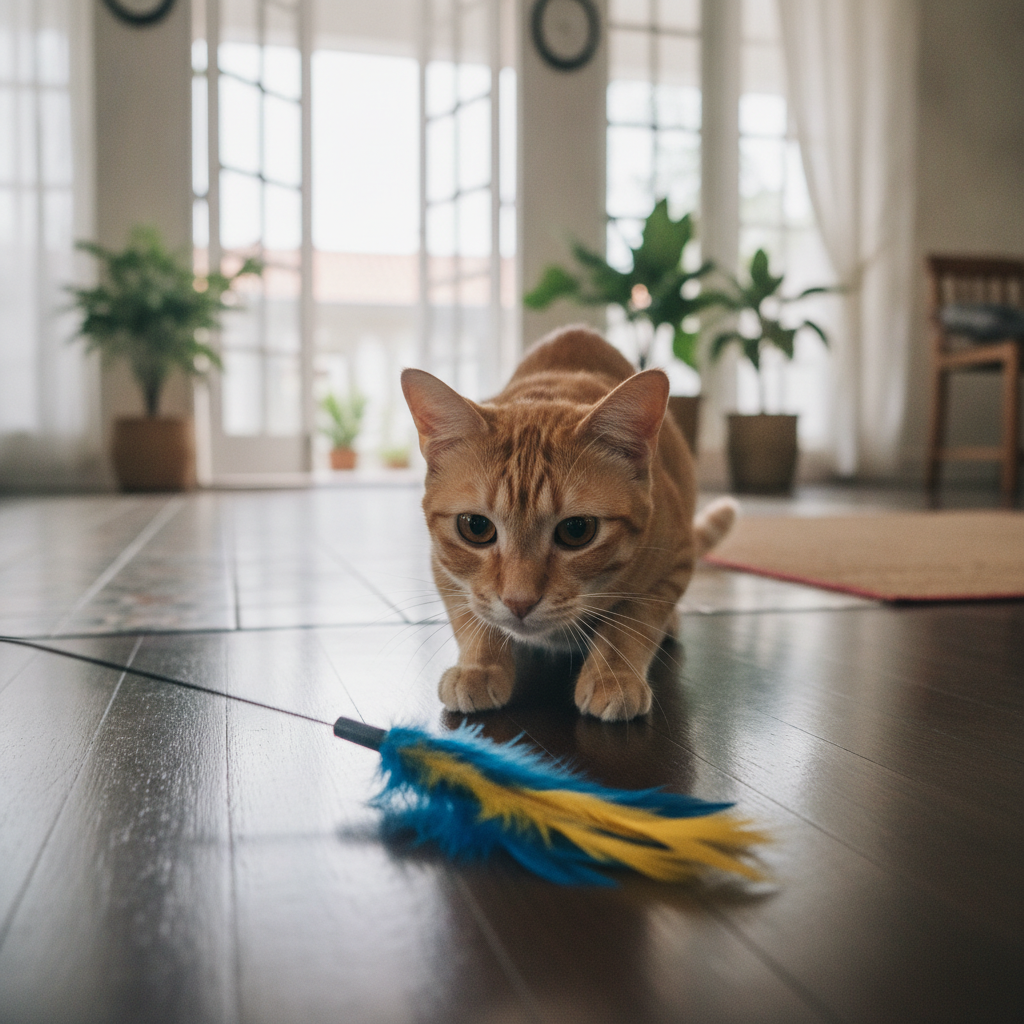
The old "cats only see black and white" line is a myth. Cats have dichromatic vision — two types of cone cells instead of our three — which is broadly similar to red-green colour blindness in humans. According to the Cornell-aligned veterinary explainer at PetMD, their cones peak in the blue-violet range (around 450 nm) and the greenish-yellow range (around 550 nm).
In practice, that means your cat lives in a muted palette of blues and yellows. Reds, pinks and oranges don't register as vivid colour — they likely read as dull greys or brownish tones. So that bright red toy you bought? Lucky isn't ignoring it to be rude; to him it's a grey lump. He's tracking it by movement and texture, not colour. If you want a toy or a feeding mat your cat actually sees as colourful, go blue or yellow.
Blurry Up Close, Deadly on Movement
Here's a surprise: cats are quite nearsighted. Their visual acuity is estimated at around 20/100 to 20/200, meaning what a person with normal sight can read clearly at 100 feet, a cat only resolves at 20 feet. Distant things are soft and blurry to them. What they lose in sharpness they make up for in coverage and speed: a cat's field of view spans about 200 degrees (you get 180), with a generous binocular overlap of roughly 140 degrees that gives the depth perception needed to time a pounce.
Then there's motion. Cats are thought to have a higher flicker-fusion frequency than humans — frequently estimated around 70-80 Hz versus our 50-60 Hz, though the exact figure is still debated among researchers. In plain terms, they refresh the visual world faster than we do, so a darting mouse that looks like a blur to us appears as a series of crisp, trackable frames to them. Some estimates suggest a cat needs close to 100 images per second to see motion as perfectly smooth, where about 20 is enough for us. It's also why some cats are unimpressed by older screens and may be subtly bothered by cheap flickering lighting — fluorescent tubes pulse at 100-120 times a second, invisible to us but registered by feline visual neurons — as veterinary vision researchers have documented in the Veterinary Information Network. This wide, fast, motion-first way of seeing is summarised well in side-by-side comparisons of cat versus human vision.
Those Slit Pupils Aren't Just for Looks
The vertical slit pupil is one of the most recognisable feline features, and it's pure engineering. Thanks to a specialised set of iris muscles, a cat's pupil can change its area by a factor of about 135 — from a wide black circle in the dark to a razor-thin slit in bright light. Your own pupil manages a factor of only about 15. That huge dynamic range protects the cat's ultra-sensitive, rod-packed retina from being blown out by tropical midday sun while still opening up fully at night.
Research summarised by the National Library of Medicine and others links the vertical-slit shape to small, ground-level ambush predators specifically: it sharpens depth cues for judging the exact distance to prey. Tellingly, big cats like lions and tigers have round pupils — they're tall enough that the slit's advantage fades, a pattern veterinary ophthalmologists at the Animal Medical Center tie directly to hunting style and height off the ground. Your house cat keeps the slit because, evolutionarily, it's still a tiny ambush hunter that happens to live on your sofa.
What Night Vision Means for the Litter Box
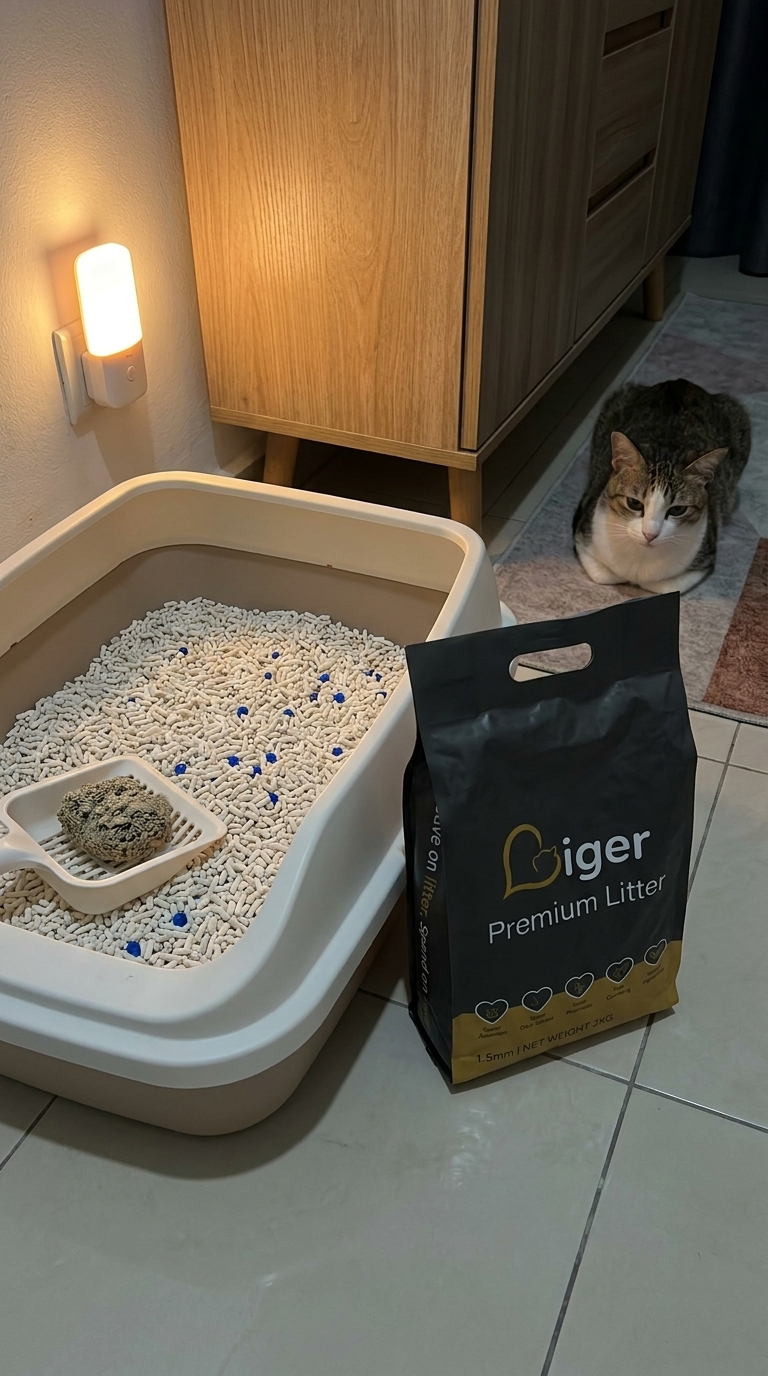
All this biology has a very practical side at home. Because cats see well in low light, many will happily use the litter box in a dim corner at night — but "low light" is not "no light." A box in a pitch-black store room can put a cat off, especially a senior whose night vision has faded. Keep a sliver of light nearby and, just as importantly, keep the box in a consistent spot; cats navigate partly from memory and a blurry close-up world, so moving the box around confuses them.
Dust matters too. A litter that throws up a cloud of fine powder isn't just bad for the lungs — it's an irritant for those sensitive eyes, especially in a cat that buries enthusiastically. This is one reason we built Liger Premium Tofu Cat Litter from food-grade soy fibre to be low-dust and fast-clumping, with a light natural scent rather than heavy perfume. Current Liger pricing (as of May 2026) is RM21.90 for a single 2kg pack, RM53.90 for 3 packs, RM89 for 5 packs and RM169 for 10 packs — the 10-pack landing at just RM8.45/kg, free shipping across Peninsular Malaysia. To size your supply, try the litter calculator, and check the dust-level comparison tool to see why low dust is kinder to your cat's eyes.
Seeing Your Home Through Your Cat's Eyes
Once you understand feline vision, your Malaysian home looks different. Bright, glary afternoon light through unshaded windows can be genuinely harsh on those light-hungry eyes — a shaded perch is a kindness, not a luxury. Cheap, flickery lighting may quietly stress a sensitive cat, so better-quality LED bulbs can help. And give your cat height: a window perch lets that wide 200-degree field do what it was built for, scanning the world for movement.
Vision is only one channel, of course. Pair this with how your cat's nose, ears and whiskers fill in everything the eyes miss, and head back to the How Cats Work hub for the full picture of feline biology. The better you understand the machine, the less mysterious — and the easier to care for — your cat becomes.