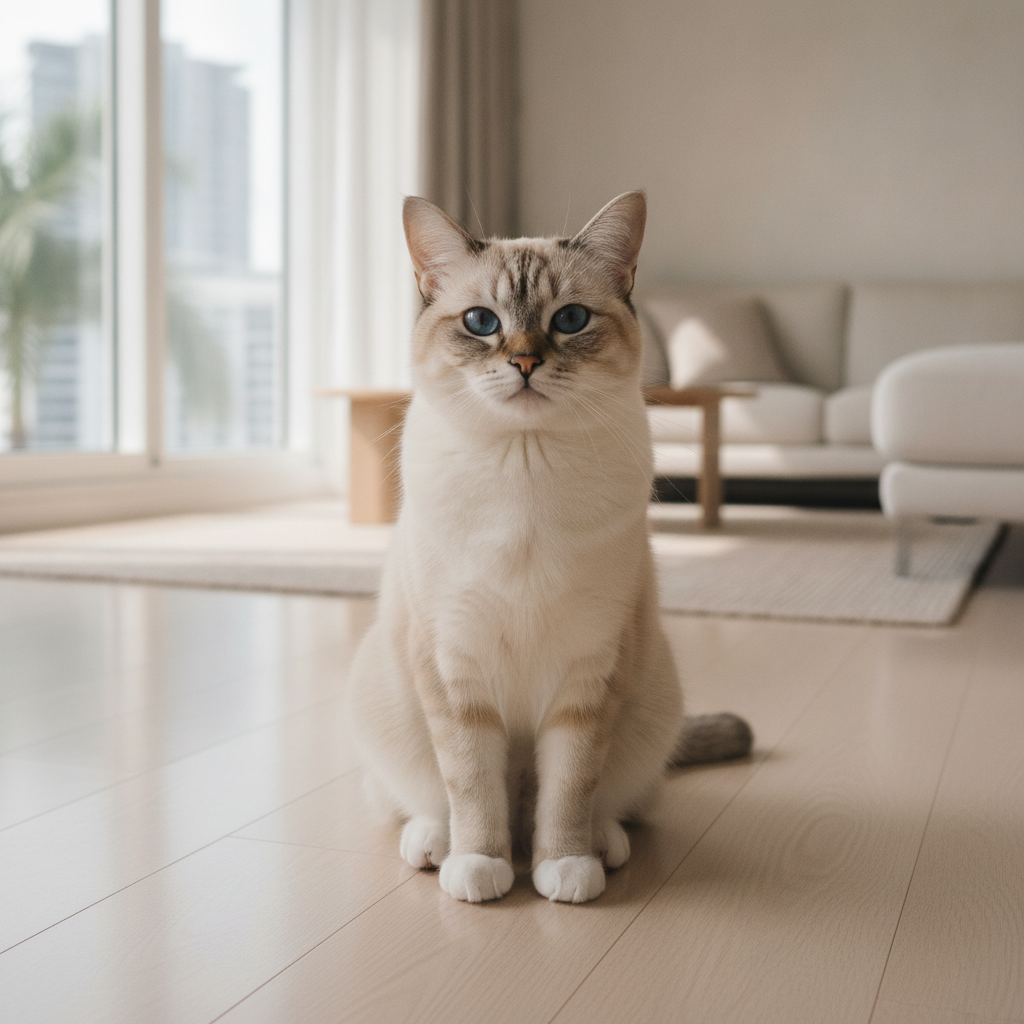
If someone shows you a photo of a gorgeous cat with deep sapphire-blue eyes, a creamy colourpoint coat, and unmistakably pure white paws on all four feet, that is a Birman — and before you go further, note that it is not a Burmese. The two names trip people up constantly, but they are completely separate breeds with different genetics, different looks, and very different histories. The Birman, known in France as the Sacre de Birmanie, is the one draped in temple legend, white gloves, and a silky single coat that makes Persian owners weep with envy. The Burmese is a sleek, solid-coloured shorthair with a completely different origin story.
This guide is breed-specific. If you are still deciding which cat suits you, start with our complete 2026 guide to cat breeds in Malaysia, then come back here. And if you are coming from research on other blue-eyed colourpoint cats, our guides on the Siamese and the Ragdoll will help you compare.
Birman vs Burmese: Two Breeds, One Confusing Name
Let us get this out of the way first because it genuinely confuses even experienced cat people. The Burmese cat is a short-haired, solid-coloured cat with yellow or gold eyes, founded in the United States in 1930 when Dr. Joseph Thompson brought a single brown female named Wong Mau from Burma to San Francisco. He then bred her with a Siamese to establish the breed. The Cat Fanciers' Association (CFA) recognised the Burmese in 1936. Short coat, solid colour, gold eyes, American-founded, Siamese genetics in the background.
The Birman, on the other hand, is a semi-longhaired, colourpointed cat with mandatory pure white paws and deep blue eyes, with documented history beginning in France in the 1920s. Its lineage involved Persian outcrossing after World War II. Long coat, colourpoint pattern, white gloves, blue eyes, French-registered. The only thing these two breeds share is a loose geographical reference in their names and the fact that both are beautiful. If a breeder or pet shop tries to sell you either as the other, walk away.
The Legend Behind the White Gloves
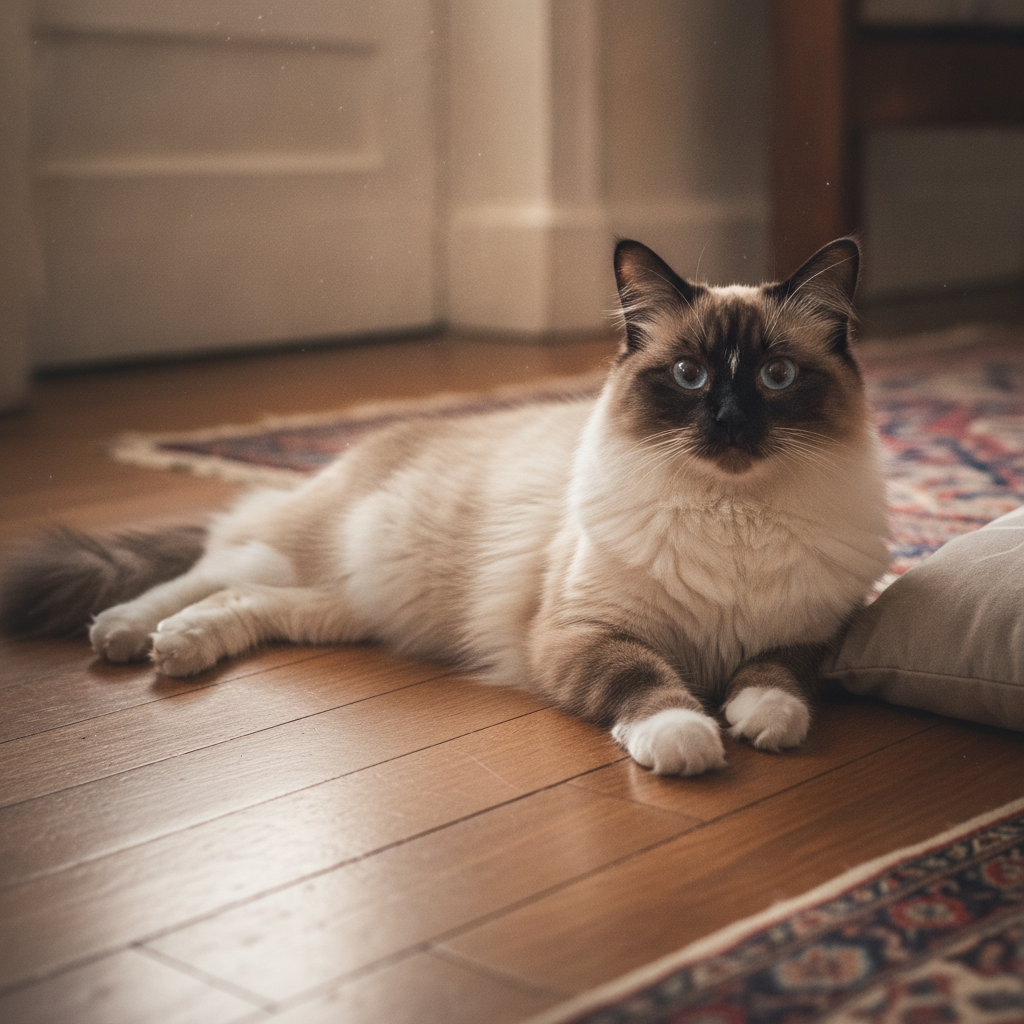
Every Birman comes with a founding myth, and it is a good one. According to the legend, the Kittah priests at the Temple of Lao-Tsun in Burma kept white, long-haired cats as companions. The head priest, Mun-Ha, had a devoted cat named Sinh. When the temple was raided and Mun-Ha was killed, Sinh placed his paws on his master's body and faced the golden goddess statue of Tsun-Kyan-Kse. A transformation happened: Sinh's white fur took on a golden sheen, his yellow eyes turned sapphire-blue like the goddess's, and his face, ears, legs, and tail darkened to match the earth. But his four paws, where they touched his dying master, remained pure white — a permanent symbol of purity and fidelity. He was said to have carried his master's soul to paradise seven days later, and all other temple cats transformed the same way.
The legend neatly explains every distinctive physical feature of the breed. The real documented history is a little more prosaic but no less interesting. The Birman was formally recognised in France in 1925 as the Sacre de Birmanie. World War II came close to wiping the breed out entirely — the entire European population reportedly survived as a single pair, Orloff and Xenia de Kaabaa. To rebuild the breed from this extreme genetic bottleneck, breeders carefully outcrossed with other long-haired cats, including Persians, which cemented the long silky single coat we see today. By the 1960s the breed had recovered enough to reach Britain and North America, where it was recognised by the CFA and TICA.
The Signature Look: Colourpoint, White Gloves, and Those Blue Eyes
The Birman's appearance is governed by one of the most precise breed standards in the cat world. According to the CFA Birman breed standard, the coat is colourpointed: the body is a pale, even shade while the face mask, ears, legs, and tail are a darker contrasting colour. Kittens are born completely white and develop their point colouration as they mature. The CFA recognises seal, blue, chocolate, lilac, red, cream, tortie, and lynx (tabby) points, among others. A faint golden-beige "golden mist" across the back is considered desirable.
The eyes must be a deep, vivid sapphire blue — any other colour is a disqualification at shows. But the real signature, and what makes the Birman unmistakable, is the white paw markings. The front paws carry symmetrical "gloves" ending in an even line across the paw at or between the second and third joint. The hind paws carry "gauntlets" or "laces" — white that extends further up the back of the leg, ideally tapering into a pointed inverted V-shape reaching halfway to three-quarters up the hock. Perfect symmetry in the laces is coveted but genuinely difficult to breed for. A coloured spot within the white or a missing glove on any paw is a disqualifying fault at shows. These white markings are produced by a specific gloving gene, distinct from ordinary white-spotting genetics.
The coat itself is medium-long to long, with a silky texture and — crucially — a single layer. There is no dense undercoat. This single coat structure means the Birman's fur is significantly less prone to tangling and matting than the double coat of a Persian, making grooming more manageable for the average owner. The body is medium-to-large and stocky; males typically weigh 4.5 to 7 kg, females somewhat less.
Birman Temperament: The Velcro Cat That Never Shouts
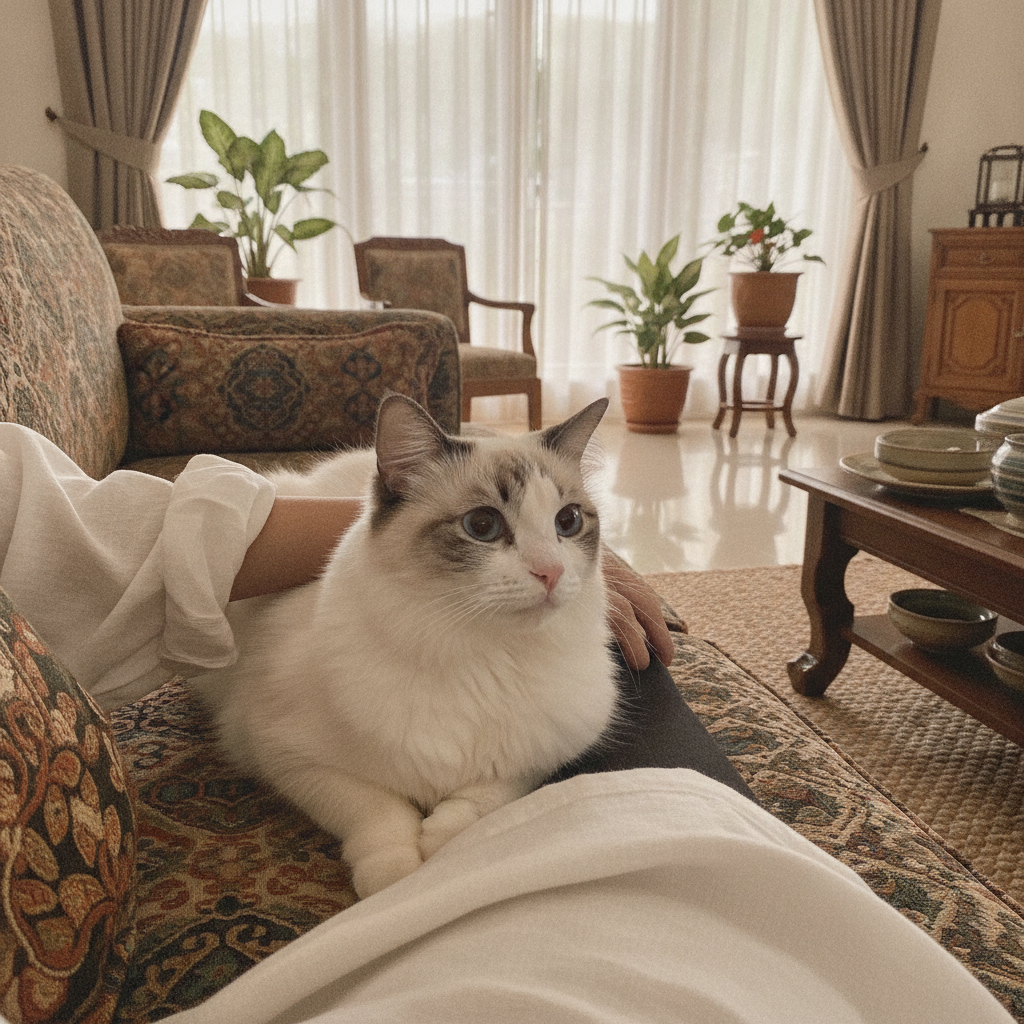
Birmans have a reputation for being exceptionally gentle, affectionate, and calm — and in practice, it holds up. They are profoundly people-oriented cats that bond deeply with their human family and tend to follow their owners from room to room, which has earned them the "velcro cat" nickname. Unlike a Siamese, they are not especially vocal; their preferred communication is a soft chirping mew rather than an ongoing commentary about your life choices.
They are playful and intelligent enough to enjoy interactive games and can pick up simple tricks, but they are equally happy to be a placid lap companion once the play session is done. The Birman's patience and tolerance make it a solid choice for families with children, and it integrates well with other cats and cat-friendly dogs. Some individuals are shy in new situations, and a degree of mild territorial behaviour has been noted, but these are typically minor compared with more assertive breeds. For a breed that demands attention and company, they are notably undramatic about expressing that need. They do not do well with extended solitude — households where someone is home during the day suit them best.
Compared with the Ragdoll (another blue-eyed semi-longhair often mentioned in the same breath), the Birman is slightly more active and curious. Compared with the Siamese, the Birman is quieter and more measured. For a fuller comparison of temperament across blue-eyed breeds, see our Ragdoll guide and our Siamese guide.
Health Risks Every Birman Owner Must Know
Behind the serene temple-cat persona are some real genetic health concerns. The Birman is a generally long-lived breed — average life expectancy in the UK is documented at 14.39 years, with many reaching 16 to 18 — but several hereditary conditions can cut that short if not managed proactively. For full context on how the Birman's lifespan compares with other breeds, see our cat lifespan by breed guide.
Hypertrophic cardiomyopathy (HCM) is the most serious concern. This is the most common form of heart disease in cats, causing thickening of the heart's muscular walls and reduced cardiac efficiency. As the Cornell Feline Health Center explains, many cats are asymptomatic in early stages — the first sign is often a murmur picked up at a routine check-up, by which point the disease may already be advanced. In Birmans specifically, one screening study of 162 cats found HCM in nearly 7% of them, with males accounting for 82% of diagnosed cases. The median age of diagnosis was 8.4 years, meaning a normal cardiac scan in a young cat does not guarantee a clean bill of health for life. No breed-specific gene test exists for Birman HCM; the gold standard is regular echocardiograms throughout the cat's life.
Polycystic kidney disease (PKD) is a second inherited risk. Fluid-filled cysts form in the kidneys from birth and gradually destroy kidney tissue, with clinical signs — increased thirst, weight loss, reduced appetite — often not appearing until around seven years of age. According to VCA Hospitals, PKD can be confirmed by ultrasound or a genetic DNA test, and responsible breeders should screen all breeding cats.
Congenital hypotrichosis is a rarer but more alarming condition. It is an autosomal recessive disorder: a kitten must inherit the gene from both parents to be affected. Affected kittens are born with little to no hair, may lack whiskers, and have a severely compromised immune system. According to the published research, the condition is typically fatal in early life. A DNA carrier test is available, so reputable breeders can identify carriers and avoid producing affected litters.
Corneal dermoid — a small patch of skin-like tissue growing on the cornea's surface — has a suggested predisposition in Birmans and causes chronic irritation and tearing if present. It is manageable with surgical removal (keratectomy) but needs to be caught early through ophthalmic examination. Obesity is also a documented risk: Birmans have a hearty appetite and a placid indoor temperament that combine to produce weight gain if feeding is not controlled. Excess weight compounds HCM risk and shortens lifespan, so measured meals twice daily rather than free-feeding is strongly recommended.
Keeping a Birman Healthy in Malaysia's Climate
Malaysia does not present the cold, dry conditions that the Birman's coat was shaped for in post-war Europe. What we have instead is year-round heat, high humidity, and no off-season for parasites. The good news is that the Birman's single coat — lacking the dense undercoat of a Persian or a British Shorthair — handles tropical heat considerably better than most long-haired breeds. The bad news is that "better than a Persian" still means your Birman needs real environmental management.
An indoor life with consistent air conditioning is non-negotiable, particularly during the midday heat. Cool resting surfaces — tiled floors, cooling mats — help. Any outdoor time should be limited to early morning or late evening in a shaded, enclosed space. Signs of heat stress include open-mouthed panting, excessive drooling, and lethargy; these warrant immediate veterinary attention.
High humidity creates conditions where fungal and bacterial skin infections thrive under coat. Brush two to three times a week rather than the temperate-climate weekly recommendation, using a stainless steel comb to remove loose hair and improve air circulation to the skin. Year-round parasite prevention (fleas and ticks do not take a monsoon holiday in Malaysia) is essential. Hydration deserves attention: multiple water sources, a cat fountain if your Birman takes to one, and wet food as part of the diet all push water intake up, which matters both for kidney health and temperature regulation.
Litter, Coat and Daily Care for Your Birman in Malaysia
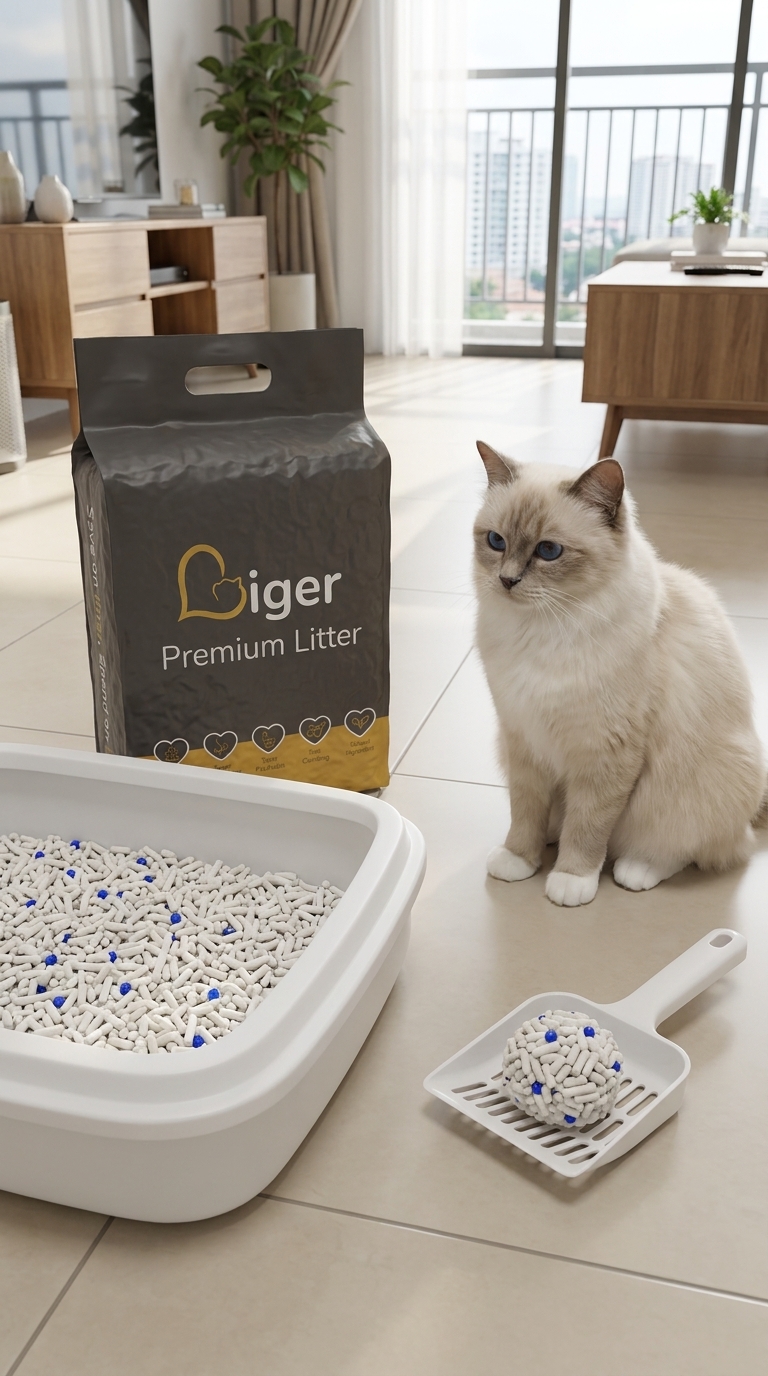
The Birman's single silky coat is genuinely lower-maintenance than a Persian's, but those white laces up the back legs are a small catch: anything dusty or sticky in the litter box will show up on them. This makes litter choice a practical matter, not just an aesthetic one.
Liger Premium Tofu Cat Litter is a low-dust, naturally clumping, flushable soy-based litter that suits an indoor long-coated breed well. The low dust matters for a sealed air-conditioned condo (airborne litter particles are respiratory irritants in a closed room), and the firm clumping means quick scooping with minimal residue tracked into those white gloves and laces. Current 2026 Liger pricing: RM21.90 for a single 1/2 kg pack, RM53.90 for 3 packs, RM89 for 5 packs, and RM169 for the 10-pack (20 kg total), which works out to RM8.45 per kg — with free shipping across Peninsular Malaysia. To work out how much litter your Birman goes through each month, use the Liger litter calculator.
Beyond litter, the daily care checklist for a Malaysian Birman owner is: measured meals twice daily (no free-feeding — they will gain weight), brushing two to three times a week, annual echocardiogram screening for HCM from middle age onwards, regular dental checks (the breed can be prone to tartar), year-round flea and tick prevention, and fresh cool water always available. None of this is onerous, but all of it is necessary.
What a Birman Costs in Malaysia (2026)
The Birman is not a common breed in Malaysia. Local registered breeders are few, imports are uncommon, and demand from owners who know the breed tends to outpace supply. As rough 2026 market guidance (not Liger figures), a registered Birman kitten from a reputable breeder typically falls in the RM2,500 to RM6,000 range, with show-quality lines, rarer point colours, or imported lineages pushing toward the higher end or beyond. Be sceptical of anything significantly cheaper — unverified "Birman" kittens are often unregistered mixed-breed colourpoint cats without health screening.
The kitten price is just the start. Budget for lifelong cardiac monitoring (echocardiograms are not cheap), quality wet and dry food with portion control, year-round parasite prevention, regular dental scaling, and a litter subscription that keeps pace with a cat that will likely share your home for 14 to 16 years. For a broader cost comparison across breeds, see our 2026 cat breed price guide. The Birman rewards the investment: buy from a breeder who screens for HCM and PKD, commit to an indoor climate-controlled life, keep the weight honest, and you have a gentle, blue-eyed companion that has been captivating households since the temples of Burma.