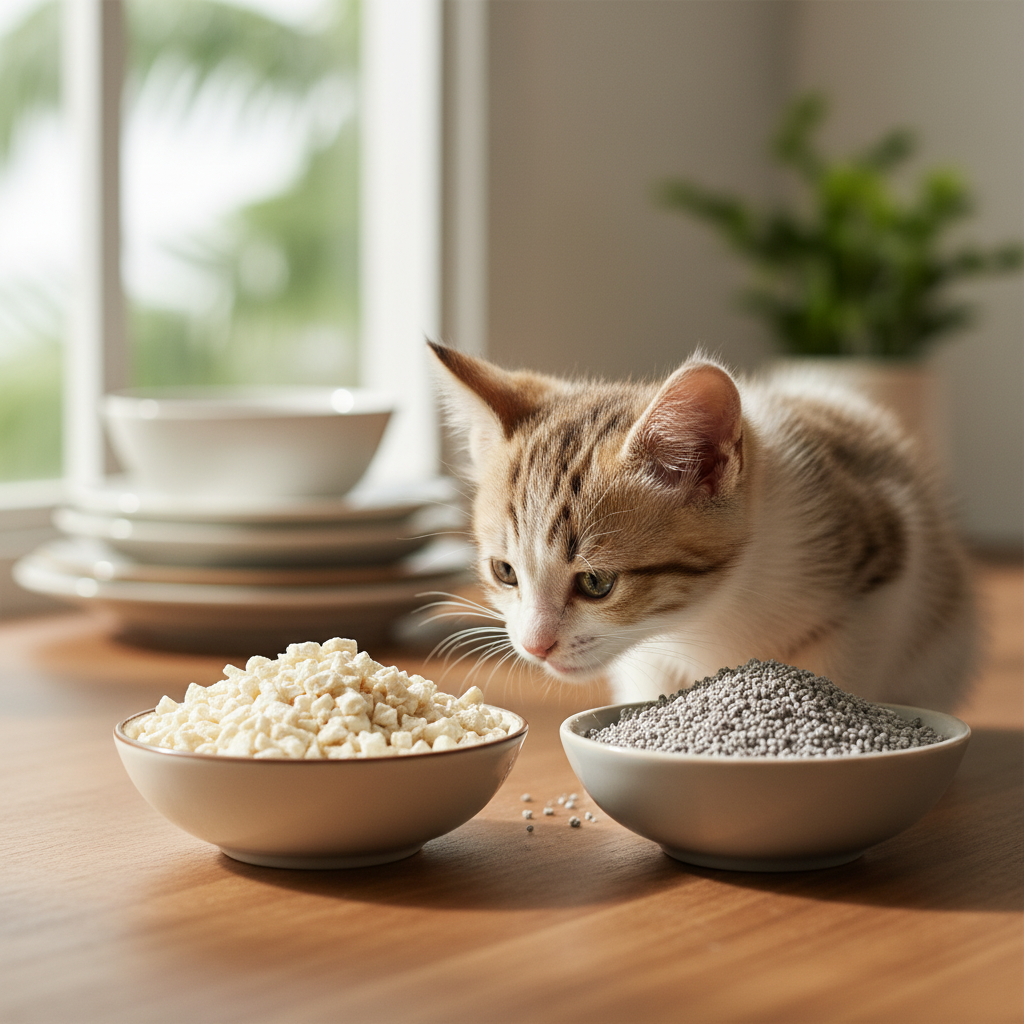
Every Malaysian cat parent who has stood in the pet aisle holding a bag of tofu litter in one hand and a bag of bentonite clay in the other has thought the same thing: what if I just mix them? Cheaper than pure tofu, harder clumps than pure tofu, less dust than pure clay. Sounds like the best of both worlds.
We thought the same thing. So we ran a real 4-week test across our 4 cats here in Klang Valley — Tiger and Lion (kitten brothers, now almost 2 years old), Ping'An (our adopted rescue mom), and Lucky (the youngest of the gang). We tried three different ratios. We measured cost, weighed bags, sniffed corners, and watched paws.
The short answer? Mixing tofu and bentonite works for one specific kind of cat parent, and it actively makes life worse for everyone else. Here is the full story, including the chemistry, the receipts, and when you should absolutely not do this.
Why Cat Parents Even Consider Mixing
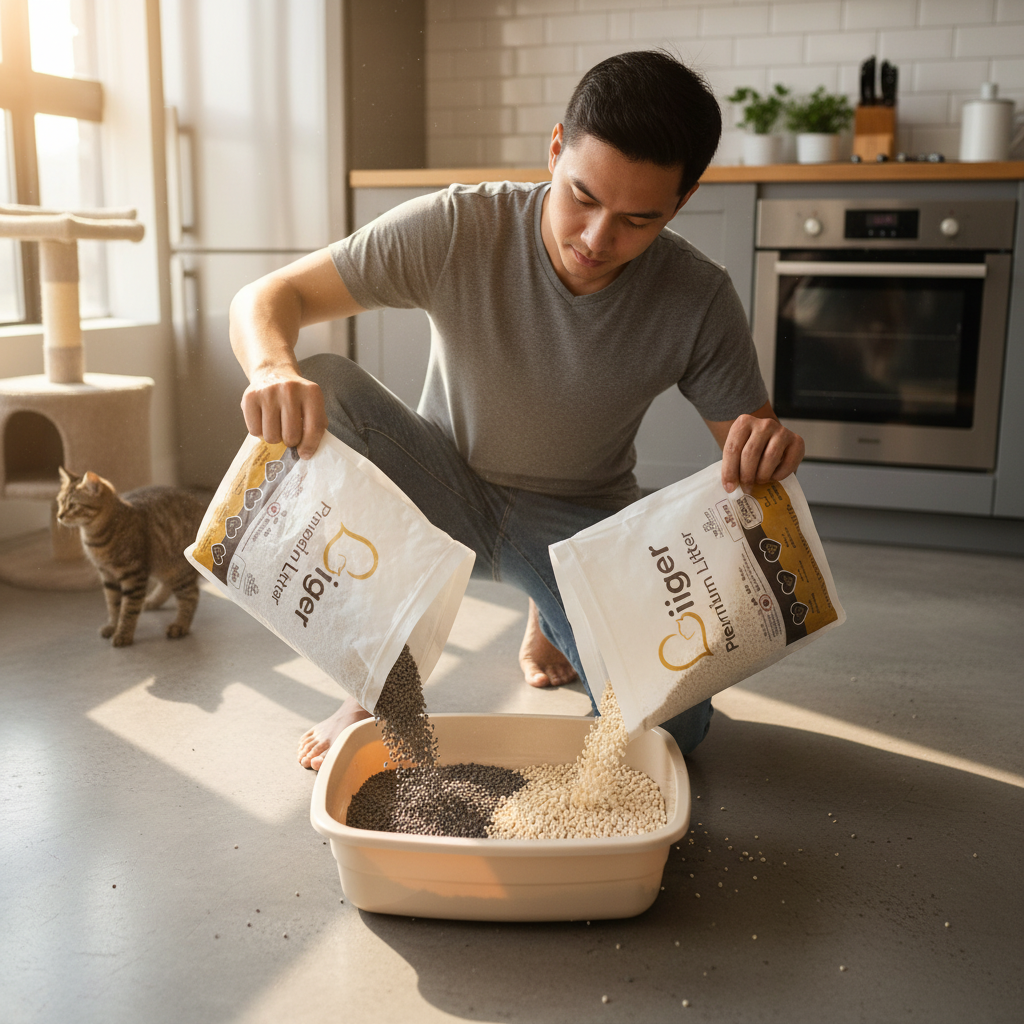
In the past five years, the Malaysian hybrid litter market has exploded. According to industry tracking, mixed-litter market share grew from 5% in 2020 to 18% in 2024. Brands like Cature have built their whole positioning around a 70% tofu and 30% bentonite "Mix Master" formula, marketed as the chemical sweet spot between performance and natural ingredients.
When I ask other cat parents in our Liger customer group why they mix, the answers always cluster into three buckets:
- Cost. Pure tofu litter is more expensive per kilogram than bentonite. Mixing feels like a way to stretch the budget without going full clay.
- Clumping. Tofu pellets clump softer and slower than clay. Some cats are big pee-ers and the clump shatters when you scoop.
- Transitioning. A cat used to clay for 5 years will sniff a bowl of tofu pellets and walk away. Mixing slowly is the standard trick.
All three reasons are valid. None of them tell the full story.
The Chemistry: What Actually Happens When Starch Meets Bentonite
Tofu litter and bentonite clay clump through completely different mechanisms, and understanding this is the key to understanding why hybrid blends behave the way they do.
Bentonite: Fast, Hard, Ionic
Sodium bentonite is volcanic ash clay made mostly of montmorillonite. Its layered silicate sheets carry a negative charge. When urine hits it, the positive ammonium and sodium ions in the urine bind to those negative surfaces in an ionic exchange. The clay platelets swell, fuse, and form a rock-hard clump in 15 to 30 seconds. According to a water absorption study on sodium bentonite, the clay can expand 15 to 18 times its original volume on contact with water. That is why bentonite clumps feel like little hockey pucks.
Tofu: Slow, Soft, Mechanical
Tofu litter is soy fiber, starch, and a bit of guar gum binder. Clumping is a two-step thing: first the pellets physically swell with moisture, then the starch gelatinises and forms a sticky matrix. This takes 5 to 7 minutes to reach full strength. The clumps are softer and bigger, but they hold together if you scoop with a gentle hand. Our own Liger Tofu Litter clumping strength test measured 97% clump integrity — but only after the gelatinisation step finishes.
What Happens When You Mix Them
This is where it gets interesting. In a hybrid blend, the porous tofu pellets act as a scaffolding. The much finer bentonite particles drift down into the gaps between pellets and sit there. When urine arrives, bentonite reacts first (seconds) and tofu reacts second (minutes). The result is a composite clump that forms quickly on the outside and slowly stabilises on the inside.
Soy protein has both positive and negative charges, so it can form hydrogen bonds with bentonite's silicate surface. This is the "synergy" brands talk about. It is real — but it is also what nullifies most of tofu litter's biggest advantages, which we will get to.
The Pros: What Actually Improves When You Mix
1. Clump Hardness Goes Up — A Lot
This was the most obvious change in our test. At a 70/30 tofu-bentonite ratio, scooping became noticeably easier. Tiger is our heaviest urinator and his clumps in pure tofu sometimes shatter into 3 pieces when I scoop. In the hybrid mix, they came out as one piece almost every time. Cature's own data claims their 70/30 blend reaches 12N/cm² clump strength in 2 to 3 seconds, which matches what we felt.
2. Odor Control on Day 3 is Better
By day 3 in any litter box, ammonia builds up. Bentonite captures ammonium ions (NH4+) through ion exchange — research suggests up to 94% capture within 30 seconds of contact. Tofu relies on absorbency and sometimes added citric acid to neutralise. The hybrid does both. In our test, the spare bedroom (Lucky's box) smelled less sharp on day 3 with the 70/30 mix than with pure tofu.
3. Upfront Cost Per Bag Goes Down
Bentonite is cheap. In Malaysia, a 10kg bag of supermarket bentonite runs RM 18 to RM 25. Premium tofu like Liger runs around RM 28 to RM 35 per 6L bag. If you mix 50/50, you drop the per-kilogram cost noticeably. We will see why this is misleading in the cons section.
The Cons: What You Actually Lose
1. Bentonite Dust Contaminates Tofu's Biggest Selling Point
This is the deal-breaker for many. Tofu litter's killer feature is being virtually dust-free. The moment you pour bentonite into the same box, you reintroduce respirable crystalline silica — a particulate that the US NIOSH limits to 0.05 mg/m³ exposure over an 8-hour workday. A peer-reviewed case study on silicosis from bentonite cat litter exposure documented respiratory disease in a human cat parent. Cats are closer to the dust source than we are, every single time they dig.
If your cat already has a sniffly nose, you should not be doing this. Full stop.
2. You Lose Flushability and Compostability — Forever
One of the main reasons Malaysian condo dwellers love tofu litter is that you can flush a small clump down the toilet. The moment any bentonite is in the bag, that benefit dies. Bentonite swells 15× in water and will turn into cement inside your pipes. IWK's own service guidelines explicitly state that sewage systems are designed only for human waste and toilet paper. Even at a 90/10 tofu-bentonite mix, you still cannot flush.
Same with composting. Bentonite is a mineral. It does not decompose. Your beautiful tofu compost is now contaminated landfill material.
3. The Cost Savings Are an Illusion (Long-Term)
This one shocked us. Tofu litter is hyper-absorbent, so a single cat typically uses about 2.5 kg per month. Bentonite is less efficient per gram and a single cat can churn through 12 to 18 kg of clay per month. A 50/50 blend lands somewhere in the middle — around 7.6 kg per cat per month based on extrapolated industry data. Even though the per-kg price drops, the consumption volume nearly triples. For our 4-cat household, the 50/50 month ended up costing more in total than the pure-tofu month, even with the cheaper per-bag price.
4. Disposal Becomes Confusing
When the bag is pure tofu, disposal is easy: small bits flushed, the rest in compost or general waste. When it is 70/30, everything goes in the bin. No exceptions. Your trash bag also gets heavier — bentonite clumps are about 2.3× denser than tofu clumps. In Malaysia's humidity, heavier wet bags also attract flies fast. We learned the hard way that fly eggs in tropical waste bins can hatch into maggots within 12 to 24 hours at 30°C if you do not double-bag and seal.
5. Litter Robot and Sifting Boxes May Jam
If you use a self-cleaning machine, mixing changes the granule profile. The Litter-Robot 4 sifting screen is optimised for granular clay. Hybrid blends with both 2-3mm tofu pellets and fine bentonite particles can either jam the screen or waste a lot of the tofu by sifting it out as "waste."
Our 4-Cat Real-World Test: 4 Weeks, 3 Ratios
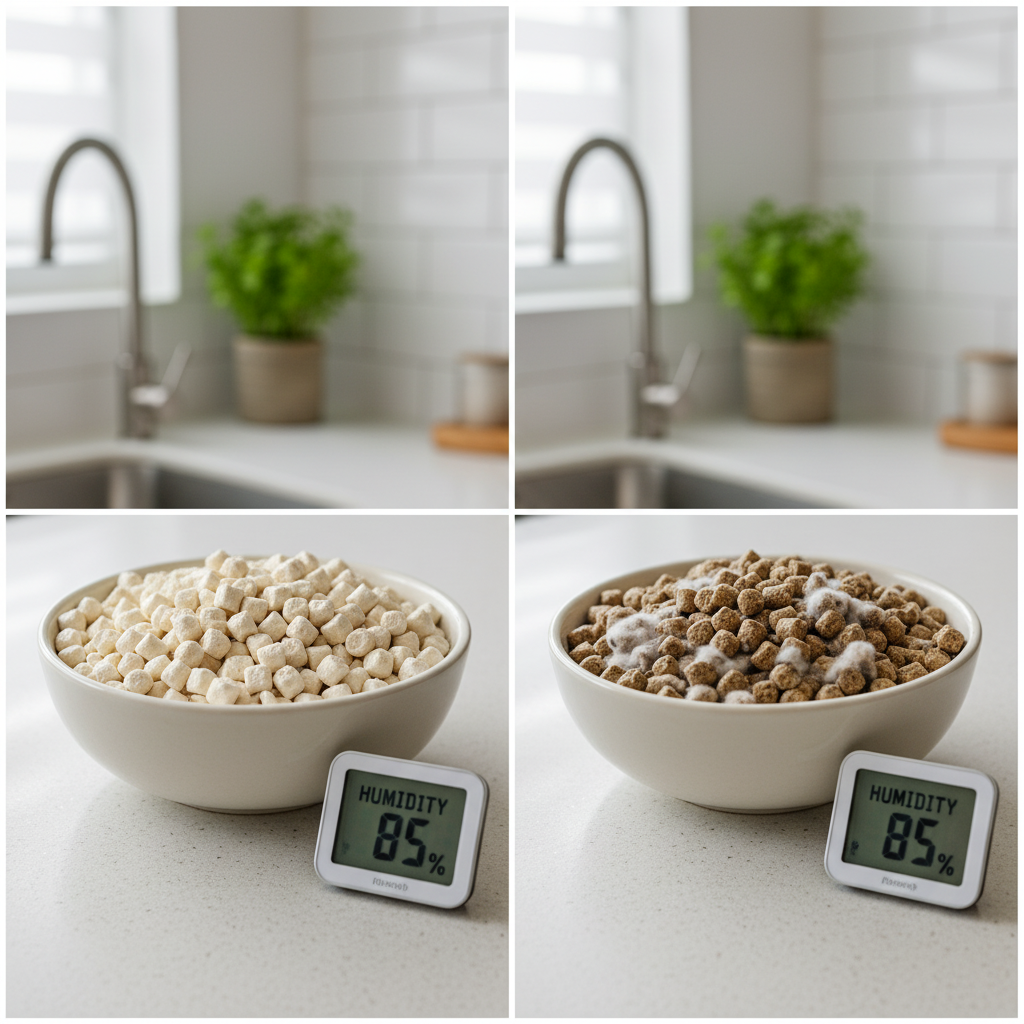
Here is what we actually did. We have 4 cats, 6 litter boxes (following the N+1 rule from Countryside Veterinary Hospital), and an unusually humid season (May, RH around 85%).
Week 1: 80% Tofu / 20% Bentonite (Low Dust Goal)
Cats accepted it instantly — no behavioural change. Dust was slightly higher than pure tofu but still very low. Clumps were marginally firmer. Lucky's box still had a mild ammonia tang by day 3. Verdict: barely worth the trade-off.
Week 2: 70% Tofu / 30% Bentonite (Cature's Ratio)
Best performing blend. Clumps were solid, scooping was effortless. Dust was noticeable when pouring fresh litter but settled fast. Tiger sneezed twice during pour-in (he is sensitive). Cost per scoop dropped about 18% vs pure tofu. We could not flush, but odor on day 3 was better.
Week 3: 50% Tofu / 50% Bentonite (Cost-Save Goal)
This was the worst week for us. Clumps were rock-hard, yes. But the dust was a problem — visible cloud during refill, and Tiger started cough-snuffling in the evenings. We weighed every bag and our actual monthly consumption projected to 7.4 kg/cat versus 2.5 kg/cat on pure tofu. The "saving" disappeared.
Week 4: Back to 100% Liger Tofu
Tiger stopped cough-snuffling within 48 hours. Boxes smelled fine with daily scooping. Compostability and partial flushability returned. The verdict from the cats was unanimous — they didn't care, but we did.
Recommended Ratios for Different Goals
If you have already decided to mix, here is our honest guidance based on the test. Use our litter calculator to estimate monthly volume for your cat count before you commit to any blend.
Transitioning from Clay to Tofu: 70% Old Clay / 30% Tofu, decreasing weekly
This is the only ratio we genuinely recommend. Start at 70/30 in week 1, shift to 50/50 in week 2, 30/70 in week 3, 100% tofu in week 4. Most cats accept tofu fully within 21 days.
Cost-Saving Goal: 50/50
If your only constraint is the per-bag price at checkout, this works. Just know that your monthly bill probably will not drop. And you lose every other tofu benefit.
Odor Control Goal: 80% Tofu / 20% Bentonite
This is the lowest-impact mix. You keep most of tofu's low-dust profile and gain modest ion-exchange odor absorption from bentonite. Good for multi-cat homes with sensitive humans.
Compare these against pure-tofu and pure-clay on our litter comparison tool so you can see the trade-off in numbers before you blend.
When You Should NOT Mix
There are four situations where mixing is a hard no, not a maybe.
- Your cat has asthma or a chronic upper respiratory condition. Veterinarians universally recommend dust-free litter for asthmatic cats. Veterinary research shows over 60% of "behavioral" litter avoidance has medical roots, and dust irritation is one of the top triggers.
- You live in a high-humidity condo without good ventilation. Bentonite plus humidity equals airborne silica that lingers. Our dust level comparison tool shows the difference visually.
- You care about composting or flushing. Even 5% bentonite ruins both. There is no "safe minimum."
- You have a Litter-Robot, ScoopFree, or PetKit Pura X. Hybrid blends are not what these machines are designed for. You will get jams or wasted litter.
Liger's Honest Take
We sell milk-scented tofu cat litter for a living, so of course we are biased. But we built Liger because we genuinely think the tropical Malaysian condo lifestyle — small spaces, high humidity, multi-cat households, light flushable disposal — is a near-perfect fit for pure tofu. Mixing in bentonite gives back one or two performance points but takes away the four things that made tofu the right choice for our climate.
If you want better clumping, try a smaller pellet size or a tofu litter with a higher starch ratio. If you want lower cost, our litter calculator usually shows pure tofu wins on monthly spend once you factor in consumption rate. If you want odor control, scoop twice a day and add baking soda — it costs nothing.
And if you absolutely must mix, do the 80/20 with a low-silica clay, ventilate the room, and never flush.
The Bottom Line
Mixing tofu and bentonite cat litter is a trade-off, not an upgrade. You get harder clumps and slightly cheaper per-kilogram cost. You lose flushability, compostability, low-dust safety, lightweight handling, and (usually) long-term savings. For a household with healthy cats, no asthma, and an existing automatic litter box that demands clay-style granules, a 70/30 commercial blend like Cature's Mix Master is a reasonable middle path. For everyone else — and especially for Malaysian condo families with sensitive cats — pure tofu remains the cleaner, healthier, and ultimately more economical choice.
Tiger, Lion, Ping'An, and Lucky have voted with their paws. We are sticking with 100% tofu.