If you've ever stood in front of the cat-care shelf doing mental math — "RM21.90 for 2 kg, or RM169 for 20 kg, which one is actually cheaper?" — you're asking the right question, but most pricing pages give you the wrong answer. They quote cost-per-kg. Your wallet cares about cost-per-day.
This is the honest math, using Liger's exact 2026 pricing, vet-backed consumption rates from the American Association of Feline Practitioners (AAFP) and the ASPCA, and a few hard-earned tactics to make every bag stretch further. By the end you'll know your real daily litter spend — and how to lower it without changing brands.
RM21.90 in, RM169 in — what does a bag of Liger actually cost you per day?
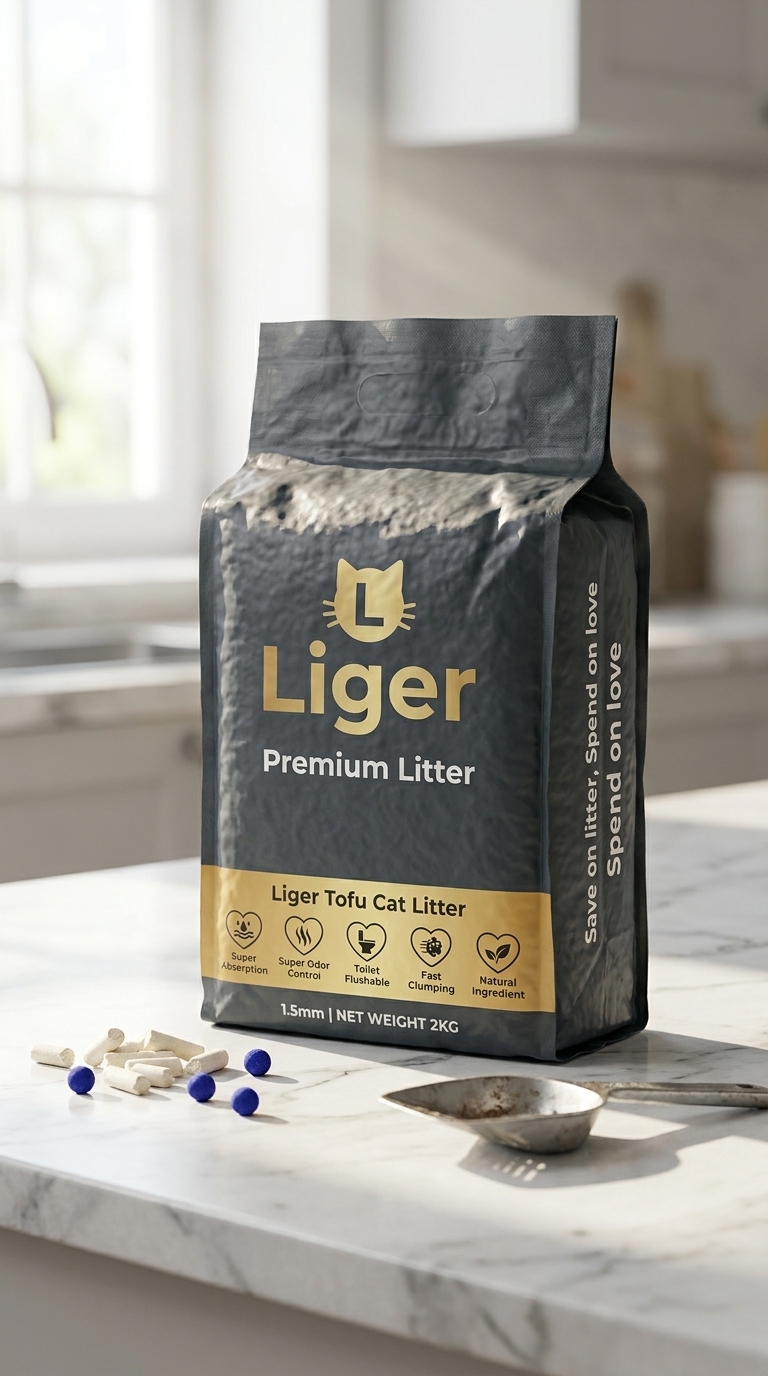
Let's start with the price tag, then immediately move past it. As of May 2026, Liger tofu cat litter is sold in four pack sizes on liger.my, all with free shipping to West Malaysia (Semenanjung):
| Pack | Total weight | Total price | Per kg |
|---|---|---|---|
| 1 pack | 2 kg | RM21.90 | RM10.95 |
| 3 packs | 6 kg | RM53.90 | RM8.98 |
| 5 packs | 10 kg | RM89.00 | RM8.90 |
| 10 packs | 20 kg | RM169.00 | RM8.45 |
That headline number — the 10-pack at RM8.45/kg is 23% cheaper than the single pack at RM10.95/kg — is true, but it's not very useful. Nobody pays per kilogram. You pay per month, per scoop, per cleanup. So the more honest question is: how many days does each bag last in a real Malaysian home? Answering that needs one missing number: how much litter a single adult cat actually goes through.
First: how long does one bag really last?
This is where most cost guides go off the rails. They quote either a wildly optimistic "one bag lasts 6 weeks!" (marketing) or a paranoid "better top up every 3 days" (over-cautious owner forums). The truth lives in the veterinary literature.
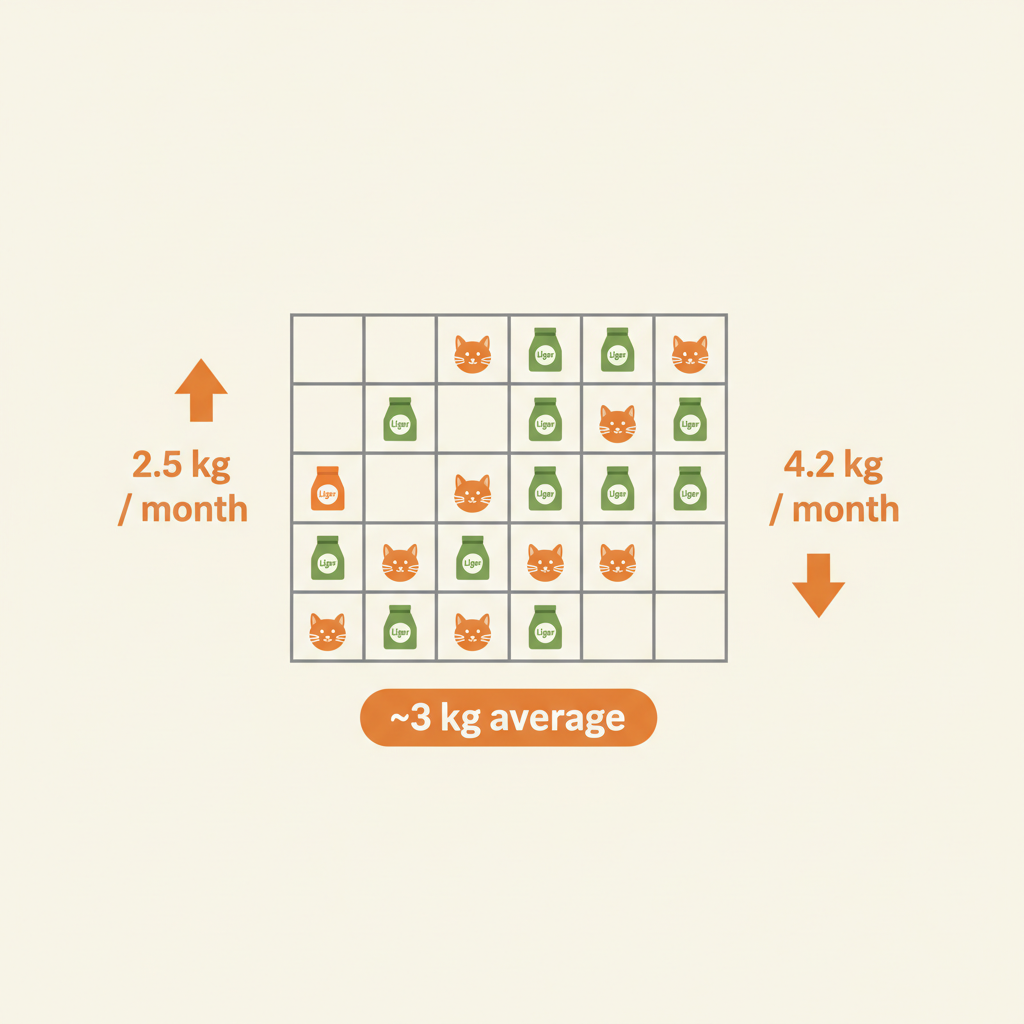
For a single, healthy adult cat following standard AAFP litter-box guidelines — minimum 1.25-inch depth, daily scooping, and a full change every 2–4 weeks — monthly tofu litter consumption lands in a tight range: 2.5 kg to 4.2 kg per month. Premium bag-size data from international brands like Tuft + Paw confirms the same ceiling (a 4.2 kg bag marketed as one month's supply). The midpoint most Malaysian owners actually report on Shopee and Lazada reviews is ~3 kg/month per cat.
What pushes you toward the high end (4+ kg/month)
- Wet food diets. A WALTHAM Centre for Pet Nutrition study found cats fed 73.3% moisture food produce 86.7 ml of urine daily on average — and a separate study showed switching from dry to fully wet food raises total urine volume by 36%. More urine = more clumps = more litter scooped out.
- Larger breeds. Maine Coons, large domestic shorthairs, and any cat over 5 kg dig deeper, urinate more, and need a deeper box. Industry standard is 2–3 inches of depth for clumping litters, which means a bigger initial fill plus larger top-offs.
- Multi-box households. The ASPCA's n+1 rule — one box per cat plus one extra — means even a single-cat home arguably needs 2 boxes. Two boxes filled to the same depth simply consumes more pellets than one.
- Senior cats and kittens. Older cats often urinate more frequently due to kidney function changes; kittens play in the litter and scatter it.
What pushes you toward the low end (2.5 kg/month)
- Adult cat (1–7 years) on a dry-only diet
- Scooping every single day without skipping
- Standard-sized box (no oversized hooded enclosure that requires deeper fill)
- Using high-clumping tofu litter (not budget pellets that crumble on scoop)
For the rest of this article, we'll use 3 kg/month as the working midpoint, and show the 2.5 kg / 4.2 kg edges in the math so you can place yourself on the spectrum.
Quick sanity check before continuing — if you want a more personalised estimate that factors in your cat's diet and box setup, run it through our litter calculator.
The honest math: cost-per-day for every Liger pack size
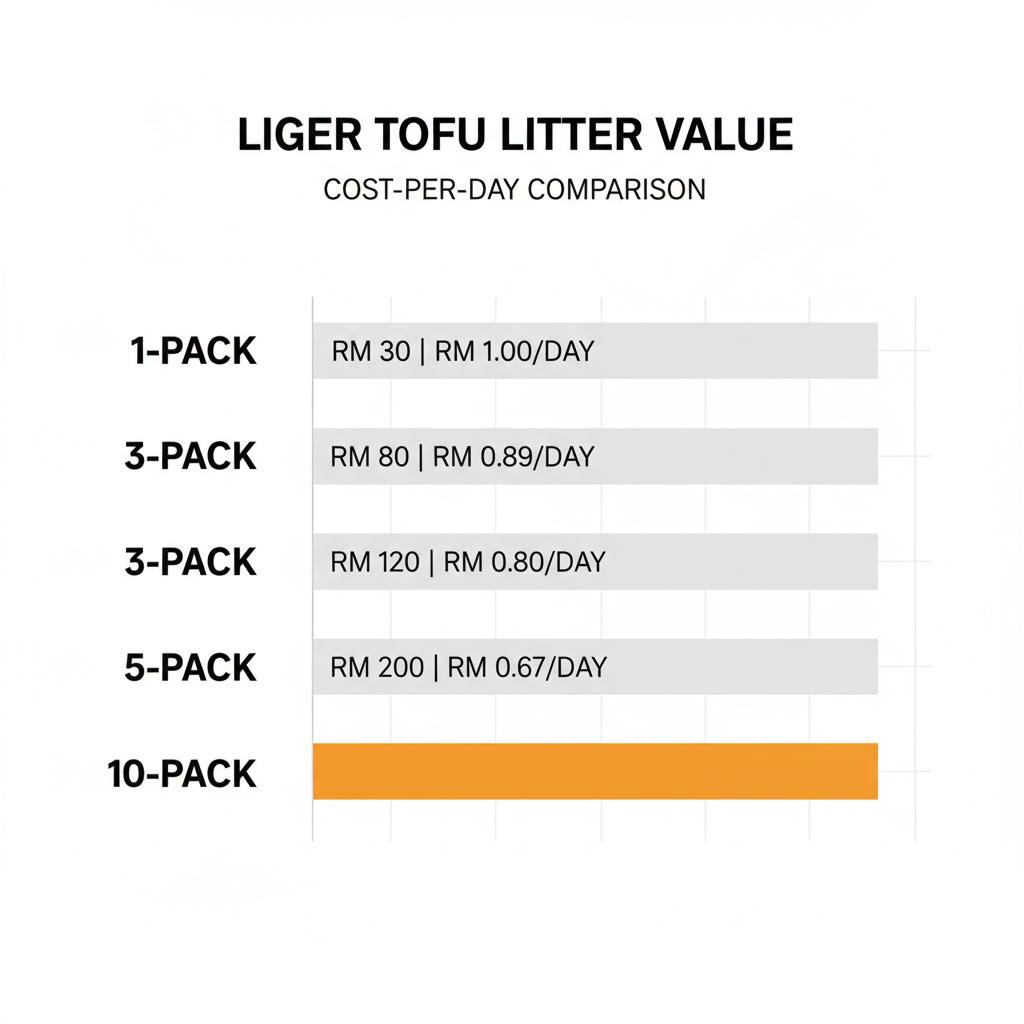
Now plug Liger's prices into real usage. The formula is simple:
Cost-per-day = (Pack price) ÷ (Pack weight in kg ÷ Monthly usage in kg × 30 days)
Or more practically: days-the-bag-lasts = (Pack kg ÷ 3 kg/month × 30), then divide pack price by that.
Single adult cat (3 kg/month midpoint)
| Pack | Days it lasts | Cost-per-day | Cost-per-month |
|---|---|---|---|
| 1 pack (2 kg) — RM21.90 | ~20 days | RM1.10 | RM32.85 |
| 3 packs (6 kg) — RM53.90 | ~60 days | RM0.90 | RM26.95 |
| 5 packs (10 kg) — RM89 | ~100 days | RM0.89 | RM26.70 |
| 10 packs (20 kg) — RM169 | ~200 days (~6.7 months) | RM0.85 | RM25.35 |
The single pack is the most expensive way to keep your cat in clean litter — about RM1.10/day, or roughly RM394/year. The 10-pack drops you to RM0.85/day, or RM310/year. That's RM84/year saved by buying once every 6–7 months instead of every 20 days. Across an average 12–15 year cat lifespan, that's RM1,000+ in real money.
The honest range (low-usage to high-usage cats)
| Pack | Low (2.5 kg/mo) | Mid (3 kg/mo) | High (4.2 kg/mo) |
|---|---|---|---|
| 1 pack — RM21.90 | RM0.91/day | RM1.10/day | RM1.53/day |
| 3 packs — RM53.90 | RM0.75/day | RM0.90/day | RM1.26/day |
| 5 packs — RM89 | RM0.74/day | RM0.89/day | RM1.25/day |
| 10 packs — RM169 | RM0.70/day | RM0.85/day | RM1.18/day |
Even at the high end (a Maine Coon eating mostly wet food in a multi-box setup), the 10-pack keeps you under RM1.20/day. That's less than a packet of nasi lemak.
Multi-cat households
For two cats, multiply monthly usage by ~1.9 (slightly less than 2× because shared boxes get scooped at the same time). Three cats = ~2.7×. With the n+1 rule applied to multi-cat litter setups, a two-cat household using 5.7 kg/month makes the 10-pack last ~105 days — RM1.61/day total, or RM0.80/cat/day.
Why cost-per-day beats cost-per-kg (and how it changes your decision)
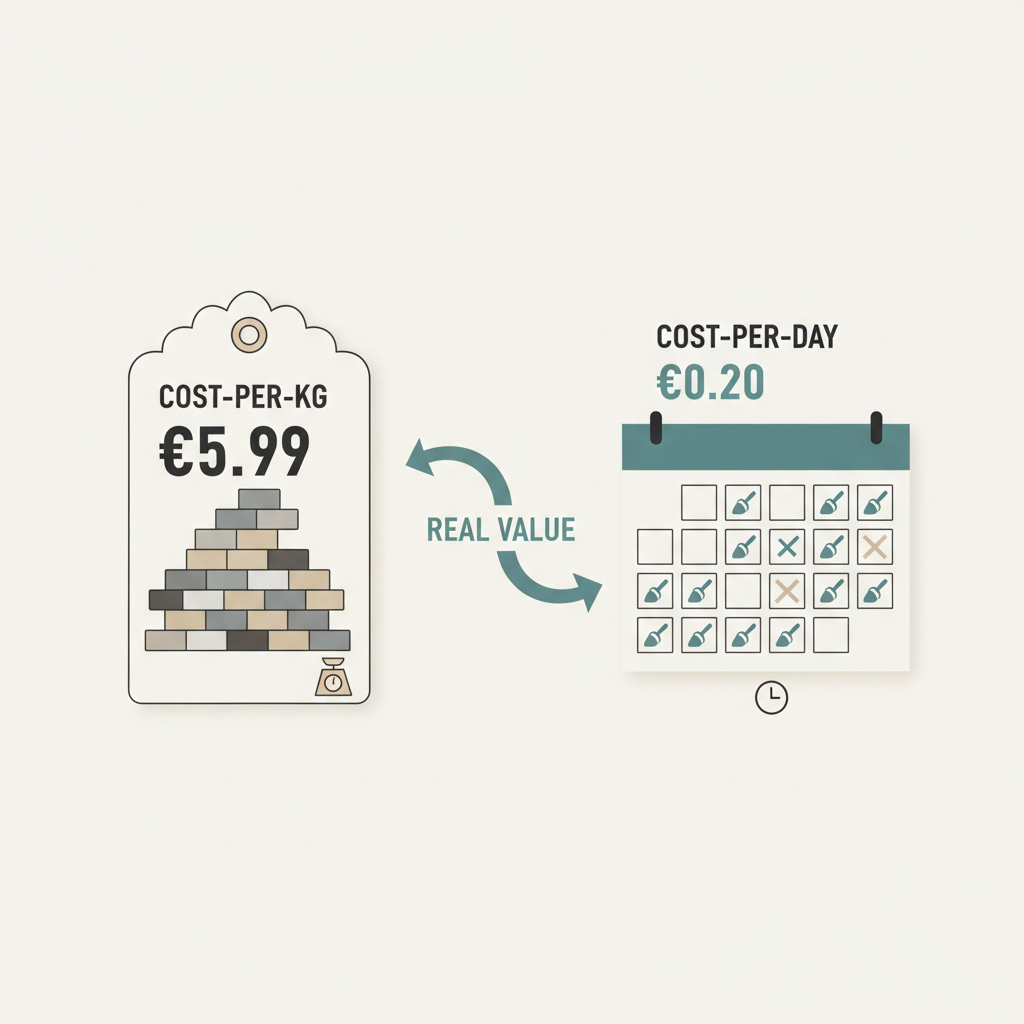
If we already have a cheapest cat litter per kg comparison, why does cost-per-day matter at all? Because cost-per-kg silently assumes every kilo gets used. In reality, a percentage of every bag gets wasted — and that percentage is wildly different between products.
Three hidden costs that cost-per-kg ignores
- Clumping efficiency. Weak clumping means clumps break apart when you scoop, contaminating clean pellets around them. You end up tossing 30–40% of "clean" litter alongside the soiled portion. With strong-clumping tofu, that drops below 10%.
- Forced full-box changes. Bentonite litters tend to produce more dust and absorb odor inconsistently due to clay composition, often forcing weekly full-box dumps. Properly maintained tofu litter only needs a full change every 2–4 weeks. Skip three forced changes a month and you've effectively gained 30% more usage from the same bag.
- Spillage and tracking. Lightweight crystal litter and certain pine pellets track aggressively, meaning litter ends up vacuumed out of the box and into the trash. Tofu's denser cylindrical pellets track less, so more of what you paid for stays in the box.
This is why a litter priced at RM10.95/kg can outperform a RM3/kg clay litter on a cost-per-day basis: you're consuming fewer kilograms per month because less of the bag is wasted. (For a deep technical dive into clay versus tofu performance differences, see the research from peer-reviewed feline husbandry studies on PubMed.)
The bulk question: should you buy 10 packs at once?
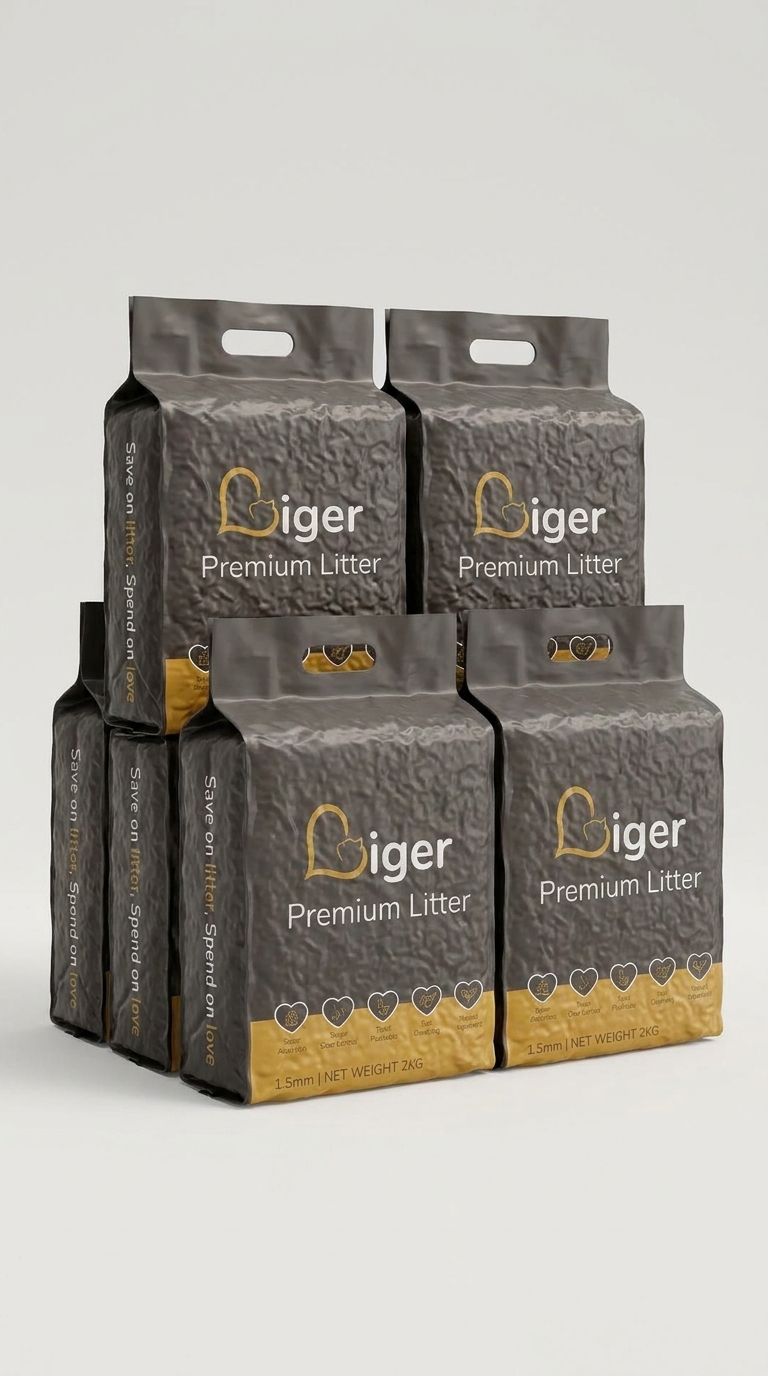
The math says "obviously yes — RM0.25/day savings adds up." Reality says "hold on, where are you putting 20 kg of litter for the next 6 months?" Three things to weigh before clicking the 10-pack:
1. Storage space and the humidity tax
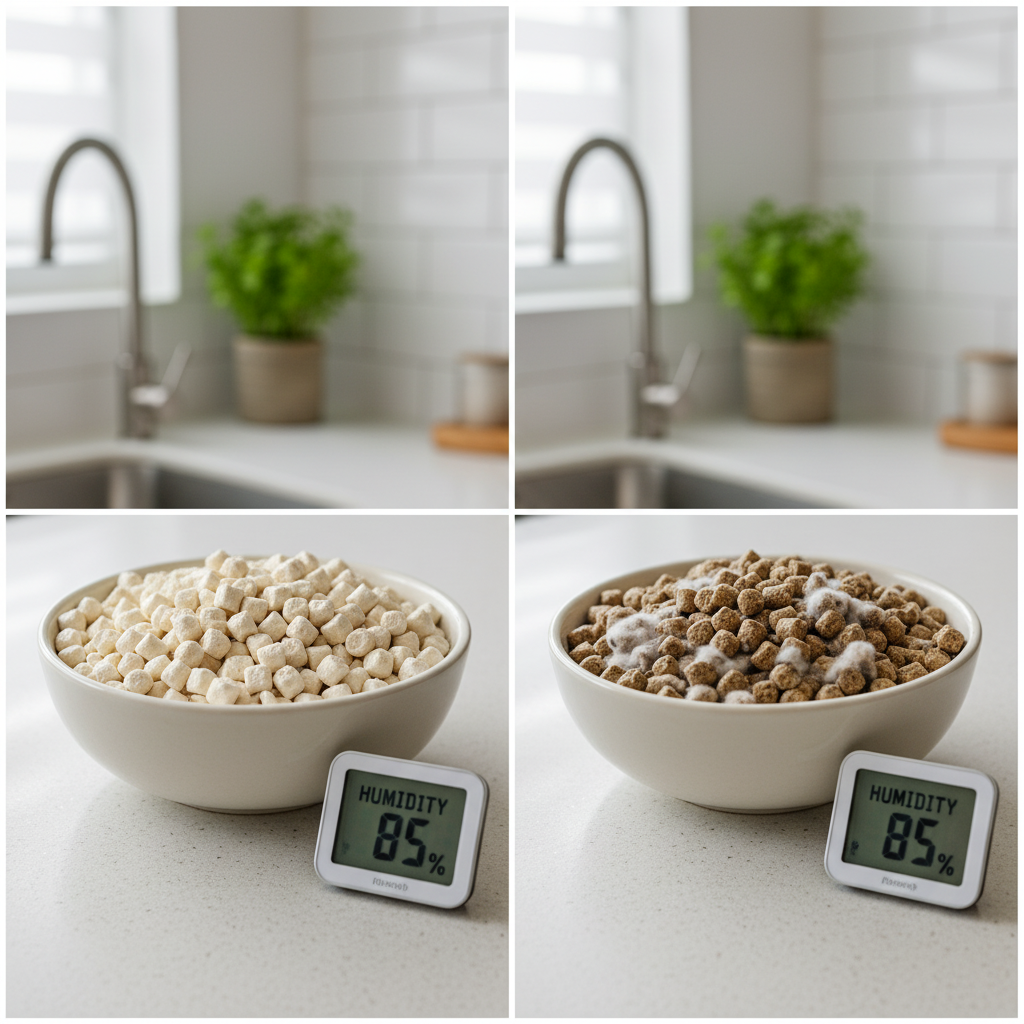
Unopened Liger bags have a ~24-month shelf life. Opened bags in Malaysian humidity? Significantly shorter. The pellets are tofu-based and will absorb ambient moisture from the air, leading to premature softening, weaker clumping, and in worst cases mold. If you can't store the extra bags in a cool, dry, sealed location (not the bathroom, not the balcony, not under the sink), your bulk savings will evaporate alongside the litter's clumping power. See our full guide on storing tofu cat litter in Malaysian humidity for storage rules.
2. Cash flow vs. unit economics
RM169 upfront is real money for many households, even if it saves RM84/year vs. buying one bag at a time. A useful middle ground: the 5-pack at RM89. You capture 95% of the bulk savings (RM0.89/day vs. RM0.85/day) at half the upfront cash outlay, lasting ~3.3 months for a single cat — long enough to feel the savings but short enough that storage doesn't become a problem.
3. Brand commitment risk
If you've never tried Liger, buying 10 packs first is a bet on a brand you haven't validated for your cat. Cats have strong texture preferences — some take to fine-pellet tofu immediately, some hesitate for a week. Start with the 1-pack to test, then commit to the 5 or 10. Our tofu cat litter maintenance guide covers transition tips if your cat is fussy.
The decision matrix
| Your situation | Best pack |
|---|---|
| First time trying Liger | 1 pack (RM21.90) |
| Confirmed your cat likes it, single cat, small apartment | 3 packs (RM53.90) |
| Single or 2 cats, decent storage, moderate cash flow | 5 packs (RM89) |
| Multi-cat household, cool dry storage, want lowest cost-per-day | 10 packs (RM169) |
8 ways to make your tofu litter last longer
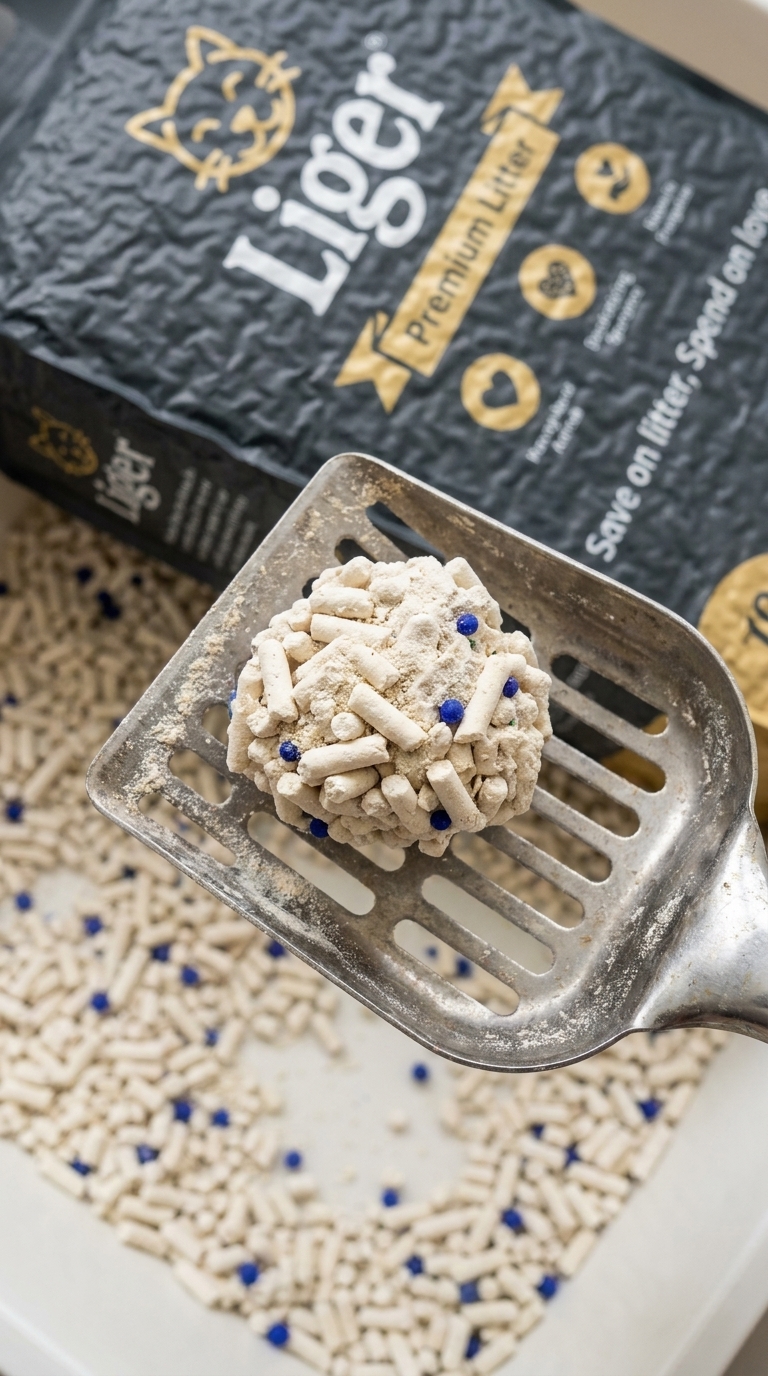
Whether you buy the 1-pack or the 10-pack, these eight tactics shift you toward the low-usage end of the consumption range. Combined, they can turn a 20-day bag into a 28-day bag — that alone pulls cost-per-day from RM1.10 down to ~RM0.78 without changing your purchase.
1. Set the depth at 5–7 cm (and no deeper)
Both AAFP and ASPCA recommend 1.25–2 inches (3–5 cm) minimum; industry consensus for clumping tofu is 5–7 cm. Going deeper feels luxurious but wastes pellets — your cat only digs the top 2–3 cm anyway.
2. Scoop daily, not every 2–3 days
This is the single biggest lever. Scooping daily removes soiled clumps before they break down or get buried, preserving the clean pellets around them. Skipping a day causes clumps to dry harder onto the bottom of the box, fragmenting when you finally scoop and contaminating more clean litter.
3. Use the right scoop
A slotted scoop with 5–7 mm gaps lets clean pellets fall through while catching clumps. Wide-gap scoops let small clumps escape; narrow-gap scoops trap clean pellets that then get thrown away. Cheap dollar-store scoops are usually the wrong gap.
4. Follow the n+1 rule, but don't over-fill each box
Two cats need three boxes — but each box only needs the minimum depth. Three half-filled boxes use less litter than two over-filled boxes and produce better behaviour. Our multi-cat litter guide walks through the placement strategy.
5. Top up — don't replace — for 2–4 weeks
Full box changes are how most owners over-consume. Top up daily after scooping (add a thin layer to replace what you removed) and only do a full dump + wash every 2–4 weeks. Check our tofu litter change frequency schedule for the exact cadence.
6. Store opened bags in airtight containers
The moment a bag is open in Malaysian humidity, the clock starts. Decant into a sealed plastic bin with a tight lid. This protects clumping strength, which is what determines how much clean litter survives each scoop.
7. Address pee problems before blaming the litter
If your cat suddenly starts peeing outside the box or you're refilling abnormally often, run the cat pee solver tool first. Frequent inappropriate urination is often a UTI, stress signal, or box-aversion issue — not a litter quality issue. Solving it stops the budget bleed.
8. Right-size your litter box
A box that's too small forces over-filling; a box too large means you're filling unused real estate. The general rule: the box should be 1.5× the length of your cat (nose to base of tail). Storage solved at the box layer means less waste at the litter layer.
When you're actually wasting litter (red flags)
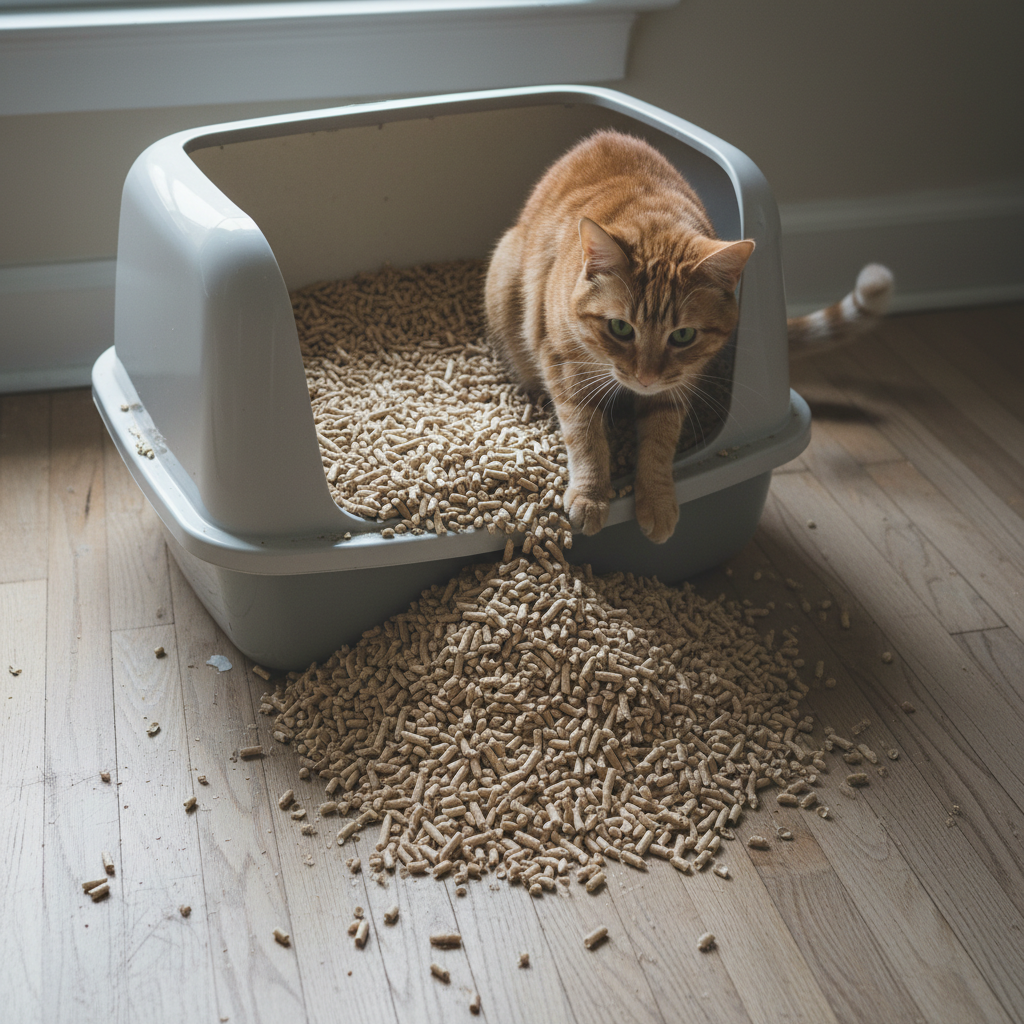
Sometimes the issue isn't the price of the bag — it's invisible waste. Three habits inflate monthly consumption without you noticing:
Changing too often
If you're doing a full dump every week with a single cat, you're consuming roughly 2× the litter you need to. A properly maintained tofu box only needs full change every 2–4 weeks. The smell-test: if your scooped box has no detectable ammonia odor 24 hours post-scoop, the remaining litter is still good. Trust the scoop, not the calendar.
Filling too deep
More than 7 cm of depth is litter you bought for no behavioural benefit. Cats don't dig deeper than 3 cm. Anything below that just sits there absorbing humidity. Cut depth from 9 cm to 6 cm and you've reduced consumption by ~30% overnight.
Using the wrong box size
A small box forces you to over-fill (because the surface area is too small for clumps to form properly) and forces full changes (because waste accumulates faster). Upgrading to a properly sized box is a one-time RM50–RM120 cost that typically pays back within 6 months in reduced litter spend. Check our litter calculator for box-and-litter sizing recommendations matched to your cat's weight.
Frequently asked questions
How many days does one Liger 2 kg pack last?
For a single average adult cat using ~3 kg of litter per month, one 2 kg pack lasts approximately 20 days. The range is 14 days (large cat on wet food) to 24 days (small cat on dry food, frequent scooping). Multi-cat households should divide by the number of cats roughly proportionally.
Is the 10-pack really 23% cheaper per kg?
Yes — the 10-pack at RM169 works out to RM8.45/kg, and the 1-pack at RM21.90 works out to RM10.95/kg. That's a 23% saving per kilogram. On a cost-per-day basis the gap narrows slightly (RM0.85 vs RM1.10, a 23% saving) since both pack sizes share the same usage assumptions.
How does tofu cat litter cost-per-day compare to clay litter in Malaysia?
Bentonite clay litters in Malaysia typically retail at RM2.50–RM8.00/kg, but a single cat consumes 9–18 kg of clay per month vs 2.5–4.2 kg of tofu. Doing the math: clay at RM4/kg × 12 kg/month = RM48/month or RM1.60/day. Tofu (Liger 5-pack) = RM26.70/month or RM0.89/day. Cost-per-day favours tofu by a wide margin once consumption is included.
Does buying 10 packs at once expire before I use them?
Unopened Liger bags have a ~24-month shelf life. A single cat goes through the 10-pack in ~6.7 months, so expiration isn't a concern — humidity damage is the real risk. Store unopened bags in a cool, dry place (not the kitchen, not the bathroom) and only open one bag at a time.
What's the cost-per-day for a household with 3 cats?
Three cats consuming roughly 8 kg/month total. The 10-pack (20 kg) lasts ~75 days, costing RM2.25/day total (RM0.75 per cat per day). At those volumes, the 10-pack is the only sensible choice — single packs would require reordering every 7–8 days.
Why does my litter consumption suddenly jump?
Three usual suspects: (1) you recently switched to wet food and urine volume is up 30%+, (2) a cat is over-urinating due to a urinary tract issue, or (3) you've started over-filling the box. Run the cat pee solver to rule out medical causes first, then audit your fill depth and scoop frequency before assuming the bag itself is the problem.
Can I split the 10-pack with a friend?
Yes — and it's the smartest way to capture the RM8.45/kg price point if you can't store 20 kg yourself. Each individual 2 kg bag in the 10-pack is sealed separately, so splitting 5/5 with another cat parent works perfectly.
The bottom line
The honest cost of keeping a single adult cat in Liger tofu litter — bought as the 10-pack — is roughly RM0.85 a day. Buying one bag at a time costs roughly RM1.10. The difference is RM91/year, and it scales with every cat you add.
But the bigger insight isn't the bulk discount. It's that cost-per-day is the only number that matters when comparing litter options. Cost-per-kg flatters cheap litters that you end up over-consuming, and penalises premium litters that you under-consume. Once you measure the right way, the answer becomes clear: buy the largest pack your storage and cash flow allow, scoop daily, keep the depth modest, and don't replace what doesn't need replacing.
Got a multi-cat household, fussy eater, or unusual usage pattern? Run the numbers through our litter calculator for a personalised cost-per-day specific to your setup.