If you have ever stood in front of your cat's bowl wondering whether you are feeding too much, too little, or just guessing like the rest of us, you are in good company. In our house we have four cats with four completely different appetites, and figuring out the right portion for each one took us years of trial, error, and one slightly chubby tabby. This guide is the feeding chart we wish someone had handed us on day one.
Here is the short version: most healthy adult cats need somewhere between 180 and 280 calories a day, and that number changes with weight, age, whether your cat is neutered, and how active they are. The Malaysian climate adds its own twist too, because our heat and humidity quietly change how much water your cat needs from food. Let's break it all down properly.
Why Calories Matter More Than Cup Counts
The biggest feeding mistake we see among Malaysian cat parents is measuring food by "scoops" or "half a cup" without ever checking the calories. The problem is that two different foods can look identical in the bowl but deliver wildly different energy. A heaping scoop of a dense, high-fat kibble can carry nearly double the calories of the same scoop of a light, fibre-heavy formula.
Cats are obligate carnivores, which means their bodies are built to run on animal protein and fat with very little carbohydrate. Research on feline metabolism shows that cats lack salivary amylase and have very low liver glucokinase activity, so they simply are not designed to process the carbohydrate-heavy diets that dominate budget kibble. This matters for portioning because high-carb foods can leave a cat full but still nutritionally short, which sometimes drives over-eating.
So the honest answer to "how much should I feed?" is not a number of scoops. It is a number of calories per day, which you then convert into whatever food you actually feed. If you would rather skip the maths entirely, our free cat food calculator does the whole calculation for you in about ten seconds. But it helps to understand what is happening under the hood, so stick with me.
The Calorie Formula: RER and MER Explained
Veterinary nutritionists work out a cat's daily energy needs in two steps. First the Resting Energy Requirement (RER), which is the calories a cat burns just lying around being a cat, then the Maintenance Energy Requirement (MER), which adjusts that figure for real life.
The standard WSAVA formula for resting energy is:
RER = 70 × (body weight in kg)0.75
That exponent makes it fiddly to do in your head, so for cats in the normal 2 to 6 kg range you can use a close shortcut: RER ≈ (30 × weight in kg) + 70. A 4 kg cat lands at roughly 190 calories of resting energy.
Then you multiply RER by a lifestyle factor to get MER:
| Life stage / status | MER factor | What it means |
|---|---|---|
| Neutered adult, indoor | 1.0 – 1.2 × RER | Most Malaysian condo cats |
| Intact adult, active | 1.4 × RER | Outdoor or kampung cats |
| Overweight, needs to slim | 0.8 × RER | Use ideal weight, not current |
| Kitten (under 4 months) | 2.5 × RER | Rapid growth |
| Kitten (4–12 months) | 2.0 × RER | Slowing growth |
| Pregnant queen | 1.6 × RER | Rising through pregnancy |
| Nursing queen | 2.0 – 6.0 × RER | Depends on litter size |
| Senior (11+ years) | 1.1 – 1.4 × RER | Varies with health |
One detail that trips up so many owners: neutering drops a cat's basal metabolic rate by 25 to 30 percent. That is why so many cats balloon in the year after their op. They keep eating the same amount while burning far less. If your cat was neutered recently, this is your warning to recalculate.
Cat Feeding Chart by Weight (Calories Per Day)
Here is the table most people come looking for. These figures assume a neutered, indoor adult cat at a healthy weight, the most common situation in Malaysian homes. Find your cat's healthy weight and read across.
| Body weight | RER (resting) | Daily calories (neutered indoor) | Active / intact adult |
|---|---|---|---|
| 2.0 kg | ~119 kcal | 120 – 145 kcal | ~165 kcal |
| 2.5 kg | ~139 kcal | 140 – 165 kcal | ~195 kcal |
| 3.0 kg | ~159 kcal | 160 – 190 kcal | ~225 kcal |
| 3.5 kg | ~177 kcal | 180 – 215 kcal | ~250 kcal |
| 4.0 kg | ~195 kcal | 195 – 235 kcal | ~275 kcal |
| 4.5 kg | ~212 kcal | 210 – 255 kcal | ~295 kcal |
| 5.0 kg | ~228 kcal | 230 – 275 kcal | ~320 kcal |
| 6.0 kg | ~261 kcal | 260 – 315 kcal | ~365 kcal |
Notice we keep saying healthy weight, not current weight. If your cat is carrying extra, feed for the weight they should be, not the weight they are. A vet can confirm the target, and our cat weight calculator helps you sanity-check whether your cat is in a healthy range using body condition scoring.
How to read the chart honestly
Charts give you a starting point, not a verdict. The single best feedback loop is your cat's body. Run your hands along their ribs once a week: you should feel the ribs with a light press, the way you feel your knuckles through the back of your hand. If the ribs are buried, dial the calories down 10 percent and check again in two weeks. AAHA weight management guidance stresses this kind of small, slow adjustment over crash dieting, which is genuinely dangerous for cats and can trigger fatty liver disease.
Wet Food vs Dry Food: The Portion Conversion
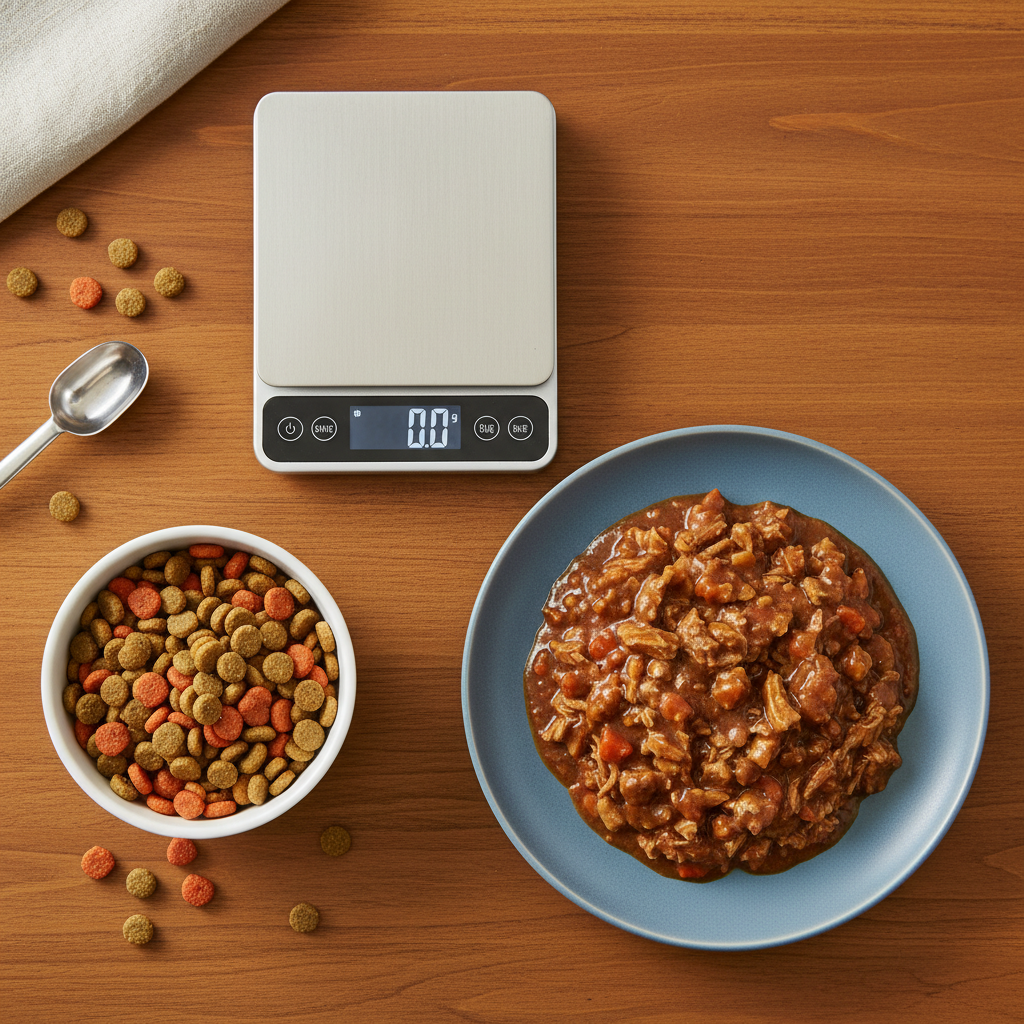
Once you know your cat's daily calories, you convert that into actual food using the calorie density printed on the packaging. Dry food is energy-dense (around 350 to 450 kcal per 100 g), while wet food is mostly water (around 70 to 90 kcal per 100 g). That is why a tiny bowl of kibble and a fat pouch of wet food can deliver the same energy.
| Daily need | Dry only (~400 kcal/100g) | Wet only (~80 kcal/100g) | Half-and-half |
|---|---|---|---|
| 150 kcal | ~38 g dry | ~185 g wet | 19 g dry + 95 g wet |
| 200 kcal | ~50 g dry | ~250 g wet (~2.5 pouches) | 25 g dry + 125 g wet |
| 250 kcal | ~63 g dry | ~310 g wet (~3 pouches) | 31 g dry + 155 g wet |
| 300 kcal | ~75 g dry | ~375 g wet | 38 g dry + 185 g wet |
Always check your own packaging, because these densities are averages. The metabolisable energy figure is usually printed near the guaranteed analysis, and if you are not sure how to find it, our guide on how to read cat food labels in Malaysia walks through exactly where to look and which numbers actually matter.
Why we lean wet in Malaysia's heat
This is where local context really changes the advice. Cats evolved from desert animals with a famously weak thirst drive, so they get a lot of their water from food. Fresh prey is about 70 to 75 percent water, while dry kibble is under 10 percent. In our tropical heat, a dry-only cat is often running on the edge of dehydration without anyone noticing.
That matters for more than comfort. Veterinary research links low hydration and dry-only diets to a higher risk of Feline Lower Urinary Tract Disease, and the problem is amplified in hot climates. We are not saying dry food is bad, our cats eat it. We are saying that in Malaysia, getting some wet food or extra water into the daily portion is good insurance. If you want to check whether your cat is drinking enough, the cat hydration calculator gives you a target based on body weight. And if you have ever been tempted to top up hydration with a saucer of milk, please read our piece on cats and milk first, because most adult cats are lactose intolerant and it does more harm than good.
Feeding by Life Stage: Kitten, Adult, Senior
Age changes the rules more than almost anything else. A four-month-old kitten and an eleven-year-old senior with the same body weight can have completely opposite calorie needs.
| Life stage | Calorie need | Meals per day | Portion approach |
|---|---|---|---|
| Kitten 8–16 weeks | 2.5× RER | 4 small meals | Free-feed or frequent; growth is fast |
| Kitten 4–12 months | 2.0× RER | 3 meals | Begin measuring; taper toward adult |
| Adult 1–7 years | 1.0–1.4× RER | 2 meals | Fixed portions; watch the waistline |
| Senior 7–11 years | 1.1–1.4× RER | 2–3 meals | Monitor for sneaky weight loss |
| Geriatric 11+ years | Varies widely | 3 small meals | Vet-guided; often need MORE |
The counter-intuitive one is the elderly cat. Many people assume old cats need less, but cats over ten often lose their ability to digest fat and protein efficiently and can start dropping weight. Unexplained weight loss with a big appetite is also a classic sign of feline hyperthyroidism, which is common past age ten, so a senior cat losing weight is a vet visit, not a reason to simply pile on more food.
Kittens: little engines
Kittens burn energy at an astonishing rate and have tiny stomachs, which is why they eat little and often. For the first few months, frequent small meals or sensible free-feeding of a growth formula is fine. The measuring discipline kicks in around six months, when growth slows and the risk of overfeeding starts to climb.
Activity Level: Indoor Condo Cat vs Kampung Roamer
Malaysia has two very different feline lifestyles living side by side, and they should not eat the same amount. The pampered KL condo cat who naps eighteen hours a day burns far less than the kampung cat who patrols a whole row of houses and hunts the occasional gecko.
Indoor cats are at real risk here. Research from animal welfare groups links a lack of environmental enrichment in indoor cats to obesity and metabolic syndrome. An indoor cat that just eats and sleeps will gain weight on a portion that would keep an active cat lean. The fix is two-fold: feed toward the lower end of the calorie range, and add movement through play.
Scheduled play also helps with feeding behaviour. Cats are wired to follow a hunt, catch, eat, groom, sleep sequence, so a short wand-toy session before a meal taps into that natural rhythm and can settle a cat that otherwise begs all day. Studies on feeding frequency show that scheduled meals, rather than constant grazing, work better with a cat's biological clock.
How Our Four-Cat Household Actually Does It
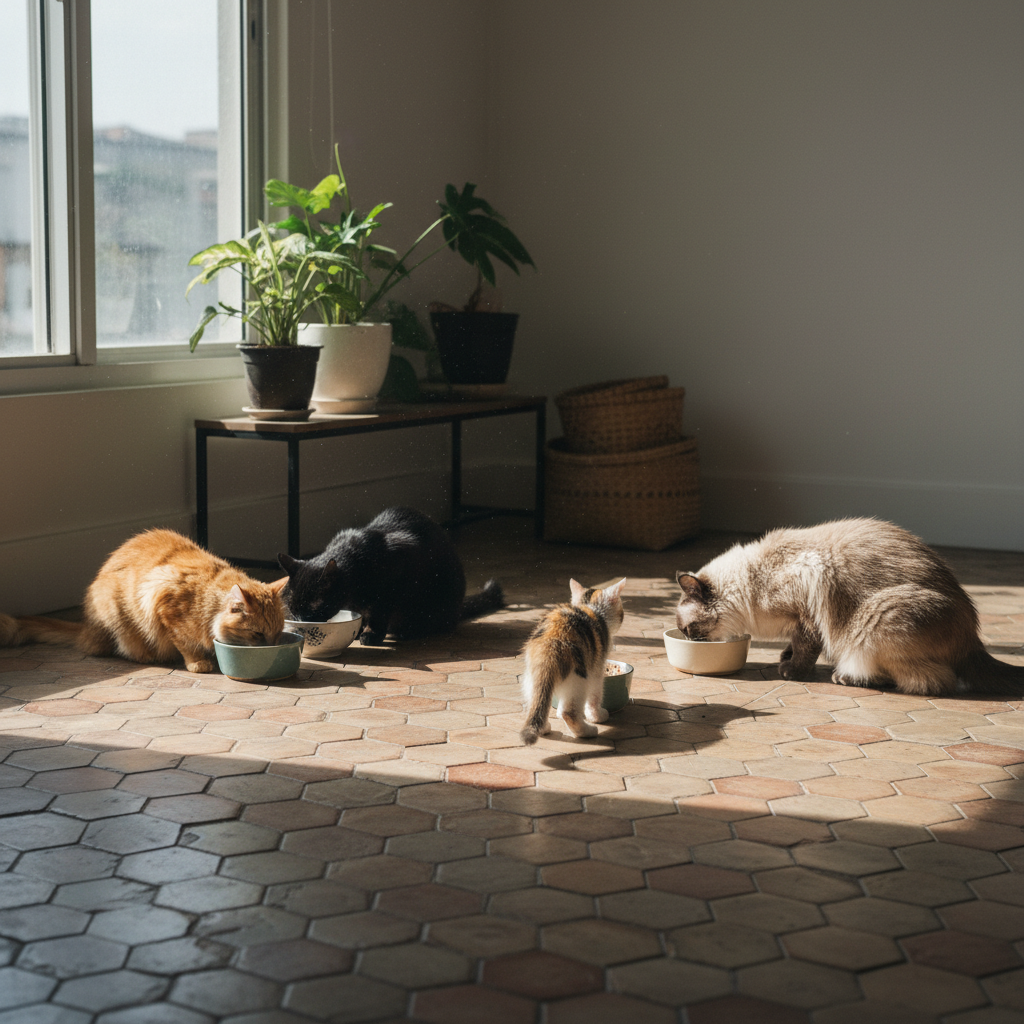
Theory is lovely, but here is how it plays out with real cats. We have Tiger and Lion, two strapping neutered brothers around 5 kg each; Ping'An, a smaller, daintier girl who hovers around 3.2 kg; and Lucky, our senior who needs watching because she has started losing a little weight with age.
If we free-fed one big communal bowl, Tiger would inhale most of it, Lion would get the leftovers, and poor Ping'An would be permanently hungry while Tiger turned into a beach ball. So we feed twice a day in separate spots. The boys get measured portions around 250 kcal each, Ping'An gets about 180 kcal, and Lucky gets slightly more than her size suggests, split into three smaller meals so she actually finishes them. We weigh them monthly on a kitchen scale (cat first, then subtract our own weight if they refuse to sit still) and adjust.
The lesson from four cats: portion individually, not as a household. A single shared bowl almost guarantees one cat is overfed and another underfed. If you have multiple cats with different needs, you may need timed feeders or separate feeding stations, the same logic we cover in our guide to keeping two cats together.
Common Feeding Mistakes Malaysian Cat Parents Make
After years of doing this ourselves and chatting with other cat parents, the same handful of mistakes come up again and again.
- Free-feeding dry food all day. The bowl is always full, the cat grazes out of boredom, and the weight creeps on. Measure the daily amount in the morning and that is the ration.
- Trusting the bag's feeding guide blindly. Pet food packaging guidance is generous, partly because heavier cats eat more bag. Treat it as a maximum, not a target.
- Forgetting treats count. Treats and that bit of chicken from your plate can easily add 20 to 30 percent of daily calories. Keep treats under 10 percent of the total.
- Not recalculating after neutering. That 25 to 30 percent metabolism drop is real. Same food, suddenly too much.
- Crash dieting an overweight cat. Sudden severe restriction can trigger life-threatening fatty liver disease. Aim to lose no more than 1 to 2 percent of body weight per week.
A quick note on ingredients too: high-carbohydrate diets are a poor fit for an obligate carnivore, and carbohydrate levels above 10 percent on a dry-matter basis are particularly risky for diabetic or pre-diabetic cats. If you want to sanity-check what is actually in the bag, our food ingredient checker can flag the things worth a second look. For owners going further down the protein route, our raw feeding safety guide covers how to do it without the food-safety risks that come with our climate.
How Many Meals a Day, and When?
Portion size answers how much; meal scheduling answers how often, and the two work together. For most adult cats, two measured meals a day is the sweet spot, roughly twelve hours apart. It keeps hunger predictable and stops the all-day begging that drives so many of us to over-treat out of guilt.
There is a biological reason scheduled meals beat constant grazing. A cat in the wild eats many tiny meals because it catches many tiny prey, but each catch follows effort. The modern always-full bowl breaks that link between activity and food. Feeding-frequency research suggests scheduled meals align better with a cat's internal clock, partly by harnessing the drowsy, content state cats fall into after eating. In plain terms: a cat that hunts (plays), catches (the meal), and then naps is a calmer, less food-obsessed cat.
Two practical Malaysian tweaks. First, in our heat, wet food left out for hours spoils fast and attracts ants, so portion wet meals to be eaten within thirty to forty minutes and remove the rest. Second, if you work long hours, a timed automatic feeder for dry food keeps portions honest while you are stuck in the jam on the way home, far better than dumping a giant morning serving the cat finishes by noon.
The Cost Side: Feeding Well Without Overspending
Feeding the right amount is also the cheapest thing you can do, because the single biggest waste in cat care is food a cat does not need eaten by a cat who then needs the vet. An overfed cat is an expensive cat: obesity raises the risk of diabetes, joint problems and urinary disease, all of which cost far more than a bag of food.
When you portion by calories, you also stop overbuying. A 4 kg neutered indoor cat eating around 220 kcal a day gets through a predictable, modest amount of food each month, and once you know that number you can buy in the right quantity instead of guessing. The same per-unit logic that makes buying litter in bulk cheaper, the way a calculator shows cost per day, applies to food. Precision saves money at both ends: less wasted food now, fewer vet bills later.
Adjusting Over Time: The Monthly Check-In
No chart survives contact with a real cat, so build a simple monthly habit. On the first weekend of each month, do three quick things: weigh the cat, feel the ribs and waist, and glance at how much food is actually being eaten versus offered.
- Weight steady, ribs easy to feel: you are spot on, change nothing.
- Weight creeping up, ribs getting buried: cut the daily portion by about 10 percent and recheck in two to four weeks.
- Weight dropping, ribs sharp, especially in a senior: do not just feed more, book a vet check, because steady weight loss can flag thyroid, kidney or dental problems.
- Food left in the bowl daily: either the portion is too big or your cat is telling you something about the food or their health.
Body condition scoring is your north star here, not the number on the scale alone, because a muscular cat and a chubby cat can weigh the same. The cat weight calculator walks you through the body condition score so you are judging shape, not just kilograms. This slow, observant approach is exactly what the AAHA recommends over dramatic diet swings.
Frequently Asked Questions
How much should I feed a 4kg cat per day?
A neutered, indoor 4 kg cat at a healthy weight needs roughly 195 to 235 calories a day. That works out to about 50 g of typical dry food, or around 250 g of wet food, or a split of the two. An active or intact 4 kg cat may need closer to 275 calories.
How much wet food does a cat need daily?
If feeding wet food only, a typical adult cat needs around 200 to 250 kcal, which is roughly 2.5 to 3 standard 85 g pouches depending on the brand's calorie density. Always check the kcal figure on your specific pouch, as it varies a lot.
Berapa banyak makanan kucing sehari?
Seekor kucing dewasa yang sihat biasanya memerlukan antara 180 hingga 280 kalori sehari, bergantung pada berat badan, umur dan tahap aktiviti. Gunakan kalkulator makanan kucing kami untuk angka yang tepat berdasarkan berat kucing anda.
Is it better to feed cats once or twice a day?
Twice a day suits most adult cats best, spaced about twelve hours apart. It keeps hunger predictable and supports a healthy routine. Kittens need more frequent meals, while some seniors do better with three smaller servings.
Why is my cat always hungry even after eating?
Common causes include a high-carbohydrate diet that fills the stomach without satisfying nutritional needs, boredom in an under-stimulated indoor cat, or feeding below the cat's actual calorie requirement. Persistent ravenous hunger with weight loss, though, warrants a vet check for conditions like hyperthyroidism or diabetes.
Do indoor cats need less food than outdoor cats?
Yes. An indoor cat that naps most of the day burns noticeably fewer calories than an active outdoor or kampung cat, so it should be fed toward the lower end of the calorie range. Adding play sessions helps an indoor cat stay lean without feeling deprived.
Putting It All Together
Feeding your cat well is not about a magic number, it is about a simple loop: estimate the calories from weight and life stage, convert that into the food you feed, then let your cat's body weight fine-tune it over the following weeks. Start with the chart, weigh monthly, feel for ribs, and adjust gently.
If you would rather not do the arithmetic, plug your cat's weight, age and activity into the cat food calculator and it will hand you a daily calorie target and a wet-versus-dry breakdown on the spot. Pair it with regular weigh-ins and you will be feeding more accurately than most cat owners ever manage, scoops and guesswork included.