Open any cat parent group in Kuala Lumpur and you will find the same complaint at least once a week: "I clean the litter box every day and my condo still smells." The follow-up is almost always the same: it takes 15 minutes, the cat watches them suffer, and by the time they finish, the bathroom smells worse than before.
The strange truth is that daily litter box hygiene is not supposed to take 15 minutes. The AAFP and ISFM Feline Environmental Needs Guidelines are blunt on this point — a single litter box, scooped daily with the right substrate and the right setup, should be a routine measured in minutes, not a chore measured in dread. The reason it ends up being 15 minutes for most condo cat parents is not because they are doing too little. It is because they are fighting their tools, their layout, and their own undefined routine.
This guide is the opposite of a deep-clean schedule. If you want the weekly empty-and-scrub plan, our companion piece on the full litter box cleaning schedule for Malaysian cat parents covers that in detail. What you will get here is the daily 5-minute habit — minute by minute, with the friction points specific to condo life in KL, Penang, and JB called out and solved.
Why Most Cat Parents Spend 15 Minutes When They Could Spend 5

Before we get into the minute-by-minute breakdown, it is worth understanding why daily litter care balloons. After watching dozens of cat parents in Klang Valley condos go through their morning routine — including my own with Tiger and Lion — three friction points show up almost every time.
Friction 1: Bad scoop, bad litter, bad combo. If your litter does not form a firm clump, you spend most of the five minutes trying to herd wet sand out of a tray. The PMC review on feline house-soiling is direct: cleanliness preference is one of the strongest behavioral drivers in cats, and crumbly clumps that leave residue behind are precisely what triggers cats to reject the box. So you scoop, residue stays, smell rises, you scoop again, and now five minutes is fifteen.
Friction 2: No defined sequence. Most people don't have a routine — they have a vague intention to "clean the box." Without a fixed sequence, every step becomes a decision, and decisions cost time. James Clear's habit-formation work and BJ Fogg's Tiny Habits framework both arrive at the same conclusion from different angles: routines that survive are routines that have been pre-decided down to the order of steps. We will use that here.
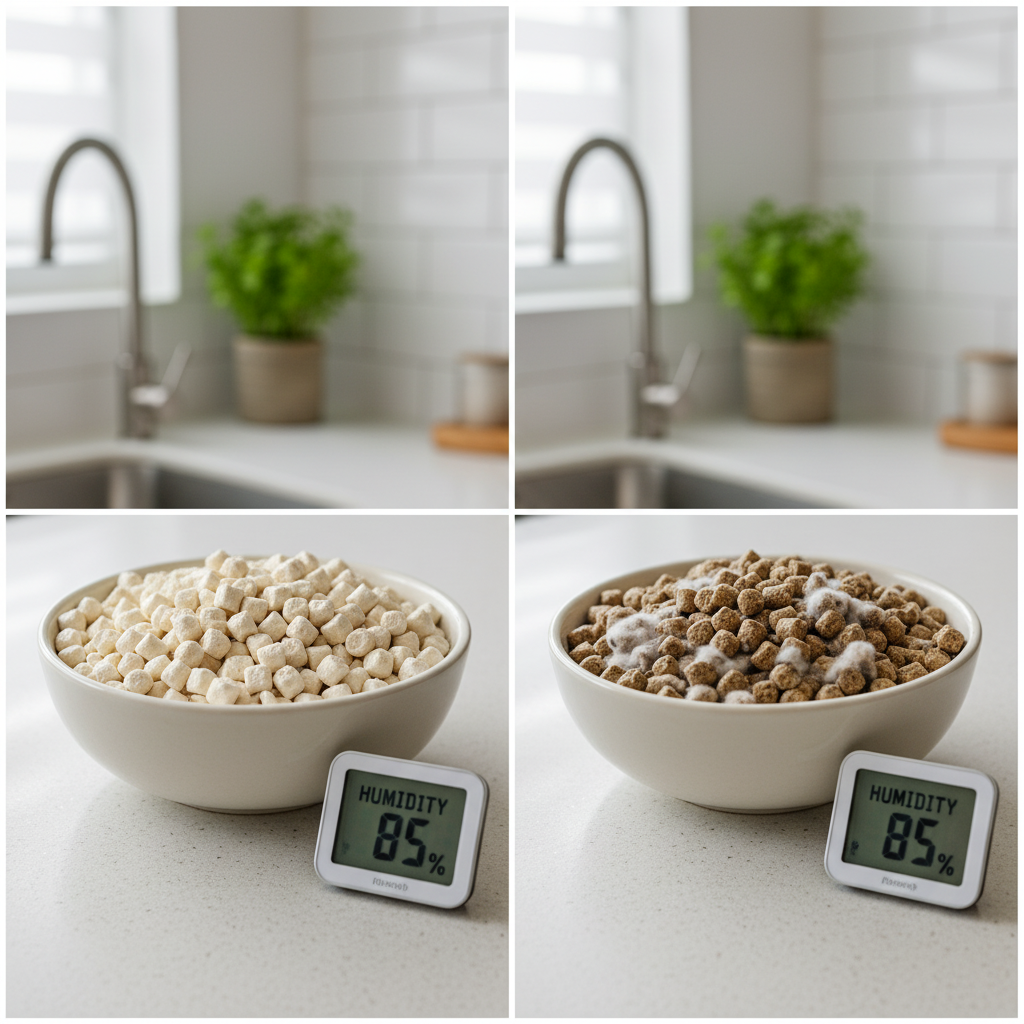
Friction 3: Condo-specific environment. Malaysian condos are humid (average relative humidity in Kuala Lumpur sits around 75 to 85 percent year-round, per MetMalaysia climate data), often poorly ventilated, and the litter box is usually in a bathroom or yard with limited airflow. Daily ammonia from cat urine in that environment does not simply disappear; it concentrates. Ignoring ventilation is the single biggest reason condo cat parents feel like their daily scoop "isn't working."
The 5-Minute Daily Routine: Minute-by-Minute
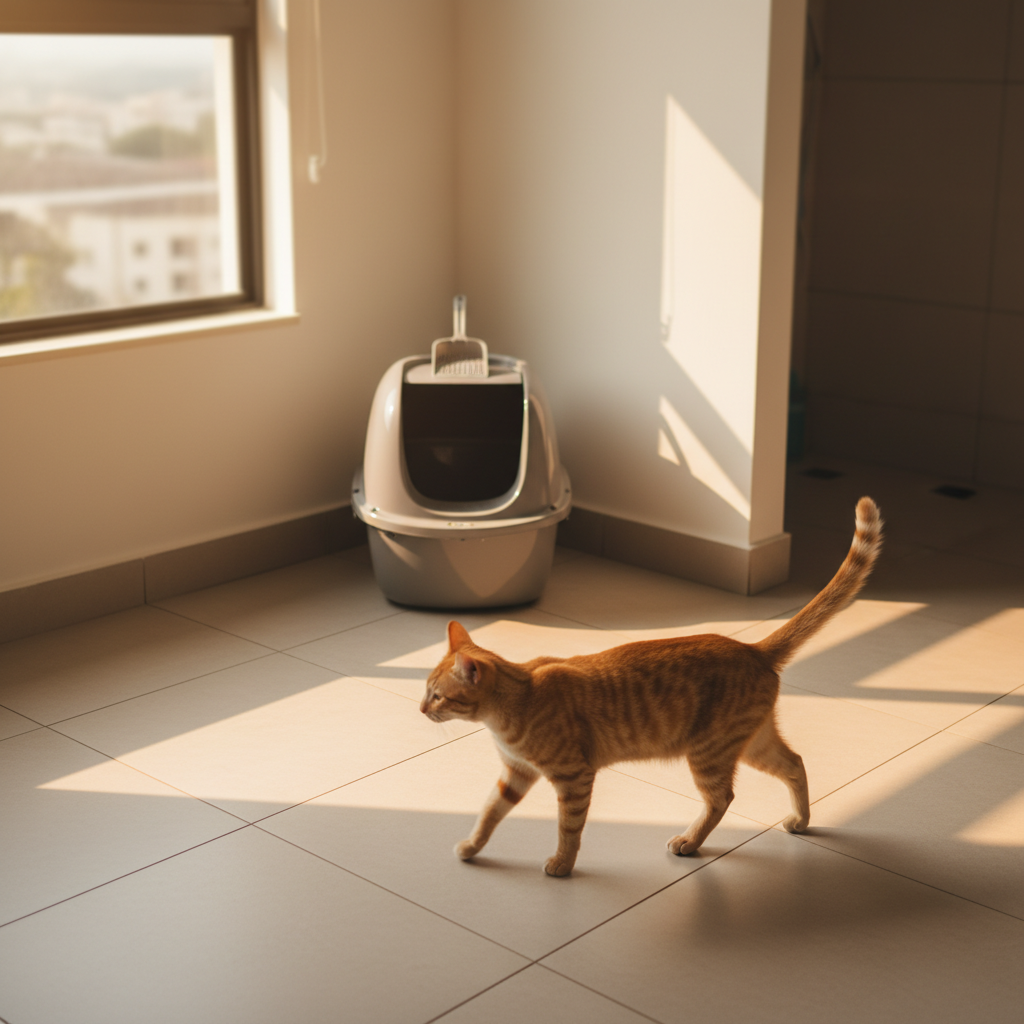
Here is the entire routine. Read it once, then read the breakdown that follows. The whole point is that by minute five, you are walking away from a litter setup that will hold up cleanly until tomorrow morning.
| Minute | What you do | Why it matters |
|---|---|---|
| 1 | Visual sweep of all litter boxes | Catches health red flags before they become emergencies |
| 2-3 | Scoop clumps and solids from every box | The hygiene core — removes the source of smell |
| 4 | Top up to the correct depth | Maintains absorption capacity for the next 24 hours |
| 5 | Quick ventilation + surface wipe around the box | Solves the humidity-concentration problem unique to condos |
Minute 1: The Visual Sweep
Before you scoop, look. This is the step almost everyone skips, and it is the step your future vet bills depend on. The Cornell Feline Health Center guidance on house-soiling and VCA Hospitals' overview of feline lower urinary tract disease both emphasize that urine output changes — bigger clumps, smaller clumps, more frequent small attempts, blood-tinted urine, hard pellets of stool instead of formed ones — are often the first sign of urinary or GI problems. Catching these on day one rather than day five is the difference between a RM150 vet visit and a RM2,000 emergency.
Train your eye to scan four things, in this order:
- Clump size and number. Two to four pee clumps per cat per day is a healthy baseline for an indoor adult cat. If you have not used the Liger litter calculator to set your baseline, do it once so you know what "normal" looks like for your household.
- Clump appearance. Firm and liftable means hydration is adequate. Tiny scattered pellets or hard "marble" stools can signal dehydration, common in air-conditioned condos.
- Color. Healthy cat urine is pale yellow when fresh. Dark concentrated yellow, pinkish, or any visible blood is a same-day vet question, not a wait-and-see one. If you see it and aren't sure what it means, the cat pee solver tool walks you through the most common patterns.
- Litter scatter pattern. A lot of overshooting the tray edge can mean the box is too small, in the wrong spot, or that something is bothering your cat about it. The companion guide on where to put a litter box in a Malaysian condo covers placement fixes.
This entire sweep takes about 60 seconds once you are practiced. Tiger, my orange tabby, has tipped me off to two early urinary issues this way over three years — both caught early enough that we avoided emergencies.
Minute 2-3: The Scoop
This is the hygiene core. Done right, it takes 90 to 120 seconds across all your boxes. Done wrong, this is where the entire routine collapses into 10 minutes of frustration.
Technique that saves time:
- Scoop at a 30 to 45 degree angle, not straight down. A flat-angle entry lets the litter sift through the scoop slots while the firm clump stays on top. Straight down lifts everything and forces you to shake the scoop, which spreads dust.
- Lift, gentle shake, dispose — one motion. Do not scoop into a pile and then re-scoop the pile. Each clump goes from box to disposal bag in a single arc.
- Get the corners. Cats often pee against the back wall of the tray. Run the scoop along all four edges, not just the middle.
- Dispose into a sealed bin or knotted bag immediately. An open scoop pail in a humid condo is just an aerosol of smell. The Indah Water Konsortium guidance is also clear that clumping clay litter should never be flushed — it expands and clogs the line. Tofu pellets that are biodegradable (like Liger) can be flushed in small amounts, but in shared-line condos I still recommend bagging to be safe.
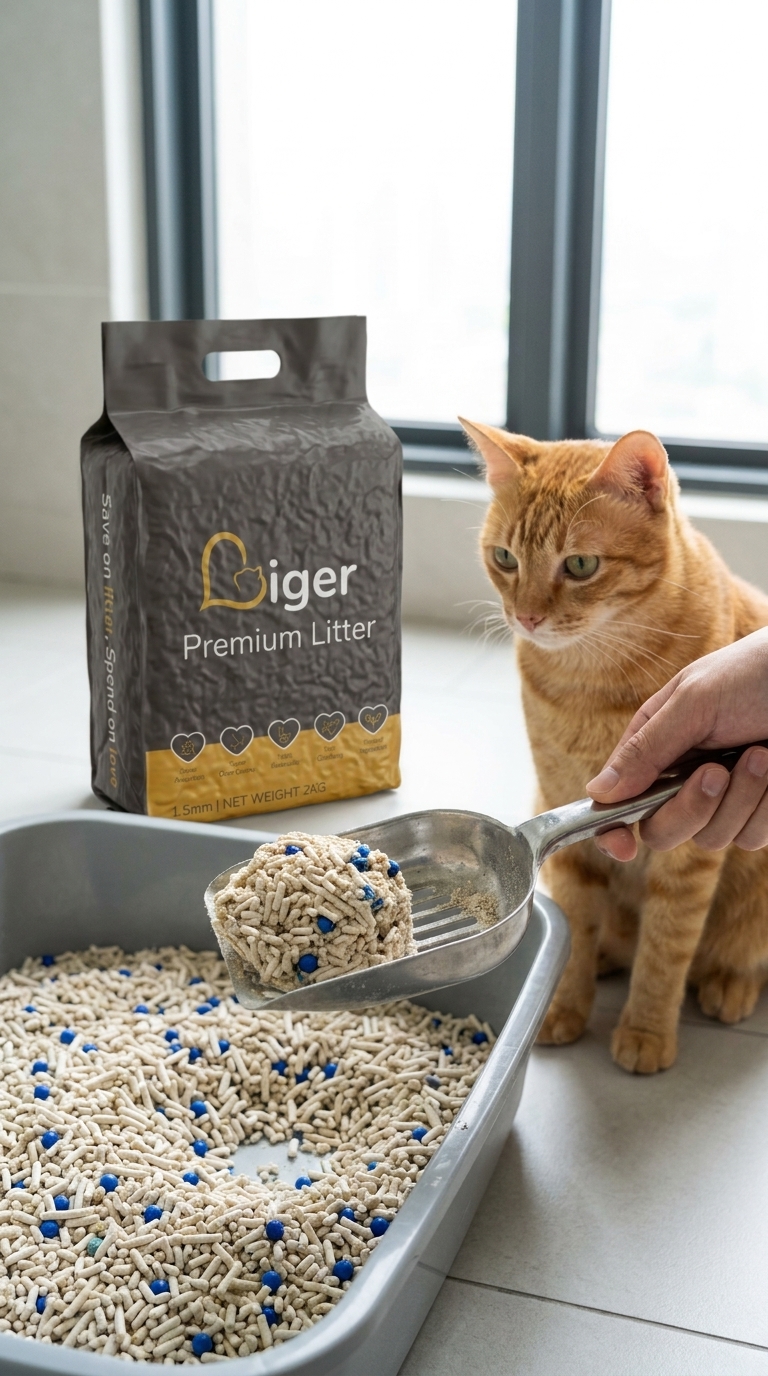
The single biggest accelerator here is the quality of the clump. A litter that forms a tight, dome-shaped clump comes out in one piece. A litter that crumbles forces you to chase fragments around the tray, and that is the difference between a 90-second job and a 4-minute job. We will come back to this in a later section because it is the most underestimated factor in the entire routine.
Minute 4: Top Up
Now refill — but only if it needs it.
The AAHA Behavior Management Guidelines and behavior consultants at the Ohio State Indoor Pet Initiative consistently recommend that depth be enough for cats to dig and bury naturally — typically 5 to 7 centimeters for clumping substrates. Less than that and the litter cannot form proper clumps. More than that and you are wasting litter and creating overspill.
How to top up in under 30 seconds:
- Eyeball the depth. If you can see the bottom of the tray after scooping, you are below baseline.
- Pour from the bag in a slow side-to-side motion, not a single dump in the middle.
- Use the back of the scoop to spread, not your hand.
- Re-check the corners — they tend to be shallowest because cats dig more in the center.
If you find you are topping up more than 200 grams a day per cat, your litter is either being over-dug, scattered too far, or you have a clumping issue. Most healthy adult cat households in a Malaysian condo run between 80 to 130 grams of top-up per cat per day.
Minute 5: Quick Ventilation + Surface Wipe
This is the step that separates a clean-looking routine from one that actually controls smell. In Malaysian condos, humidity traps odor molecules close to the floor. You can scoop perfectly, top up perfectly, and still have a faintly stale bathroom by the afternoon if you do not vent.
The 60-second ventilation move:
- Open the bathroom or yard window for at least one minute. Even a sliver of cross-flow drops ammonia concentration measurably.
- If your unit has no openable window in the litter area, run an exhaust fan for 60 seconds.
- Wipe the floor immediately around the tray with a dry microfiber cloth. Scattered pellets that sit on tile collect humidity and break down into smell sources.
- If it is a haze day or you can't open windows, our deeper guide on fixing litter smell in Malaysian humidity has the closed-window protocol.
This last minute is the one that took me longest to add. I used to skip it and then wonder why everything still smelled by 6 PM. Once it became automatic, the difference in air quality was obvious within a week.
What Cuts the 15 Minutes Down to 5
You can do all five minutes perfectly and still bleed time if your substrate is fighting you. Here is what actually compresses the routine.
Low dust matters more than you think. Dusty litters force you to slow your scoop, pause for the cloud to settle, and wipe surfaces more often. Beyond time cost, the PMC report on bentonite-associated respiratory issues is a reminder that low dust is not a luxury — it is a respiratory health margin for both you and the cat. Soft tofu pellets that don't shatter under cat paws hold their structure and stay out of your lungs.
Firm clumping is the single biggest time multiplier. A clump that holds together comes out in one scoop motion. A clump that breaks into fragments turns minute 2-3 into minute 2-6. This is where Liger's structural advantage shows up in a way that matters daily — the firm-clumping action means the scoop step is genuinely 90 seconds, not four minutes of fragment-hunting.
Soft pellet texture preserves cat acceptance. Cats reject substrates they find uncomfortable underfoot, which means more scatter and more outside-the-box accidents. Soft pellets pass the paw-comfort test that the McGowan et al. elimination ethogram study identified as a major elimination behavior driver.
None of this is a sales pitch to switch your litter. It is simply why the routine works in 5 minutes for some cat parents and stays stuck at 15 for others. If your current substrate is doing those three things — low dust, firm clumps, soft texture — keep it. If it is failing one or more, your routine will keep stretching no matter how disciplined you are.
Habit Stacking: Anchor This to Your Existing Morning Routine
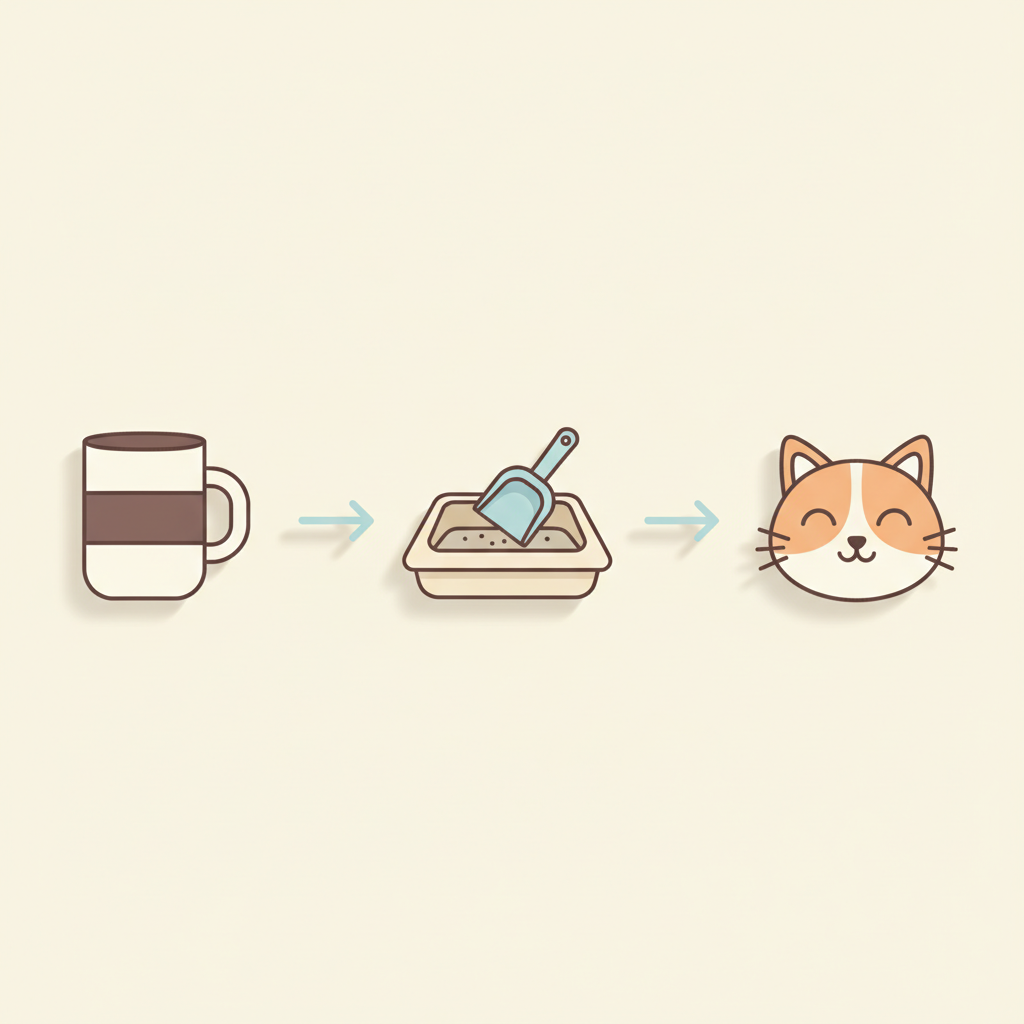
The fastest way to make a 5-minute routine stick is to stop treating it as a new habit and start treating it as an extension of one you already have. This is the habit-stacking principle popularized by James Clear: attach the new behavior to an existing anchor.
For most Malaysian condo cat parents, the anchor options are:
- Right after the morning coffee or kopi is brewed — while it cools, you scoop. The coffee acts as a built-in 5-minute timer.
- Right before leaving for work — last action before you put your shoes on. This guarantees the cat returns to a fresh box during the day.
- Right after the cat's morning feeding — cats often pee within 15 to 30 minutes of eating, so you'll catch the freshest deposit and minimize ammonia development.
Pick one anchor. Do not pick two. The whole point of habit stacking is that one trigger reliably fires one behavior. If you try to attach the routine to multiple triggers, none of them become automatic.
I anchored mine to coffee. Three years in, I do not think about whether to scoop — the smell of kopi tells my hands to pick up the scoop. That is the goal.
Multi-Cat Households: Same 5 Minutes Per Box?
The honest answer is roughly yes, with caveats. The iCatCare guidance on multi-cat households reinforces what most behaviorists agree on: the N+1 rule (one box per cat, plus one extra) is not optional. Two cats need three boxes. Three cats need four.
The 5-minute routine scales like this:
| Cats | Boxes | Realistic time | Notes |
|---|---|---|---|
| 1 | 2 | 5 minutes | The baseline |
| 2 | 3 | 7 minutes | Scoop scales linearly |
| 3 | 4 | 9 minutes | Still daily, no exceptions |
What does not scale linearly is the visual sweep. In a multi-cat home, you need a way to know which cat produced which clump, especially when one is showing early urinary signs. Some cat parents use slight color differences in litter trays (one cat per tray-color), some use placement (one per room), and some pay attention to clump location patterns. The guide on how many litter boxes you need in a Malaysian condo covers the spatial planning side in detail.
Condo-Specific Friction Reducers
Daily routines that work in landed homes often break in condos. Here are the friction reducers I have seen actually work in Klang Valley condo units.
The balcony ventilation hack. If your litter box is anywhere near a balcony, open the balcony door (not just the window) during the scoop. Balcony airflow in high-rise units is significantly stronger than bathroom window airflow.
The 5 PM second-sweep option. If you work from home and your cat is producing a heavy afternoon clump, a 60-second scoop at 5 PM extends freshness into the evening with almost no time cost. This is not a second routine; it is a 60-second insurance check.
Haze day protocol. When windows must stay shut (KL haze season, late dry season, or heavy construction outside), run the bathroom exhaust fan for 5 full minutes after scooping, not 60 seconds. The closed-air environment needs more turnover.
Track your scoop pail. A scoop pail filled with bagged waste sitting in the bathroom for 24 hours becomes its own smell source. Take it to the bin chute or rubbish room immediately after the routine — this is a 30-second walk that saves hours of background odor.
When 5 Minutes Isn't Enough
The daily 5-minute routine is the hygiene floor, not the entire program. There are situations where it will not be sufficient on its own, and pretending otherwise creates a different problem.
- Once a week (or every 10 days), you need a full or partial litter empty-and-refresh. The companion cat litter box cleaning schedule for Malaysia lays out the weekly and monthly cadence.
- If your cat suddenly stops using the box, daily scooping does not fix the underlying issue. Behavior, medical, or environmental causes need investigation — start with our guide on why cats stop using the litter box in Malaysia.
- If smell persists despite a clean routine, the issue is usually humidity or ventilation, not scooping frequency. See the litter smell humidity fix guide.
- For deeper tofu litter care tips, our tofu cat litter maintenance guide covers humidity storage, expiry, and refill technique.
If you find yourself needing 10+ minutes daily, something upstream of the routine is broken — substrate, box count, or placement. Fix that, then return to 5 minutes.
What I Learned After 365 Days of the 5-Minute Routine
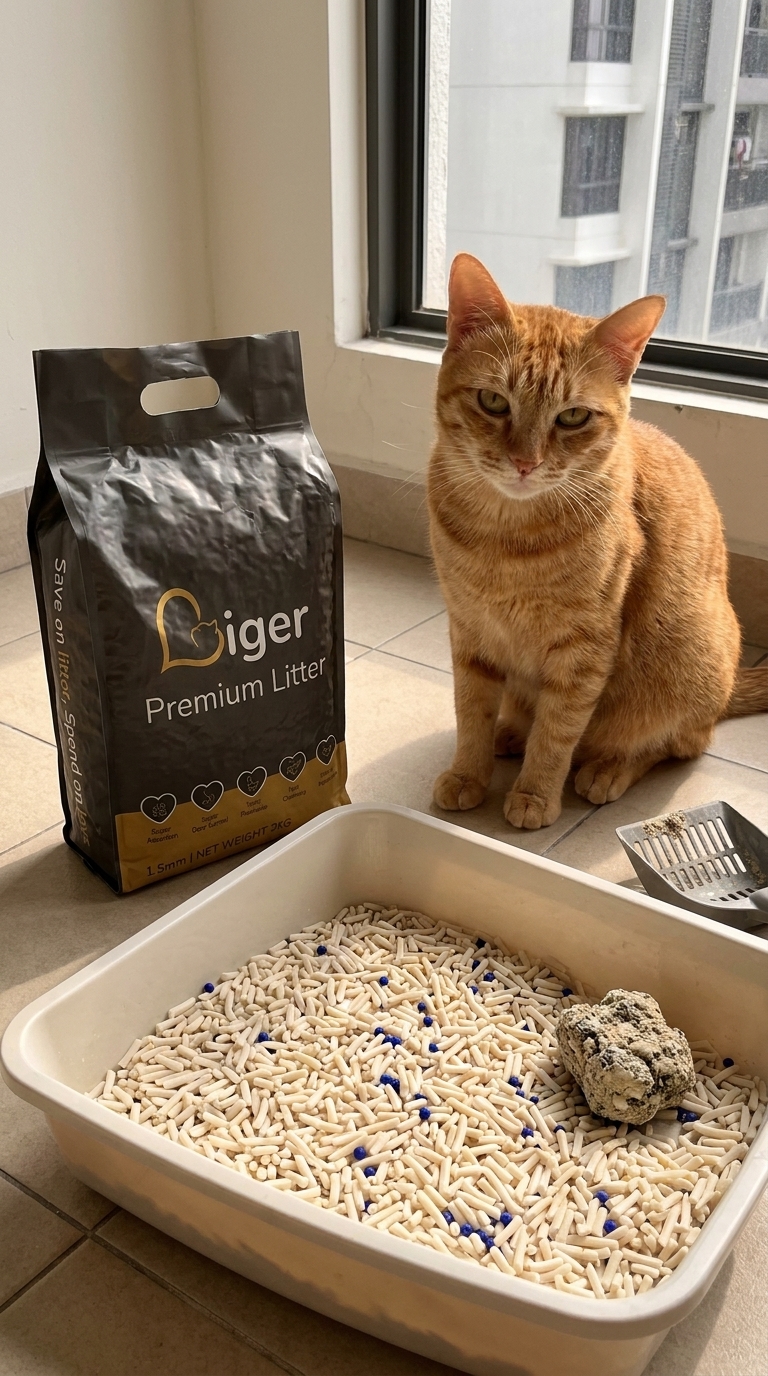
Tiger and Lion have been on this routine for over a year now, with the same setup: two trays, tofu pellets, anchored to morning coffee. Three things genuinely surprised me.
First, the smell control improvement was non-linear. The first week of doing minute 5 (ventilation) properly cut perceived smell more than the first three months of disciplined scooping alone. Air movement is undervalued.
Second, the visual sweep paid for itself within the first 90 days. Lion had a small urinary clump pattern change that I would have written off as random had I not been looking. A vet visit caught the start of a urinary issue. Total cost: under RM200. Without the daily look, that would have been a midnight emergency.
Third, the routine made me a better cat parent in a way I did not expect. Five minutes a day of attention on your cat's elimination is five minutes a day of attention on your cat. They notice. Tiger now waits by the trays in the morning, supervises, and walks me to the kitchen afterward. Routines aren't just about hygiene — they are about relationship.
Tracking the Habit (Without Apps)
You do not need an app for this. The cat parents I know who have stuck with the routine longest use one of three trackers:
- The bag count. One small disposal bag per day. If yesterday's bag is still empty by morning, you skipped.
- The litter weight trend. Mark the side of the bag with a marker line each time you top up. The lines tell you usage patterns.
- The kopi cup. If you finished your coffee and didn't scoop, you broke the chain. Visible behavioral feedback.
None of these require apps, notifications, or willpower. They use objects already in your environment as the tracker. That is the habit-formation principle that matters: environment beats motivation.
FAQs
How many times a day should I scoop my cat's litter box?
Once a day, every day, is the baseline supported by AAFP/ISFM guidelines and aligned with cat behavioral preferences for clean elimination areas. Some multi-cat households or households with cats that produce heavier output benefit from a second 60-second scoop in the evening, but daily is the floor, not the ceiling.
Can I really keep a Malaysian condo smell-free with only 5 minutes a day?
Yes, but only if the 5 minutes includes ventilation. Scooping alone in a humid condo concentrates odor. The minute-5 ventilation step is what makes the routine actually work in a tropical apartment environment.
What if I miss a day?
Skip-day recovery is straightforward: do a slightly longer scoop the next morning (about 8 minutes instead of 5), check the trays for early signs the cat went outside the box, and ventilate twice as long. One missed day is recoverable. Three missed days starts to affect cat behavior and increases the risk of out-of-box elimination.
Do I need to wear gloves and a mask for daily scooping?
Gloves are sensible especially for immunocompromised individuals or during pregnancy due to toxoplasmosis risk (per general veterinary guidance such as CDC toxoplasmosis recommendations). A mask is usually not necessary if your litter is low dust, but it is a low-cost upgrade on haze days.
Is daily scooping enough, or do I still need weekly cleaning?
Daily scooping handles the hygiene floor. You still need a weekly or 10-day full empty and tray wash. The two routines are complementary — see the weekly cleaning schedule guide for that side of the program.
What is the right amount of tofu litter to top up daily?
Most healthy adult cat households run 80 to 130 grams of top-up per cat per day. If you are pouring more than 200 grams per cat daily, something is off — scatter, over-digging, or clumping problems. The Liger litter calculator gives you a personalized baseline based on cat count and box setup.