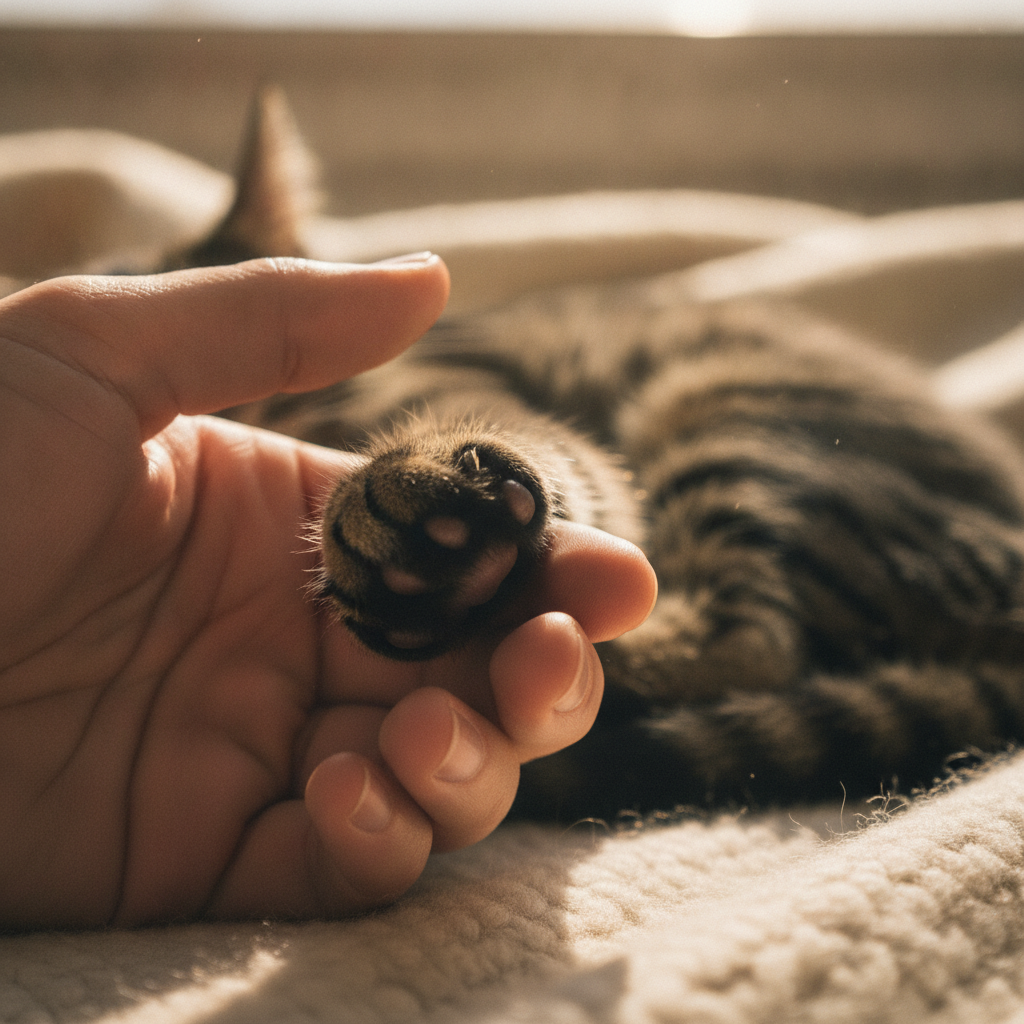
We all love the "toe beans". But those squishy pink pads are doing a lot more than looking cute on your Instagram. They're shock absorbers, temperature sensors, sweat glands and scent markers — and the claws above them are tools your cat needs to balance, stretch, climb and feel secure. Trimming nails is only the start. This guide covers everything else about feline feet: how to check them, the pad and claw problems that creep up (especially in older cats), and why "just declaw it" is one of the worst things you can do to a cat.
If you've already got nail-clipping sorted, good — that's covered separately in our guide to cutting cat nails safely. This is the bigger picture.
Your Cat's Paws Are Working Overtime
Cats are digitigrade — they walk on their toes, not their soles. Every leap onto your fridge lands on those paw pads, which cushion a core of fat and elastic tissue to protect the bones and joints underneath. Each front paw has four toe pads, a large central pad, a higher-up carpal pad that works like a brake, and a dewclaw on the inner side that never touches the ground. The pads are packed with nerve endings (which is why many cats hate having them touched), contain the only sweat glands a cat has, and carry scent glands for marking territory. In short: paws are sensory Swiss Army knives, and they deserve more than an afterthought.
This sensitivity is also why paw handling needs patience. Many cats instinctively guard their feet, so the goal is to make touching them a normal, no-drama part of daily life — a few seconds of gentle pad-holding paired with a treat, built up over weeks. A cat that tolerates paw handling is a cat whose problems you'll actually catch, and whose nail trims won't turn into a wrestling match.
The Weekly Paw Check (Two Minutes, Big Payoff)
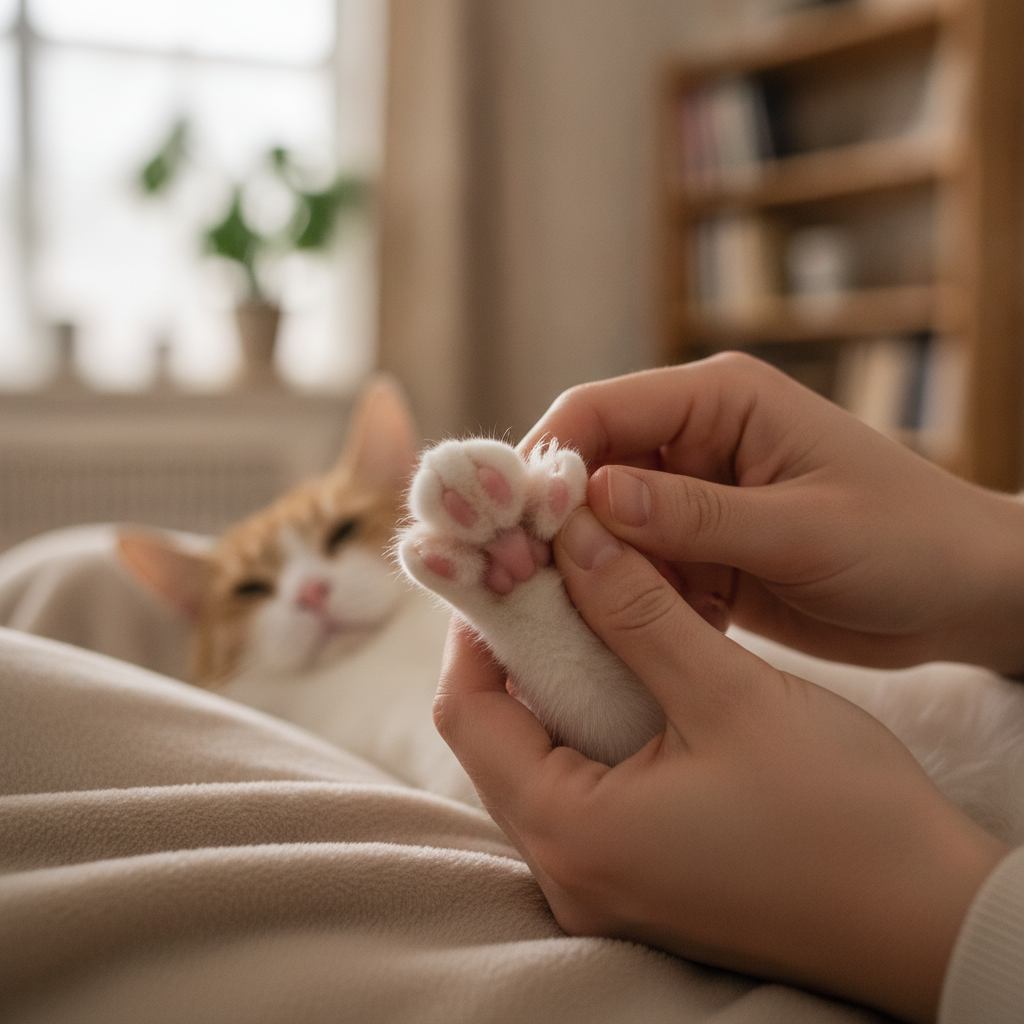
Pick a moment when your cat is relaxed and sleepy. Gently hold each paw and press lightly above a toe to extend the claw. You're looking for:
- On the pads: cuts, cracks, blisters, splinters, thorns, stuck litter, swelling, lumps or odd discoloration.
- On the claws: any growing in a curl toward the pad, splits, breaks, or an outer sheath that isn't shedding.
- Between the toes: redness, ticks, cysts, or smelly discharge.
If your cat pulls away hard, vocalises or tries to bite, that's a pain signal worth noting. Excessive licking or chewing of a paw, limping, or refusing to put weight on a foot all point to a problem. One tip from Cornell veterinarians: if you ever bandage a paw at home, never wrap it tight — you can cut off circulation and cause worse damage than the original injury. When in doubt, leave it open and call the vet.
Paw Pad Problems: Pillow Foot, Cracks and Hot-Floor Burns
A few specific conditions are worth knowing by name. Feline plasma cell pododermatitis — charmingly nicknamed "pillow foot" — is an immune-mediated condition where the pads go soft, spongy and "mushy", often with a purplish tint and fine white scaly lines. PetMD notes that roughly half of cats with pillow foot also test positive for FIV, so it's worth a proper vet diagnosis rather than a guess. Hyperkeratosis is the opposite texture — pads that become thick, hard, dry and cracked, sometimes growing horn-like bits ("horned paws"); the fissures can bleed and get infected.
There's also a very Malaysian hazard: hot surfaces. A car bonnet, a sun-baked balcony tile or hot tarmac can burn paw pads quickly. If you ever let your cat onto a balcony or take it outdoors, check that the surface isn't too hot for your own hand first. Burned pads look red, blistered or peeling and need a vet.
One sign covers most pad trouble: obsessive licking of one foot. Cats lick to soothe pain and irritation, so a paw that gets far more attention than the others usually means something hurts. Per PetMD, sudden or severe paw swelling — especially if it's hot to the touch, has an open wound, or comes with limping — is a red flag that needs same-day veterinary attention. Pale or blue-tinged pads are a circulation emergency.
When Claws Go Wrong: Seniors, Dewclaws and Ingrown Nails
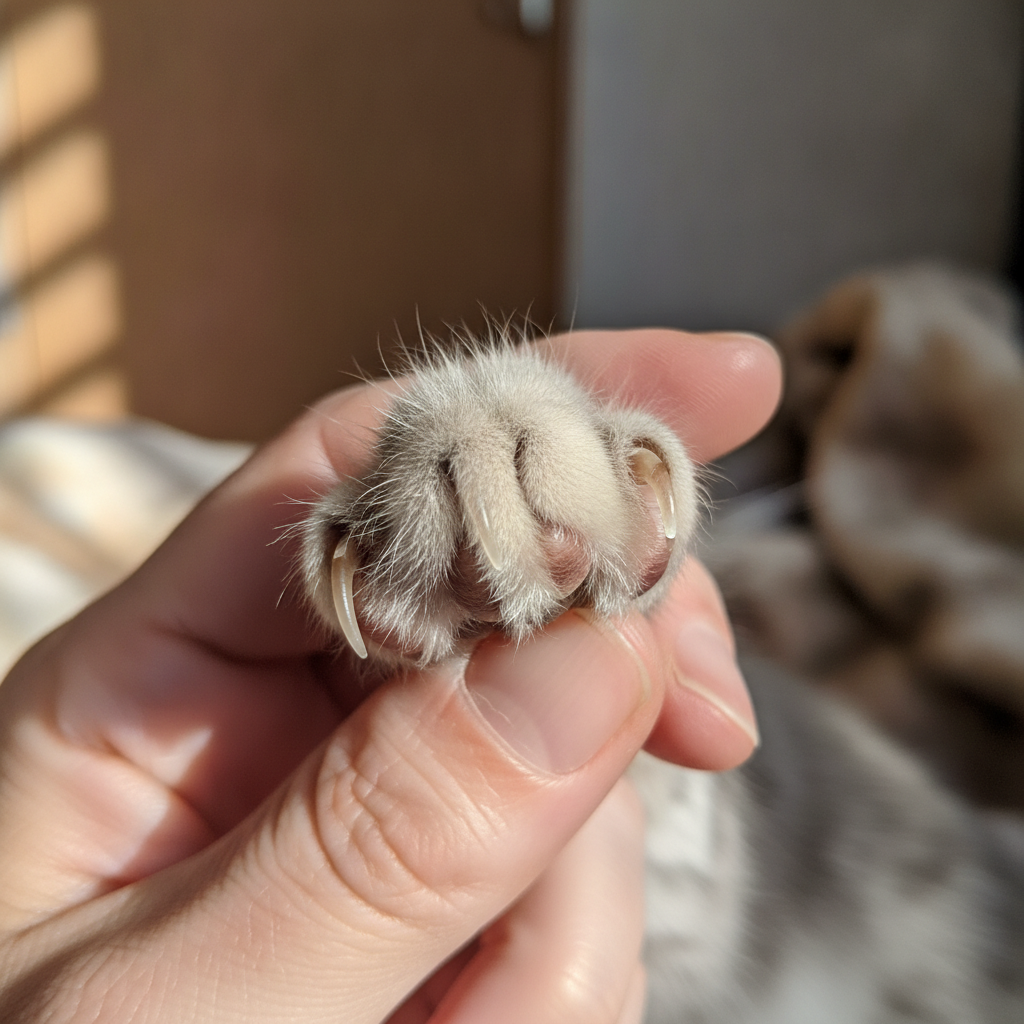
This is where older cats really need you. Senior cats slow down, develop stiff or arthritic joints, and scratch less — so the claw's outer sheath stops shedding and the nail keeps growing. At the same time, geriatric claws get thicker and more brittle. The result is overgrowth that curls around and pierces the paw pad, an agonising ingrown claw. The dewclaws are the worst offenders, because they never wear down on the ground.
An ingrown nail causes limping, swelling, bleeding, a foul smell, and constant licking of the foot, as feline health resources describe. Do not try to dig out an embedded claw yourself — it's extremely painful and you'll make it worse. That's a same-week vet job: they'll trim it, clean the wound and treat any infection. Prevention is simple: trim senior cats' nails every two to four weeks (more often if needed) and check the dewclaws every single time.
A broken or torn claw is also more common than owners expect — a claw snagged on a carpet loop can rip and expose the sensitive, blood-rich "quick". Minor bleeding usually stops with gentle pressure; profuse bleeding that won't stop, or a claw hanging off, needs a vet. And because arthritis makes scratching painful, giving an older cat a low-effort horizontal scratcher (a flat cardboard pad) encourages the natural sheath-shedding that keeps claws healthy without forcing a tall stretch they can't manage.
Many-Toed Cats: Polydactyl Paw Care
Some cats are born with extra toes — "polydactyl" or "Hemingway" cats, the ones with adorable mitten paws. It's a harmless dominant genetic trait, not a disease. But those extra toes come with extra claws that often grow at odd angles and don't wear down naturally, which makes them especially prone to overgrowing and turning ingrown. They also snag on carpet and furniture more easily. If you've got a polydactyl cat, just be more diligent: inspect every toe (it's easy to miss one tucked on the side) and keep all the claws trimmed. International Cat Care discourages deliberately breeding cats for the trait precisely because of these care complications.
Declawing: Why It's an Amputation, Not a Manicure
Let's be blunt, because this matters. Declawing (onychectomy) is not nail removal — it's the surgical amputation of the last bone of every toe, the equivalent of cutting off a human finger at the last knuckle. The harm is well documented. A landmark study in the Journal of the American Veterinary Medical Association found 33% of declawed cats develop at least one behavioural problem — 15.4% develop litter box avoidance (the surgery makes digging painful) and 17.9% bite more, having lost their primary defence. Many suffer chronic pain and altered gait for life.
The profession has shifted hard against it: the American Veterinary Medical Association updated its policy in 2020 to actively discourage elective declawing, and the procedure is banned in over 42 countries including the UK, Australia and most of Europe. The good news is that the humane alternatives genuinely work — behaviour clinics report over 90% success managing scratching without surgery:
- Scratching surfaces: offer sturdy posts (tall enough for a full stretch, ~28–36 inches) in sisal, cardboard and carpet, placed near where your cat already scratches.
- Regular trimming: blunt the tips every 1–2 weeks.
- Soft nail caps: vinyl caps glued over trimmed nails, lasting 4–6 weeks — for indoor cats only.
- Positive reinforcement: reward use of the post; never punish, which just creates stress (a leading cause of scratching in the first place).
What Your Litter Does to Sensitive Paws
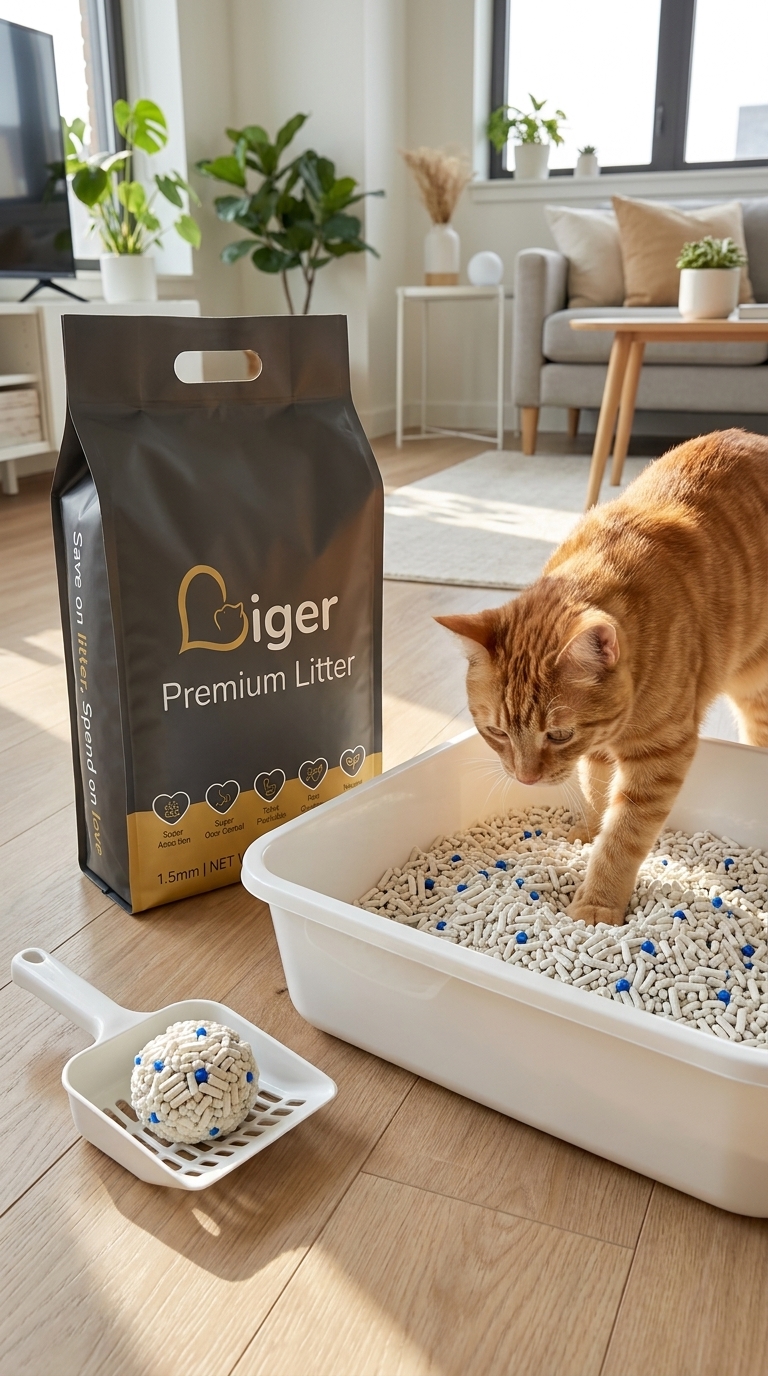
Here's the grooming-and-litter connection most people miss: your cat's bare pads press into litter several times a day. A sharp, gravelly or heavily dusty litter is rough on already-sensitive feet — especially for seniors with arthritis, cats recovering from surgery, or any cat with a pad condition. A soft, low-dust, fine-textured litter is simply kinder underfoot, and the less dust there is, the less irritating powder clings between the toes.
That's a real reason we use Liger Premium Tofu Cat Litter at home — the soy-based pellets are soft and low-dust, gentler on paws than coarse clay or sharp crystal, while still clumping firmly so the box stays clean. Current pricing (as of May 2026): RM21.90 for a 2kg pack, RM53.90 for 3, RM89 for 5, and RM169 for the 10-pack (about RM8.45/kg, free shipping in Peninsular Malaysia). If your cat has tender feet, our guide to the best cat litter for sensitive paws goes deeper, and you can weigh textures with our dust-level comparison tool. For the full grooming picture, head back to our complete home grooming guide.
Healthy paws come down to one cheap habit: a two-minute weekly check. Catch the cracks, the ingrown dewclaw, the stuck splinter early — and keep those toe beans doing their job for years.