Picture the cat on an ancient Egyptian wall painting: lean, alert, large-eared, with a coat that seems to shimmer in the torchlight. Now picture that same cat dismantling your curtain rod at 7 a.m. and stealing a pen off your desk at noon. That is the Abyssinian, and if you are thinking about getting one in Malaysia, this guide is your honest briefing before you sign anything.
The Abyssinian is one of the oldest-looking pedigreed cats in the world and one of the most popular globally, ranking 7th out of 46 breeds registered with the Cat Fanciers' Association (CFA) in 2022. It is also one of the most demanding in terms of stimulation, and it carries a health profile that requires more than casual attention. If you are still choosing between breeds, start with our complete 2026 guide to cat breeds in Malaysia, then return here for the full Abyssinian picture.
Origins: Egypt, India, or Both?
The Abyssinian's name implies an Ethiopian origin, but the true story is more tangled and far more interesting. The most romantic theory traces the breed back to the sacred cats of ancient Egypt. Supporters point to the striking resemblance between modern Abyssinians and the elegant felines carved into Egyptian murals, and to a 1951 examination of 192 cat mummies at the British Museum, which reportedly found nearly all resembled the Abyssinian physique. It is a compelling story and, according to Wikipedia's well-sourced breed entry, a persistent one.
But modern genetics offer a different answer. Research from the University of California, Davis, found that Abyssinians carry genetic markers common to both Southeast Asian and Western cat populations, pointing to an origin along the coast of the Indian Ocean rather than North Africa. The strongest physical evidence sits in a museum in the Netherlands: a taxidermied ticked tabby cat at the Leiden Zoological Museum, purchased between 1834 and 1836, labeled "Patrie, domestica India." That is decades before the breed was formally established in Britain, and it suggests that British merchants brought ticked-coated cats home from Indian or Southeast Asian ports, not from Abyssinia.
The breed's official Western history begins with a cat named Zula, brought to England in 1868 by a British officer after the Anglo-Abyssinian War and exhibited at the Crystal Palace cat show in December 1871. She gave the breed its name, but no records confirm she ever produced kittens that contributed to the foundation stock. The modern Abyssinian is now widely understood to have been developed in Great Britain by crossing imported ticked cats with native British shorthairs to fix a consistent type. Harrison Weir published the first official breed standard in 1889, the CFA recognised it in 1917, and TICA awarded it championship status in 1979.
Athletic Build: More Than Just Decorative
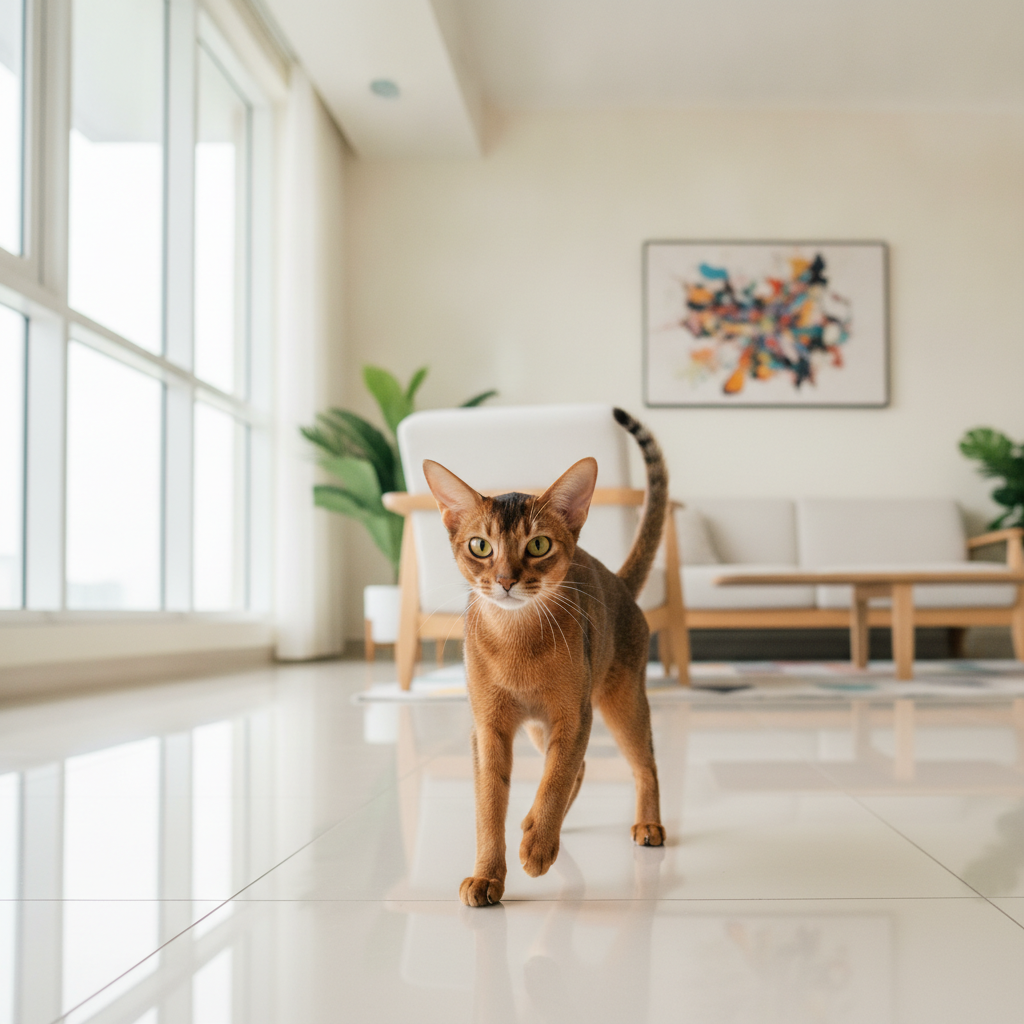
The Abyssinian is a medium-sized cat with no wasted material. The body is medium-long, lithe and muscular, sitting between the compact build of a British Shorthair and the elongated foreign type of a Siamese. It stands with a slight arch in the back that gives the impression of a cat permanently ready to spring, which is accurate, because it usually is. Long, slim legs end in small oval paws that look almost dainty, yet the overall impression is of lean, purposeful power. Males are proportionately larger than females, but neither sex looks heavy.
The head is a gently rounded wedge with large, alert, broad-based ears set as if actively listening to something just out of earshot. The eyes are large, brilliant and almond-shaped in shades of gold or green, and are accentuated by a fine dark line surrounded by a lighter area that gives the cat a permanent "eyeliner" look. It is an elegant face that manages to look simultaneously ancient and wholly alert. Adults typically weigh between 3.5 and 5.5 kg, and the breed's average lifespan is 9 to 15 years with proper care, as noted by PetMD.
A Coat That Shimmers: The Ticked Agouti Explained
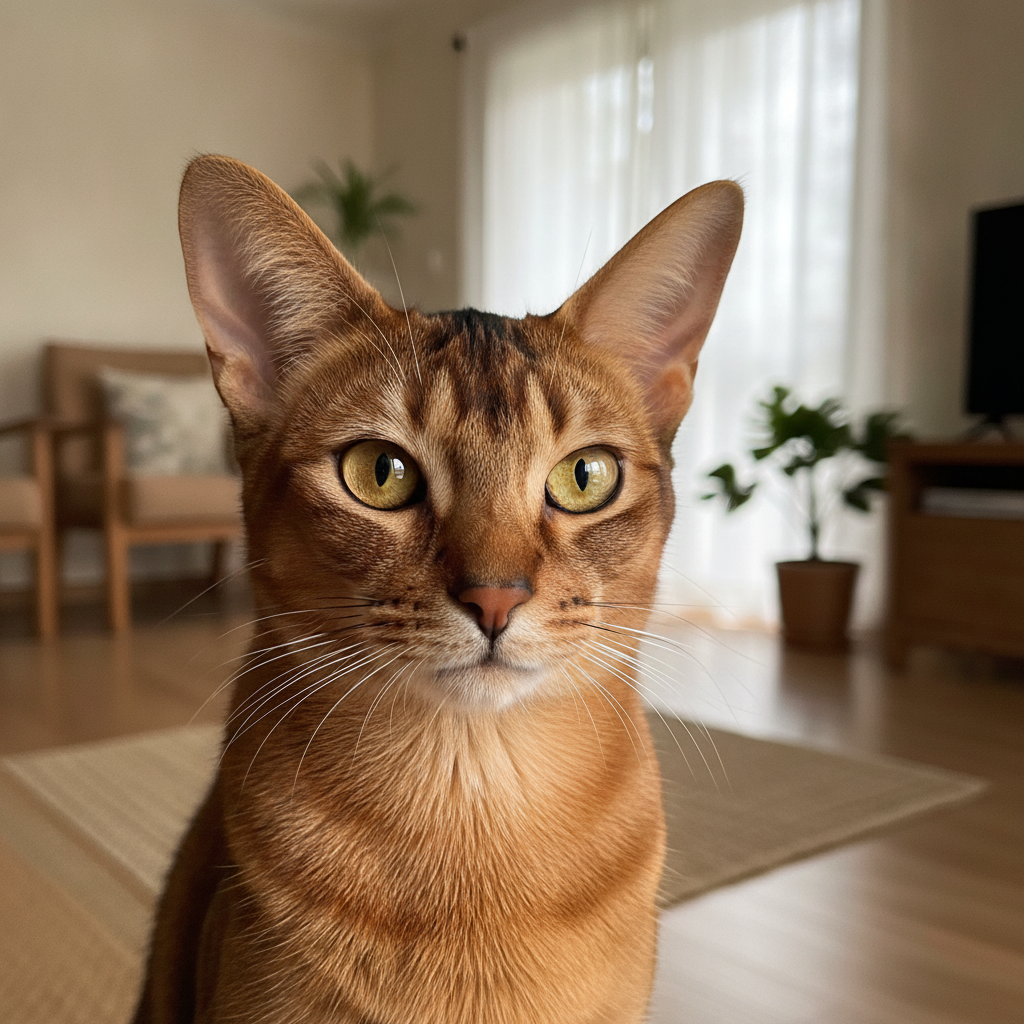
The Abyssinian's most defining feature is not its build or its face but its coat. Each individual hair carries four to six bands of alternating lighter and darker colour, with the lightest shade at the base and the darkest at the tip. This is the ticked agouti pattern, and the visual effect is a shimmering, multi-tonal coat that changes character depending on the light angle — warm in sunlight, almost velvety in shade.
The coat is short, fine, silky and close-lying, with a natural lustrous sheen. Unlike most tabbies, the Abyssinian's ticking should be free of traditional barring on the legs, neck rings, or a spotted belly. A clear, evenly ticked pattern is the standard. The CFA recognises four colour variants: Ruddy (warm burnt sienna ticked with black, the most iconic), Cinnamon/Sorrel (rich red ticked with chocolate brown), Blue (warm beige ticked with slate blue), and Fawn (warm rose-beige ticked with light cocoa). The good news for Malaysian owners: this short, fine coat is genuinely low-maintenance. A weekly pass with a rubber curry brush is enough to remove loose hair and maintain the sheen, with no professional grooming required.
The Aby-Grabby Temperament: Enrichment or Chaos
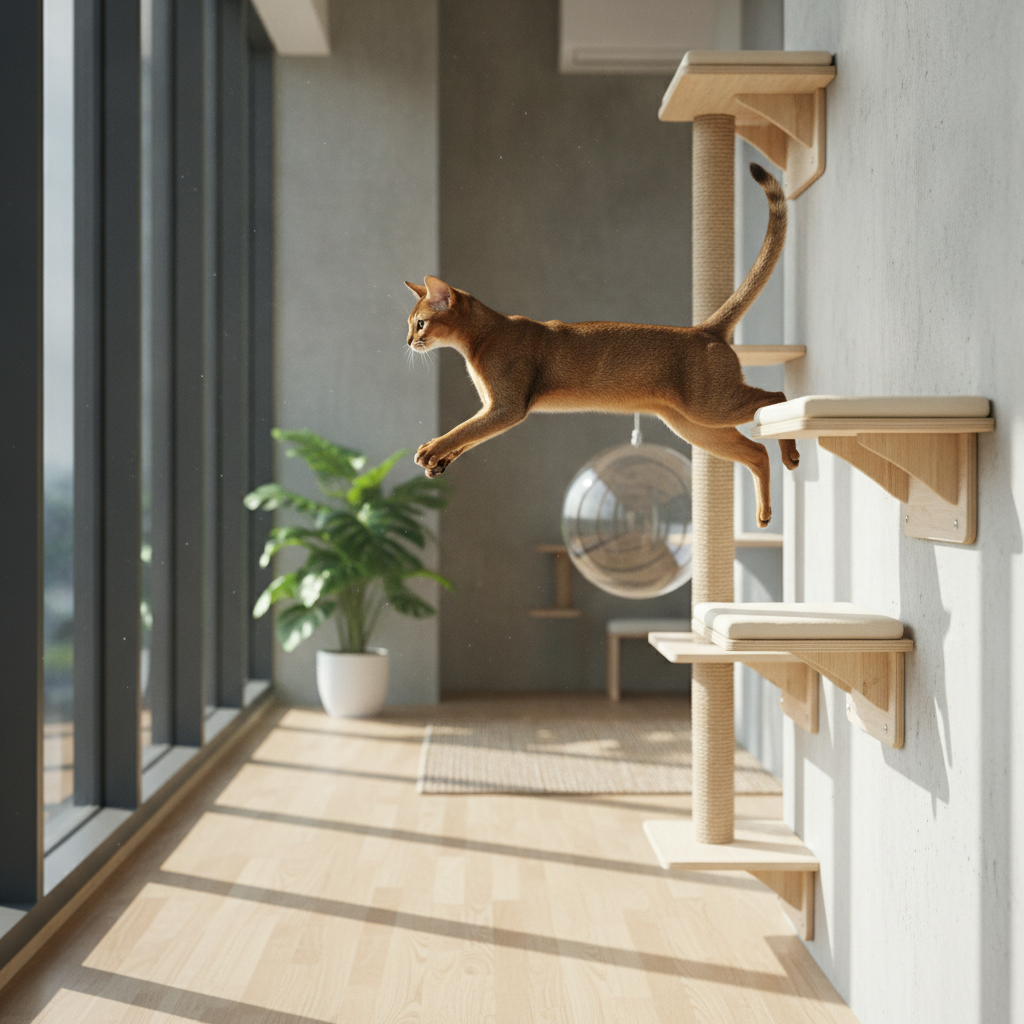
There is a nickname that circulates in Abyssinian owner communities: "Aby-grabby." It refers to the breed's compulsive habit of inserting itself into whatever is happening and physically interacting with every object in reach. Keys, pens, phone cables, your breakfast. The Abyssinian does not sit and observe. It participates.
The CFA breed profile summarises the Abyssinian temperament with one word: BUSY. This is not hyperbole. These cats are insatiably curious, athletically capable, and deeply people-oriented. They climb, they problem-solve, they play fetch, and they follow their owners from room to room like a particularly nimble shadow. They are affectionate without being clingy in the lap-cat sense, preferring to express devotion through shared activity rather than passive sitting. They form strong bonds with their families and do not thrive alone for long periods.
What this means practically is that an Abyssinian in a small condo without enrichment is not a calm cat. It is a stressed one, and a stressed Abyssinian finds creative outlets fast. Multi-level cat trees, wall-mounted shelves, rotating puzzle feeders, wand toys and daily interactive play sessions are not optional extras for this breed. They are the minimum requirement. This is also worth considering against apartment size: our guide to the best cat breeds for Malaysian apartments walks through which hyperactive breeds really suit condo life and which ones need more space. Abyssinians can work in a condo, but only with serious vertical enrichment and an owner who is genuinely home for a meaningful part of the day.
Health Risks You Must Know Before Buying
The Abyssinian's elegant frame conceals a significant genetic health burden. Prospective owners need to understand four conditions in particular, because they are breed-prevalent, some are testable before purchase, and the consequences of ignoring them are severe.
Pyruvate Kinase Deficiency (PK-def) is a metabolic disorder that causes red blood cells to break down prematurely, resulting in hemolytic anaemia. A peer-reviewed study published in the NIH database found that 7.4% of Abyssinians tested were affected and 23.3% were carriers; an Australian study put the carrier rate at 25%. Symptoms range from asymptomatic to severe lethargy, pale gums, and jaundice, often appearing before three years of age. PK-def is autosomal recessive, meaning two copies of the mutation are needed to produce an affected kitten. A DNA test exists and must be part of any responsible breeding programme. Ask to see the results before you commit to a kitten.
Progressive Retinal Atrophy (PRA) is a degenerative eye disease that leads to irreversible blindness. According to PetMD, the most common form in Abyssinians (PRA-rdAc) is autosomal recessive and causes gradual vision loss, typically starting with night blindness between ages three and five. A rarer dominant form (PRA-Rdy) can cause blindness as early as seven weeks. A Swedish study found 45% of Abyssinians over two years of age were affected by some form of PRA. DNA tests are available for both forms.
Renal amyloidosis is a fatal, incurable disease in which an abnormal protein called amyloid deposits in the kidneys, causing organ failure. As Cornell Feline Health Center explains, Abyssinians have a familial predisposition to this condition; amyloid deposition can begin between 9 and 24 months of age, though clinical signs of kidney failure often do not appear until one to five years old. There is no cure, and the prognosis once kidney failure develops is poor.
Patellar luxation and dental disease round out the profile. One European study found that 38% of Abyssinians examined had patellar luxation, a congenital kneecap dislocation that ranges from a barely-noticeable skip in the gait to persistent lameness requiring surgery. The breed is also frequently affected by gingivitis and periodontal disease, which is the leading cause of tooth loss in cats. Daily tooth brushing with feline-safe toothpaste is not optional for this breed; it is a practical necessity. See our cat lifespan by breed guide for how proactive dental care affects longevity across breeds.
Keeping an Active Breed Cool in Malaysia
The Abyssinian's short coat is genuinely heat-friendly compared with longhaired breeds, but its energy level creates a different problem. An active cat generates more body heat. A cat's normal body temperature sits at 38.3 to 39.2 degrees Celsius, and heatstroke can occur once core temperature climbs above 40 degrees. In a 33-degree Klang Valley afternoon, an Abyssinian that has just sprinted the length of your apartment five times is closer to that line than you might think.
The practical answer is an indoor life with air conditioning or strong cross-ventilation during peak heat, cool resting surfaces such as tiled floors or a cooling mat, and multiple water sources including a fountain to encourage drinking. As Cats Protection UK advises, scheduling vigorous play sessions for early morning or late evening, when temperatures are lower, reduces the heat load meaningfully. Wet food as part of the diet also increases water intake, which matters in a humid climate where cats often drink less than they should. Watch for panting, excessive drooling, and lethargy as early heat stress signals, and treat them as a vet call, not a wait-and-see moment.
The Abyssinian's social nature also means it does not cope well with extended solitude. An isolated, under-stimulated Abyssinian in a closed apartment at midday is a recipe for both stress and mischief. A companion cat or cat-friendly dog helps considerably, provided introductions are handled carefully.
Litter for an Always-On Cat: Why Low Dust Matters
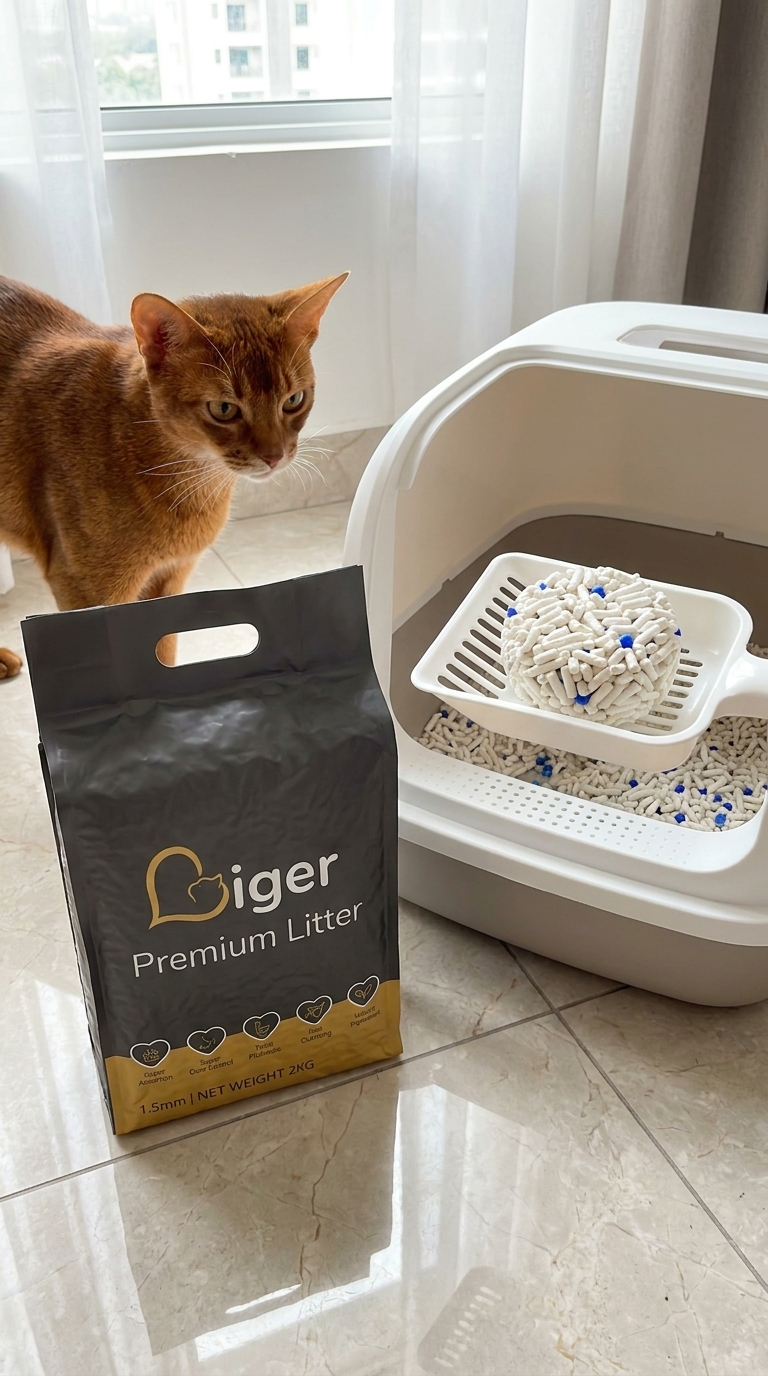
An active breed uses the litter box more than a sedentary one, and in a sealed, air-conditioned Malaysian apartment, what comes out of that box matters for everyone in the room. Dusty litter is a respiratory irritant, and fine litter particles tracked across tile floors are a daily nuisance when a high-energy cat bolts in and out of the box at speed.
This is why Liger Premium Tofu Cat Litter is a practical fit for Abyssinian owners. It is made from compressed soy fibres, which means it is low-dust, naturally clumping, and flushable, producing firm clumps that are quick to scoop. The low-tracking formula reduces the scatter that an energetic cat creates, and the minimal dust is better for both cat and owner in a closed, climate-controlled space. For a breed that is always on the move, a litter that does the job quietly in the background is genuinely useful.
Current 2026 pricing: RM21.90 for a single 2 kg pack, RM53.90 for 3 packs, RM89 for 5 packs, and RM169 for the 10-pack (20 kg), which works out to RM8.45 per kg — free shipping in Peninsular Malaysia. For one Abyssinian, the 5-pack at RM89 typically covers around 10 weeks. Use the litter calculator to size your exact usage.
What an Abyssinian Costs in Malaysia (2026)
Abyssinians are not common in Malaysia. There are reputable breeders, but supply is limited compared with Persians or British Shorthairs, and you will likely need to wait for a litter or source from a breeder who imports bloodlines. As rough 2026 market guidance (not Liger figures), registered kittens from health-screened lines typically fall in the RM2,000 to RM5,000 range, with show-quality ruddy and sorrel lines pushing toward the upper end. Be cautious of any listing significantly below RM2,000 claiming full pedigree; unregistered kittens of unknown health status are not a bargain when PK-def and PRA testing alone represents real investment on the breeder's side.
Beyond the purchase price, budget honestly for the lifetime cost: quality wet and dry food (active cats burn more calories), annual vet checks that include eye exams and basic bloodwork to catch renal amyloidosis early, proactive dental scaling, and the enrichment equipment this breed genuinely needs. Our cat breed cost calculator lets you model monthly costs against your setup, and our 2026 cat breed price guide puts the Abyssinian in context against other popular pedigreed cats. If you want the comparison at a glance, the Malaysia cat breeds hub links all the breed profiles in one place.
The Abyssinian rewards the right owner enormously: it is intelligent, engaging, visually stunning, and genuinely fun to live with. But it is a commitment to activity, enrichment, proactive healthcare, and daily interaction. If you want a cat that sits quietly on the couch and asks nothing of you, look elsewhere. If you want one that treats every day as a project, the Abyssinian is hard to beat.