One morning your cat wakes up with a red, weepy, half-shut eye. Is it just a bit of dust, the start of "tear stains", or something that needs a vet today? In Malaysia, where humid weather and crowded rescue/cattery settings let eye infections pass around easily, conjunctivitis is one of the most common reasons cats end up at the clinic. This guide walks through what it actually is, how to tell it apart from harmless tear staining, the warning signs that mean "go now", and how vets treat it — all anchored to veterinary sources, not guesswork.
Quick but important: this article is educational. Eyes are fragile and some eye problems can blind a cat within a day or two. Nothing here replaces hands-on advice from your own vet. When in doubt, get the eye looked at.
What Conjunctivitis Actually Is (And Why It's Not "Tear Stains")
Conjunctivitis means inflammation of the conjunctiva — the thin pink membrane that lines the inner eyelids and covers the white of the eye. When it gets irritated or infected, the eye looks red (hyperemia), may swell (chemosis), and produces discharge that ranges from clear and watery to thick yellow-green. According to Cornell Feline Health Center, it is one of the most frequently diagnosed eye conditions in cats.
Here is the distinction every cat parent should internalise: conjunctivitis is an active, often uncomfortable disease; tear staining is mostly a cosmetic flaw. Tear staining (epiphora) is the reddish-brown mark on the fur below the eye caused by porphyrins — iron-containing pigments in tears — oxidising in the light. In simple tear staining the eyeball itself looks white, calm and pain-free. With conjunctivitis, the eye is red, swollen, and the cat may squint or paw at it. If you have been blaming "salt" or "tear stains" for a red, squinty eye, that is the wrong frame — we cover the real story of staining in our guide to cat tear stains. VCA Hospitals stresses that the presence of redness, swelling, and pain is what separates true inflammation from a purely cosmetic stain.
The Usual Suspects: What Causes Pink Eye in Cats
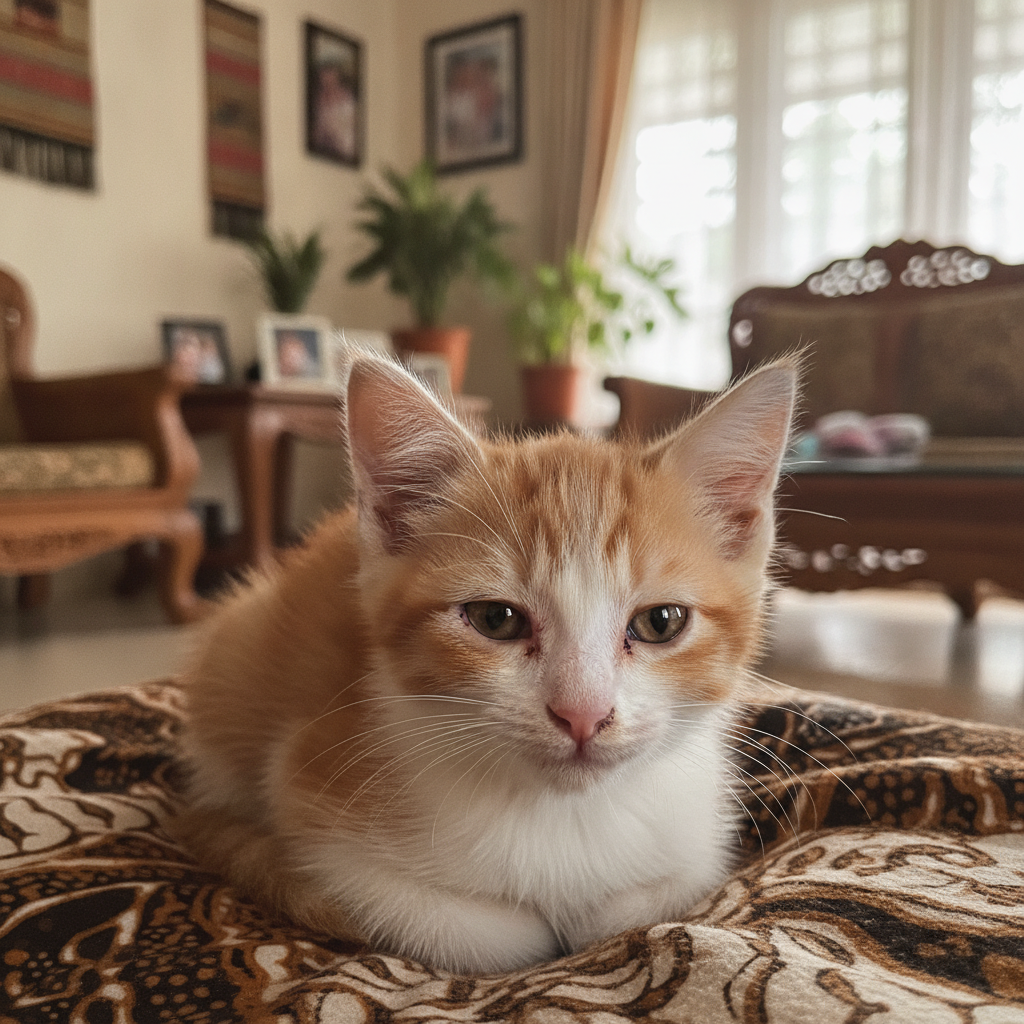
Causes split into infectious (most common) and non-infectious.
Feline Herpesvirus-1 (FHV-1) is the single biggest infectious cause. It is everywhere: over 90% of cats are exposed, and around 80% become lifelong latent carriers, with flare-ups triggered by stress. VCA notes the tell-tale sign of an active herpes flare is a branching ("dendritic") corneal ulcer.
Feline Calicivirus (FCV) often comes bundled with cat-flu signs; its giveaway is mouth ulcers (drooling, reluctance to eat). Chlamydia felis is a bacterium notorious for dramatic swelling that can puff the eyelids almost shut, usually starting in one eye then spreading to the other — common in kittens and multi-cat homes. Mycoplasma often tags along as a secondary invader on an eye already inflamed by something else.
Non-infectious triggers matter too: allergies (itchy, clear watery discharge, often alongside skin issues — see our Malaysian cat skin guide), foreign bodies like a blade of grass (sudden, intense squinting in one eye), flat-faced breed anatomy in Persians, and plain environmental irritants — dust, smoke and chemical fumes can all spark a transient conjunctivitis, per the MSD/Merck Veterinary Manual. That last point is worth holding onto: a dusty home environment is a real, avoidable irritant.
Signs to Watch For
Conjunctivitis can look mild or severe. Run through this mental checklist:
- Redness of the eye-white and inner eyelids
- Swelling — sometimes so much the eyelids look puffy or partly shut
- Discharge — clear/watery (often viral or allergic) or thick yellow-green (often bacterial)
- Squinting, blinking, or holding the eye closed
- Pawing or rubbing the face against furniture
- Third eyelid showing across the eye
- For viral cases, often sneezing and nasal discharge too
One eye or both? Chlamydia classically starts in one and jumps to the other; a sudden, painful single eye raises suspicion of a foreign body or ulcer. If you are building a broader sense of when symptoms are serious, our list of 12 warning signs your cat is sick is a useful companion.
🚨 When It's an Emergency: Don't Wait
Most conjunctivitis is treatable, but some signs mean the eye itself is in danger. Treat these as "see a vet today, not next week":
- Forceful squinting (blepharospasm) — the cat can't or won't open the eye. This signals real pain and can mean a deep injury, ulcer or internal inflammation (uveitis).
- Any cloudiness, haze, or blue/grey tint on the normally clear cornea.
- A visible corneal ulcer — an open sore on the eye surface. PetMD warns untreated ulcers can deepen, get infected, and lead to rupture or blindness.
- Sudden, severe swelling, profuse discharge, blood in the eye, a bulging or sunken eye, or unequal pupils.
Critical safety rule: never put human over-the-counter eye drops in your cat's eye unless your vet specifically tells you to — especially anything with steroids (hydrocortisone). On an ulcerated eye, steroids can stop healing and trigger catastrophic damage. The safe first move is a quiet, dim room and a fast trip to the clinic.
How Your Vet Diagnoses It
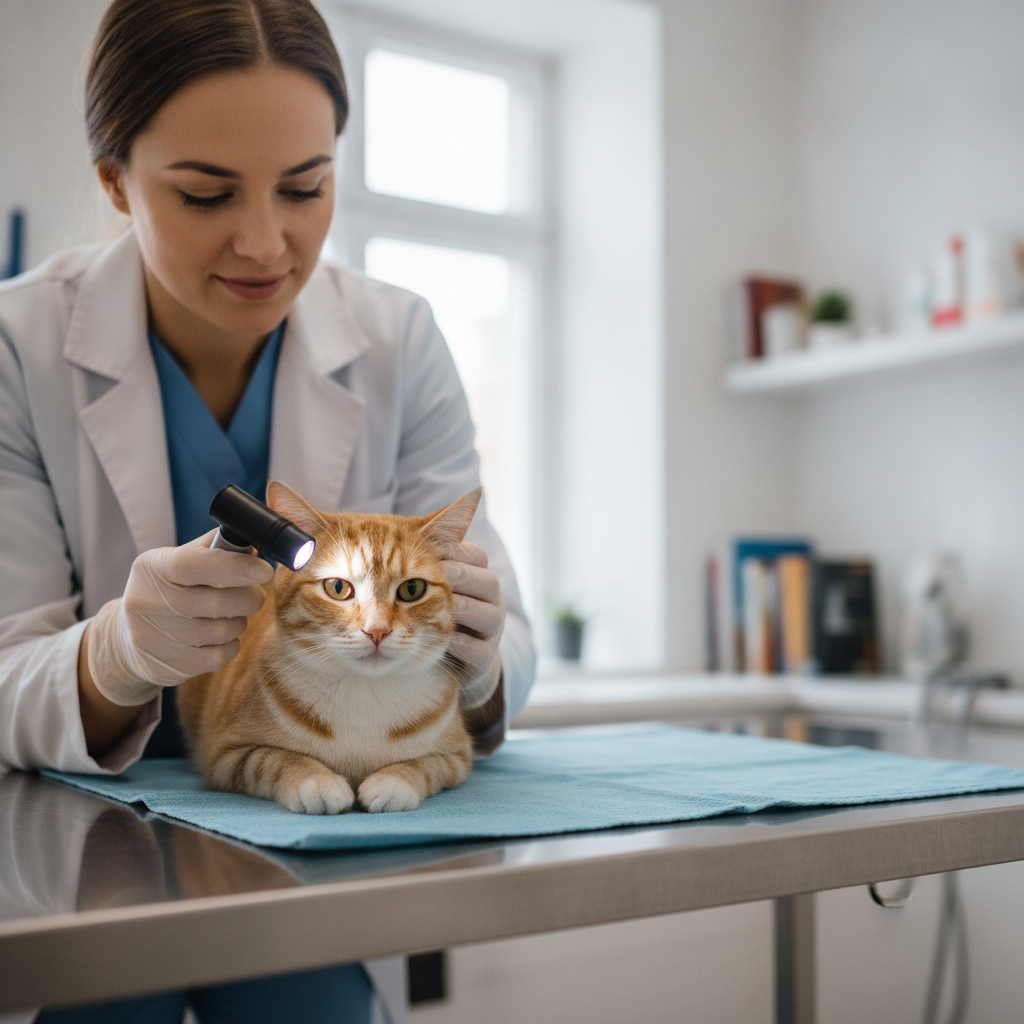
Because treatment depends entirely on the cause, vets don't just guess. A proper work-up may include:
- Ophthalmic exam — assessing redness, swelling, discharge type and pain.
- Fluorescein stain — an orange dye that glows on any corneal scratch or ulcer. It is mandatory before prescribing steroid drops, exactly because steroids are dangerous on an ulcer.
- Schirmer tear test — measures tear production to check for "dry eye".
- Tonometry — eye-pressure check to rule out glaucoma and uveitis.
- Cytology & PCR — swabs that identify the specific bug. PCR is the most sensitive test for FHV-1, Chlamydia and Mycoplasma, per Today's Veterinary Practice.
Treatment: Why the Right Diagnosis Beats Guesswork
There is no single "conjunctivitis cure" — the medicine must match the cause.
Bacterial (Chlamydia, Mycoplasma): oral doxycycline is the treatment of choice; for C. felis, the Merck Vet Manual describes a minimum four-week course to fully clear it, and often treating every cat in the house. (Doxycycline must be given with a little water or food to avoid throat irritation — your vet will brief you.)
Viral (FHV-1): moderate-to-severe cases may get oral antivirals such as famciclovir, sometimes with topical antivirals if the cornea is ulcerated, plus antibiotics to cover secondary infection.
The L-lysine myth: for years L-lysine was pushed for herpes cats. The evidence didn't hold up — a 2015 systematic review (NIH/PMC) found no evidence it prevents or treats FHV-1, and some data suggested it could make things worse. Save your money and follow your vet's actual protocol.
Because dosages and drug choices depend on weight, the specific pathogen, and the state of the cornea, we deliberately don't list home doses here — getting it wrong on an eye is high-stakes. Your vet sets the plan.
Stopping the Spread in a Multi-Cat Home

Infectious conjunctivitis is contagious — a big deal in Malaysian homes with several cats, fosters, or a rescue background. It spreads by direct contact, sneeze droplets, and fomites: shared bowls, bedding, litter boxes, and even your hands and clothes. Calicivirus is especially hardy and can survive on surfaces for up to a month.
Practical control:
- Isolate the affected cat; tend to healthy cats first, sick cats last; wash hands between cats.
- Clean then disinfect shared surfaces (detergent first to lift grime, then an appropriate disinfectant — diluted bleach works against calicivirus, while many general-purpose "quat" cleaners do not).
- Separate resources. The rule of thumb is one litter box per cat plus one spare, kept clean — our litter calculator helps you size that out.
- Cut airborne irritants. Since dust is a documented non-infectious trigger, a genuinely low-dust litter helps. Liger Premium Tofu Cat Litter is a soy-based tofu litter made for exactly this — low dust, flushable for fast clean-ups, and easy to scoop so the box (a known fomite) stays hygienic. It's Halal-certified and starts at RM21.90 for a 2 kg pack, down to RM8.45/kg on the 10-pack — useful when you're managing several cats at once. For allergy-prone or flat-faced cats whose eyes irritate easily, the dust angle is covered further in our guide to the best litter for asthma & allergies.
Prevention & The Bottom Line
You can't bubble-wrap a cat's eyes, but you can stack the odds:
- Vaccinate. Core vaccines cover FHV-1 and FCV; they don't fully prevent infection but reduce how severe flare-ups get.
- Lower stress. Since stress reactivates latent herpes, stable routines, hiding spots, and not overcrowding (small stable groups) genuinely cut recurrences.
- Quarantine newcomers before mixing them with resident cats — new cats are the classic way infections enter a household. Our new cat owner checklist walks through a sensible intro.
- Keep the environment clean and low-dust to remove avoidable irritants.
Conjunctivitis ranges from a minor, self-limiting nuisance to the first sign of a vision-threatening emergency — and you usually can't tell which from the sofa. If your cat's eye is red, weepy, swollen or squinty for more than a day, or if it ever looks cloudy or the cat is in obvious pain, book the vet. For the bigger picture on feline illness in our climate, see our overview of common cat diseases in Malaysia. Quick action protects the one set of eyes your cat has.