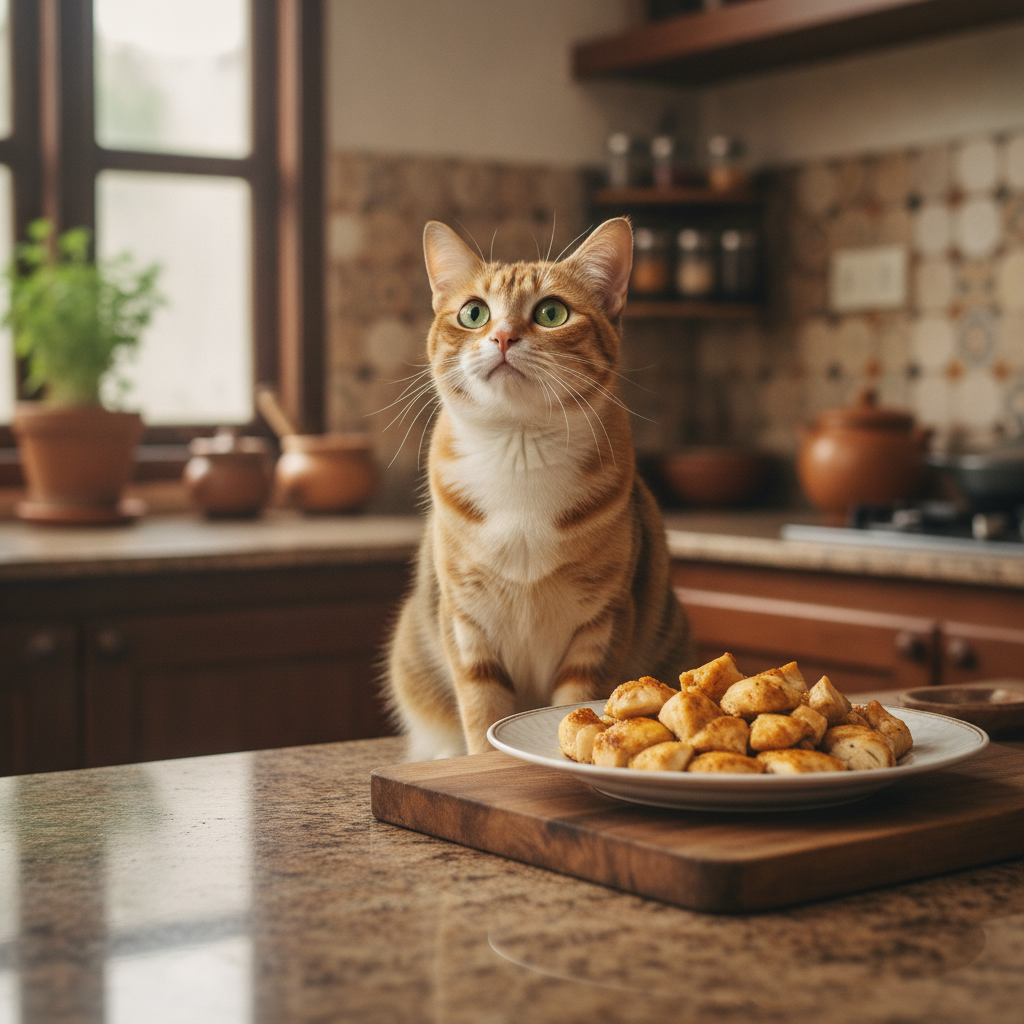
Your cat is staring at your dinner with those big pleading eyes, and you're wondering: is it actually okay to share a bite? Sometimes yes — but the list of safe human foods is shorter than most people think, and the preparation rules matter more than the food itself. This guide covers what cats can safely eat, how to prepare it, how much, and the "harmless" foods that are quietly a bad idea. For the flip side — everything that's outright dangerous — keep our toxic human foods guide bookmarked, and use the can my cat eat this? tool for quick checks.
The Golden Rule: 10% and No More
Before any specific food, internalise one number. Cats are obligate carnivores whose nutritional needs are fully met by a complete, balanced commercial diet — so any human food is a bonus, not a food group. The veterinary standard, echoed by the ASPCA, is the 10% rule: treats of any kind should never exceed 10% of daily calories. For a typical 4.5 kg indoor cat eating around 200 kcal a day, that's just 20 calories of treats — roughly one tablespoon of cooked chicken. With over half of pet cats now overweight, that ceiling is the difference between a treat and a problem. If you want the full calorie maths, see our portion guide.
To see how fast 20 calories disappears, here are common safe treats with their rough calorie counts and a sensible portion:
| Food (cooked & plain) | Portion | Approx. calories |
|---|---|---|
| Chicken (no skin/bone) | 1 tbsp, chopped | 15–20 |
| Turkey (white meat) | 1-inch cube | 20–25 |
| Salmon | 1 tbsp, flaked | 25–30 |
| Egg (scrambled/boiled) | 1 tbsp, chopped | 20–25 |
| Cheddar cheese | 1 die-sized cube | 15–20 |
| Plain pumpkin | 1–2 tsp | 5–10 |
One tablespoon of chicken essentially uses up the whole day's treat budget for an average cat — so treats really do mean a pinch, not a plate.
Cooked Meat: The Safest Treat of All
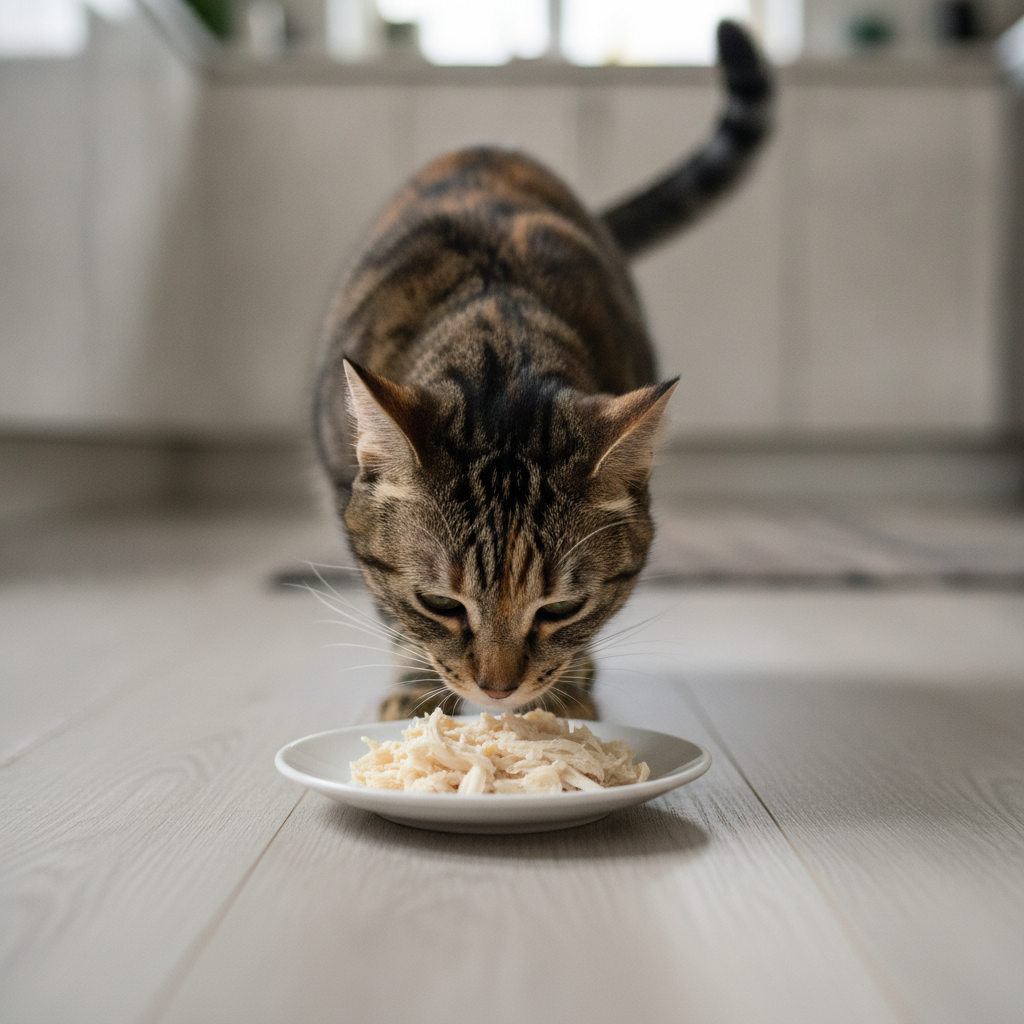
Since cats are built to eat animal protein, plain cooked meat is the most natural treat you can offer. Good options are boneless, skinless chicken and turkey, and lean beef. Small amounts of cooked liver are fine too — but strictly small, because liver is extremely high in Vitamin A and too much causes painful Vitamin A toxicity and bone problems.
The rules are simple but non-negotiable: cook it thoroughly (boil or bake) to kill Salmonella and E. coli, remove all bones, trim skin and fat, and serve it completely plain — no salt, oil, sauce, onion or garlic. Skip fatty, processed meats like bacon, sausage and deli slices: they're loaded with sodium and preservatives, and the high fat can trigger pancreatitis. A tablespoon of chopped plain chicken is a perfect treat-sized portion.
There's a reason meat sits at the top of the safe list. Cats rely on animal tissue for nutrients they can't make themselves — taurine for heart and eye health, preformed Vitamin A, arachidonic acid, and niacin (vitamin B3), all of which are richest in meat. That's also why no vegetable, however healthy, can replace it. A small piece of cooked muscle meat genuinely aligns with how a cat's body is built to eat, which is more than can be said for most things we'd hand down from the table.
Fish: Fine Cooked, Dangerous Raw
Cooked fish is a good source of omega-3s for skin and coat — think cooked salmon, cod or flounder, served plain and deboned. Canned light tuna in water (no salt) is okay as an occasional treat, but keep it infrequent because of mercury, and avoid high-mercury fish like swordfish entirely.
The one hard line: never feed raw fish. Raw fish contains thiaminase, an enzyme that destroys thiamine (vitamin B1), and a thiamine deficiency causes serious neurological problems including seizures. That's separate from the bacterial risk all raw protein carries. Fish also shouldn't become a staple even when cooked — a fish-only habit can crowd out balanced nutrition and, in some cats, contribute to urinary issues. Treat it as an occasional change of pace. If you're weighing up raw feeding more broadly, read our raw feeding safety guide first.
Eggs, and a Tiny Bit of Cheese
Fully cooked eggs — scrambled or boiled, no salt, butter or milk — are a great high-protein treat. Keep them cooked, not raw: raw egg carries Salmonella risk, and raw egg white contains avidin, which blocks absorption of the B vitamin biotin. As for the cliché cat-and-cheese pairing, a single die-sized cube of hard cheese like cheddar is tolerable for some cats because it's lower in lactose than milk — but it's high in fat and salt, so treat it as a rare nibble, not a habit. The same logic applies to almost every dairy item: cats simply aren't built to process milk sugar past kittenhood, so the safest assumption is that dairy will upset their stomach unless proven otherwise in tiny amounts.
Vegetables Cats Can Actually Eat
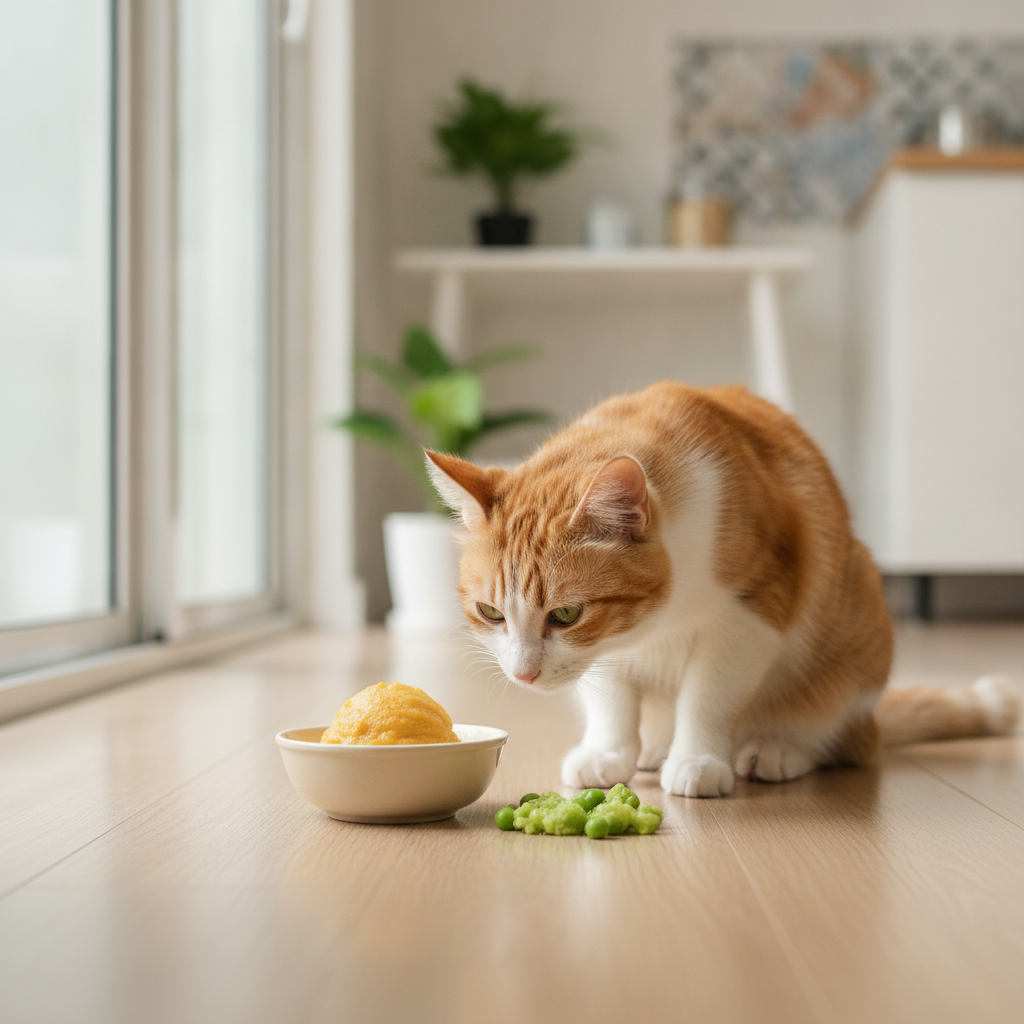
Cats don't need vegetables, but a few make decent low-calorie treats and can help digestion. Plain cooked pumpkin is the star — vets often recommend a teaspoon or two to ease both constipation and mild diarrhoea thanks to its fibre. Cooked carrot (mashed or finely chopped) and green peas are also safe. Everything must be steamed or boiled soft, served unseasoned, and cut small to prevent choking. One to two teaspoons once or twice a week is plenty. Skip onions, garlic, leeks and chives entirely — more on why below.
Plain Is Non-Negotiable: Preparation Rules
If there's a single takeaway, it's this: plain is paramount. The seasonings we love are where the real danger hides. The allium family — onion, garlic, chives and leeks — damages feline red blood cells and can cause life-threatening haemolytic anaemia, in any form: raw, cooked, powdered, or hidden in broth, gravy and some baby foods. The PDSA warns that symptoms (lethargy, pale gums, reddish-brown urine) can take days to appear, and the MSD Veterinary Manual classes all alliums as toxic to cats.
Beyond alliums: no salt (risk of sodium poisoning and dehydration), no oil or butter (gastrointestinal upset, pancreatitis), and no cooked bones (they splinter and can perforate the gut). Boil, steam or bake — nothing else.
In a Malaysian kitchen this rules out more than people expect. Most of our home cooking is built on exactly the things cats can't have — onion and garlic bases, santan, salted and spiced gravies, soy sauce and stock cubes. So a piece of chicken from the rendang pot is not a safe treat, even though plain chicken is. If you want to share, set aside a small, unseasoned piece before the seasoning goes in. That one habit removes most of the accidental-poisoning risk in a typical household.
The "Safe" Foods That Actually Aren't
Some foods carry a reputation for being cat-friendly that they don't deserve. Milk is the big one: most adult cats are lactose intolerant after weaning, so a saucer of milk usually means vomiting, diarrhoea and bloating within 8–12 hours — and it's startlingly calorie-dense. We bust this fully in the truth about cats and milk. Raw meat and fish get sold as "natural" but carry bacterial and thiamine risks. Processed meats (ham, bacon, sausage) hide salt, fat and often onion or garlic powder. And as covered, liver is healthy in tiny amounts but toxic in excess.
A quick word on a few notorious toxins so they're on your radar: chocolate, caffeine, alcohol, grapes and raisins are all genuinely dangerous and warrant an emergency vet call. Xylitol (a sugar-free sweetener) is severely toxic to dogs; its effect on cats is less clearly established, but it's firmly in the "don't risk it" category. PetMD's toxic foods list is a good reference, and the ASPCA is clear that cats can't thrive on plant-based diets either — the meat isn't optional.
Introducing New Treats? Watch the Litter Box
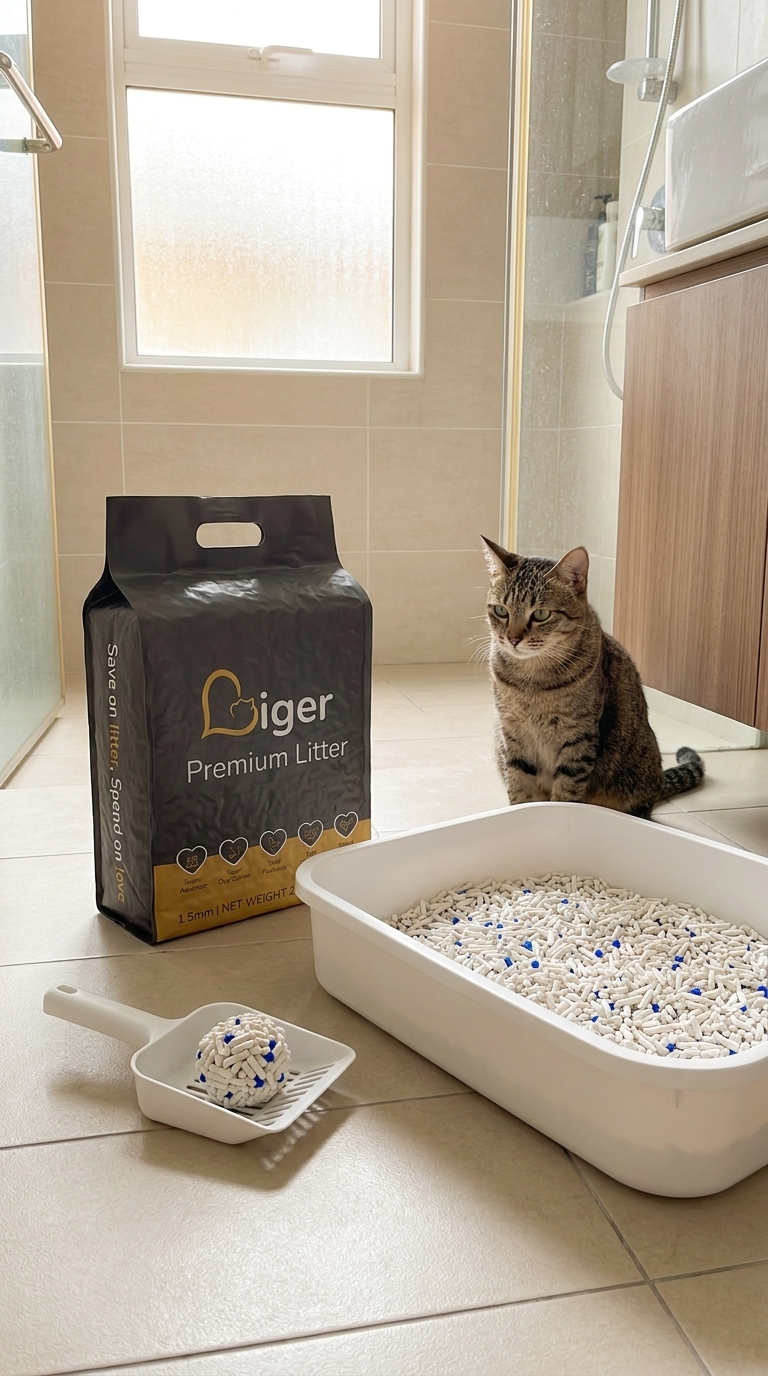
Here's a practical habit that catches problems early: whenever you introduce a new treat, give a small amount and then check the litter box over the next day or two. A cat's digestion is sensitive, and a new food that doesn't agree with it shows up first as loose stool or a change in routine — long before it becomes a bigger issue. Firm, well-formed stool means the treat agreed with them; loose or frequent stool means scale back. This only works if your litter actually lets you read what's going on, which is where a low-dust, firmly clumping litter like Liger Premium Tofu Cat Litter earns its place: each deposit locks into a clean, scoopable clump, so changes are easy to spot, and the natural plant-starch formula keeps dust (and odour) down in a closed Malaysian home. A 2 kg pack is RM21.90, or RM8.45/kg on the 10-pack with free Peninsular shipping (current pricing as of 2026) — size your supply with the litter calculator. For the complete picture on feeding, head back to our cat nutrition hub, and when in doubt about any food, ask your vet first.