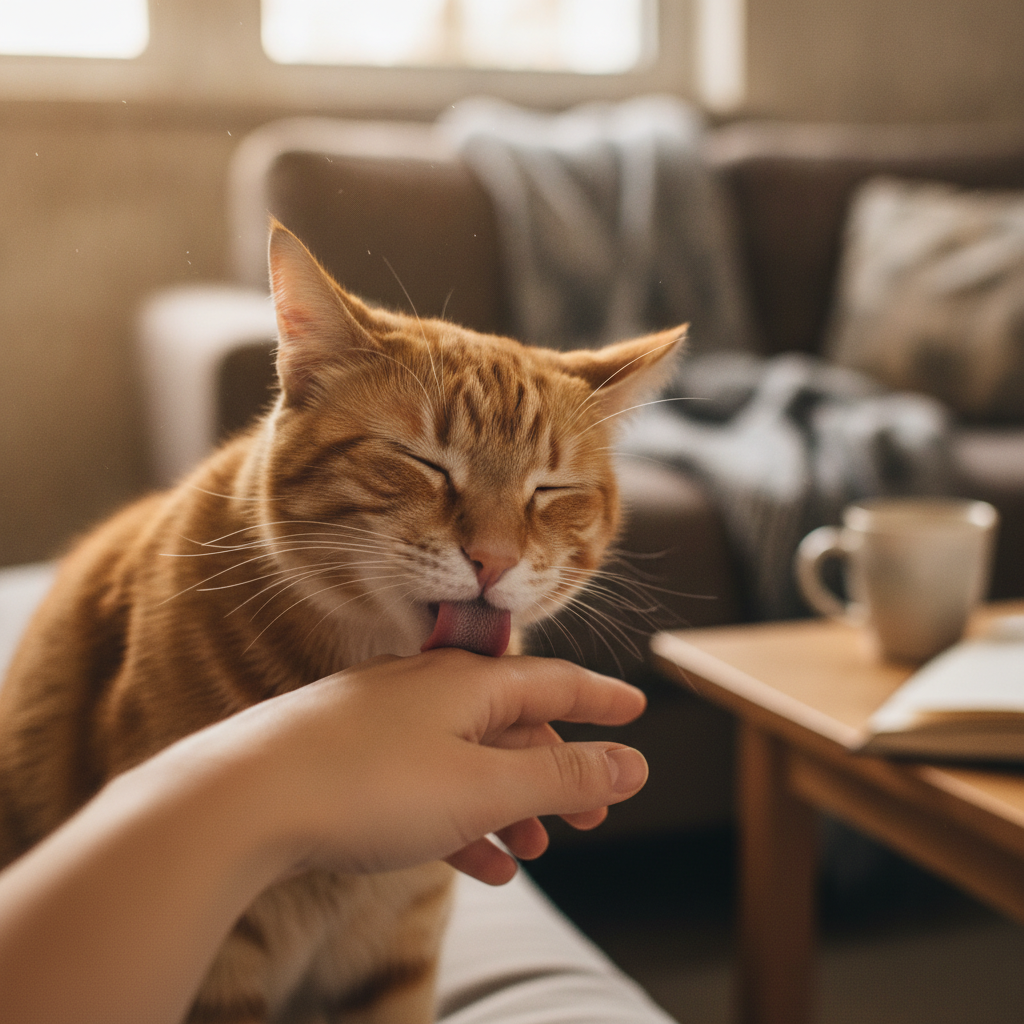
Your cat grabs your hand, fixes you with a serious look, and starts licking — that wet, oddly rough little tongue working away at your skin. Is it love? A grooming demand? A taste test? Mostly, it's one of the highest compliments a cat can pay you. But licking sits on a spectrum, and at the far end it can be a genuine cry for help. Here's how to read it.
This guide covers what licking means, why the tongue feels like sandpaper, and the crucial line between affectionate grooming and a medical problem. It's part of our Malaysian guide to cat behaviour.
Your Cat's Lick Is a Compliment (Mostly)
When your cat licks you, it's treating you like another cat — specifically, a trusted one. The behaviour is called allogrooming (one animal grooming another), and it starts at birth. A mother cat licks her newborns to clean them, stimulate breathing, and — for the first weeks of life — trigger their toileting. That first grooming forms the kitten's very first social bond, hard-wiring an association between licking, comfort and safety.
Cats carry that into adulthood, but they're picky: they only allogroom "preferred individuals" — littermates, long-term housemates, and the humans they trust. So when your cat licks you, as Cats Protection explains, it's signalling that you're family. There's a scent layer too — by mixing its saliva with your smell, your cat folds you into the household's shared "group scent," literally marking you as part of its territory and social group. It's the same trust language as the slow-blink we cover in does your cat actually trust you.
The Sandpaper Tongue: Why It Feels Like That
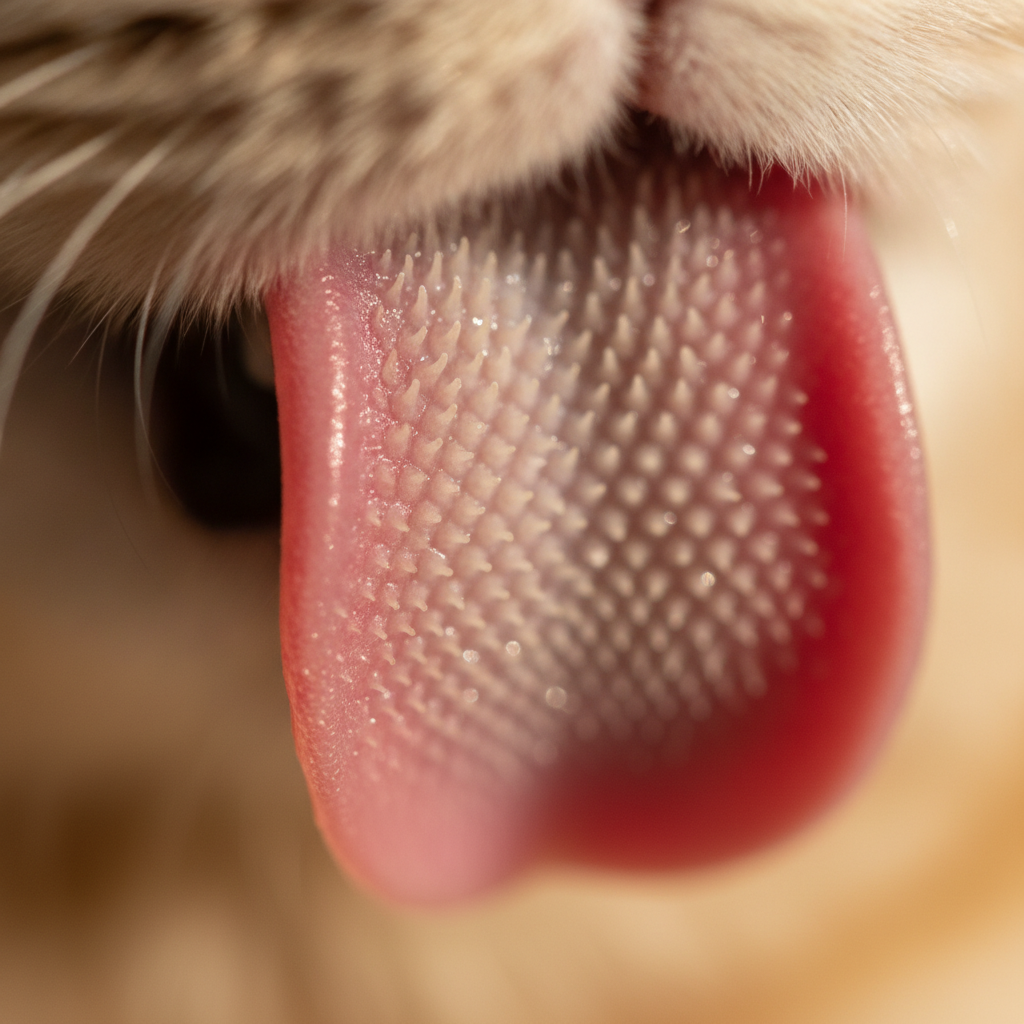
That distinctive rasp comes from one of nature's neatest tools. A cat's tongue is covered in roughly 290 backward-facing spines called papillae, made of keratin — the same tough protein as their claws and your fingernails. Research from the Georgia Institute of Technology, published via the NIH, used micro-CT scans to reveal these spines aren't solid cones as long assumed, but scoop-shaped with a tiny U-shaped cavity at the tip.
That hollow scoop wicks up saliva and delivers it deep into the fur, right down to the skin — which is what makes feline grooming so ruthlessly efficient at removing loose hair, dander and dirt. It's also a cooling system: as that deep-delivered saliva evaporates, it can account for up to a quarter of a cat's body cooling, a real asset for a cat in Malaysia's heat. The spines even inspired a 3D-printed "tongue-inspired" pet brush. On your bare skin, those 290 keratin hooks are exactly why a few licks start to feel like fine sandpaper.
So Why Does My Cat Lick Me Specifically?
Pulling it together, when your cat licks you it's almost always some blend of three things, per PetMD:
- Affection and bonding. It's extending the comfort-grooming it learned from its mother. Grooming even releases calming endorphins, so it soothes the cat as much as it flatters you.
- Scent-marking. It's claiming you as part of its safe, familiar group — a declaration of belonging.
- Attention or a request. Sometimes a lick is simply "pay attention to me" or part of a wider bid for interaction or food.
One thing it is not: dominance. While cats grooming other cats can carry a status element — a higher-ranking cat will often groom a lower-ranking one around the head and neck — behaviourists are clear that a cat licking a human is read purely as trust and inclusion, not a power play. Take the compliment.
Context helps you read it precisely. A few gentle licks while you're petting and your cat is purring is pure contentment. Licking paired with head-butts and cheek-rubs is full-on bonding and scent-mixing. And a sudden, insistent lick when the food bowl is empty is your cat doing what cats do best — using affection to get your attention. None of these are problems; they're just your cat talking to you in the language it knows.
When Licking Becomes a Problem: Overgrooming
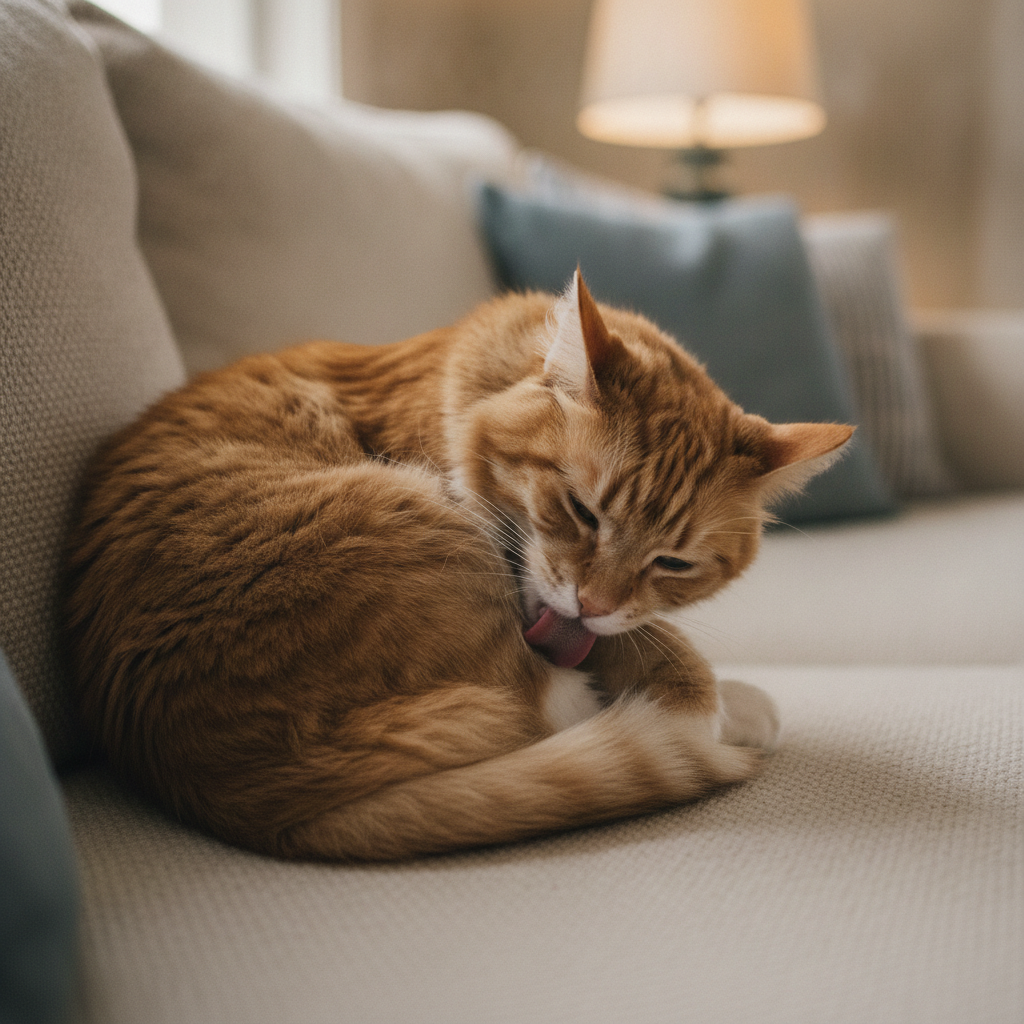
Here's where it gets important. Healthy cats are fastidious — they can spend 30% to 50% of their waking hours grooming, so long sessions alone are normal and nothing to worry about. The red flag isn't time spent; it's physical damage. Overgrooming announces itself on the body, not the clock:
- Bald patches or thinning fur (alopecia), often on the belly, inner thighs, or a single leg or paw — the easy-to-reach spots
- Hair that looks broken, stubbly or "barbered" rather than naturally shed
- Red, raw, irritated skin, scabs or open sores
- Frantic, intense, trance-like licking that's hard to interrupt — versus normal grooming, which a cat happily pauses for food or play
- More hairballs than usual, from swallowing all that extra fur
There's a nasty trap here that Cornell's feline experts call the "itch-lick cycle": the rough papillae abrade the skin, which inflames it, which makes it itchier, which drives more licking — and the raw skin invites secondary infections that itch even more. A small irritation can spiral into a chronic wound fast.
It's Probably Medical First — Not "Just Stress"
If your cat is licking itself bald, resist the urge to label it anxiety. The evidence is striking: a landmark 2006 study published in the Journal of the AVMA found that 76% of cats referred to specialists for presumed "stress" hair-loss actually had an underlying medical cause. Only about 10% were purely psychological. Vets now treat stress-grooming as a "diagnosis of exclusion" — something you land on only after ruling out the physical causes:
- Allergies — the biggest culprit, especially flea-bite allergy, environmental allergens, and food reactions (adverse food reactions were the single most common finding). Diagnosing a food allergy needs a strict 8-week elimination diet.
- Parasites — fleas and mites cause intense itching; rigorous prevention matters (see the hidden risks of cheap flea collars).
- Pain — a cat licking one specific spot may have arthritis there, or be grooming a sore belly over a urinary problem.
- Skin infections — bacterial or fungal (ringworm) irritation feeds the cycle.
The location is a clue: licking at the tail base often points to flea allergy; the lower belly can signal a urinary tract issue. Our skin condition checker can help you describe what you're seeing before the vet visit — but a vet exam is non-negotiable for any cat losing fur.
When It Really Is Stress
Once your vet has cleared the medical causes, then you're looking at a genuine behavioural overgroom — a self-soothing habit, since licking releases those calming endorphins. Some cats are more prone: sensitive purebreds like Siamese, Burmese, Abyssinian and Himalayan are over-represented. Triggers are usually change: a new pet, a house move, a new baby, a shift in your schedule.
The fix is reducing stress and boredom, never punishment (which just adds anxiety and worsens it). Build a predictable routine, add vertical space and scratching posts, and run at least two 10–15 minute interactive play sessions a day — ideas in indoor cat enrichment. Gently redirect a licking session to a toy rather than scolding. In stubborn cases a vet may add an anti-anxiety medication alongside the behavioural work. Be patient: even once the cause is fixed, the habit can take about a month to fade.
The Environment Connection: Cutting the Irritants
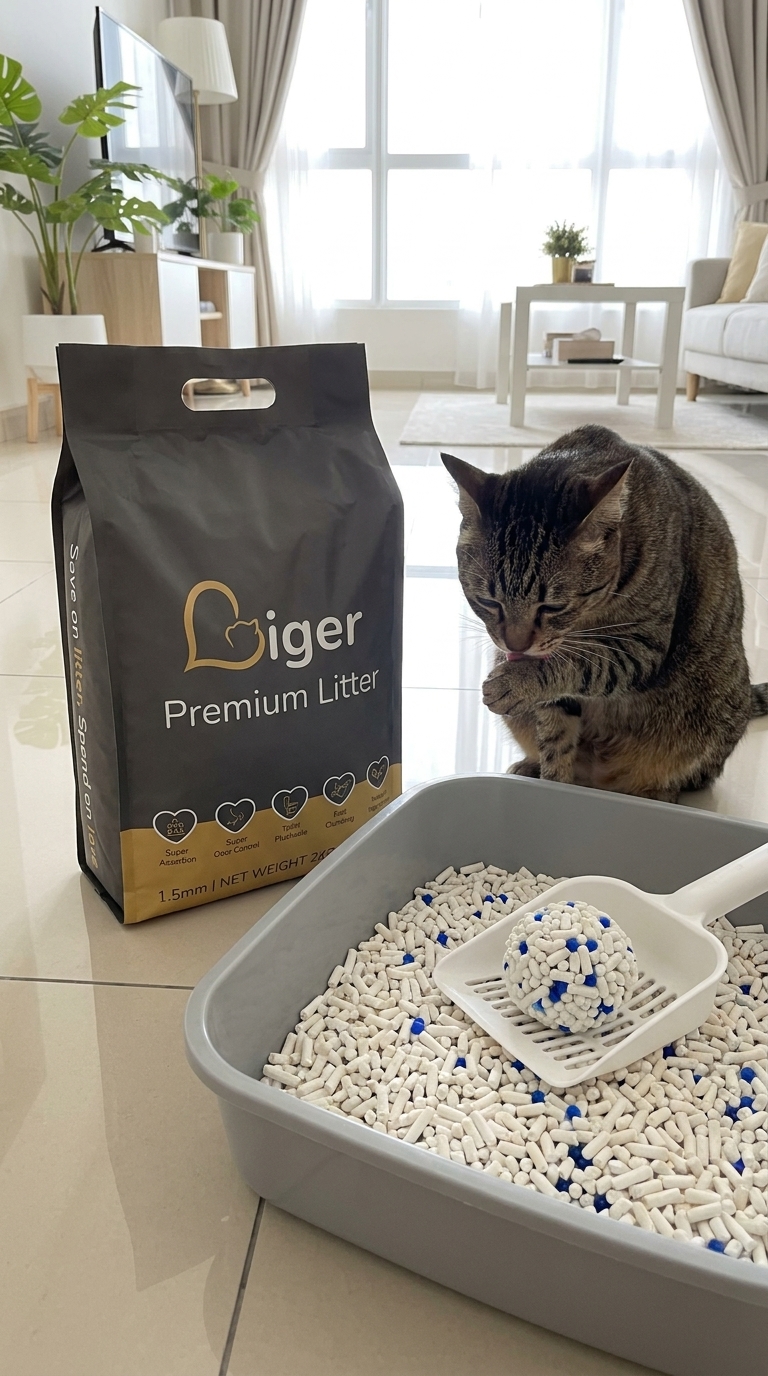
Whether the overgrooming is allergy-driven or stress-driven, your cat's everyday environment is part of the picture — and the litter box is a bigger factor than most owners realise. Two reasons. First, your cat steps in its litter several times a day, then meticulously licks its paws clean and swallows whatever was on them. Second, a dusty clay litter throws fine particles into a sealed, air-conditioned Malaysian home, adding to the environmental-allergen load that can keep itchy skin inflamed.
A low-dust, natural litter cuts both of those. Liger Premium Tofu Cat Litter is made from food-grade plant starch and throws off very little airborne dust, so there's less irritant settling on the coat your cat is grooming and less for it to ingest off its paws. It clumps firmly for a clean, low-odour box too — which matters because a stressful, smelly toilet is itself a low-grade stressor that can feed anxiety-grooming. It runs from RM21.90 (2 kg) to RM169 for the 10-pack (about RM8.45/kg, free shipping in Peninsular Malaysia, current pricing as of May 2026). For the wider dust-and-allergy angle, see our dust-free litter guide, and size your usage with the litter calculator.
So the next time your cat grooms you with that sandpaper tongue, enjoy it for what it almost always is — a small, slightly scratchy declaration of love and trust, built on instincts that go all the way back to its mother's first licks. Just keep half an eye on how your cat grooms itself: a full, healthy coat and calm, interruptible grooming means a happy cat, while bald patches, raw skin or frantic licking mean it's time to call the vet rather than wait and see.