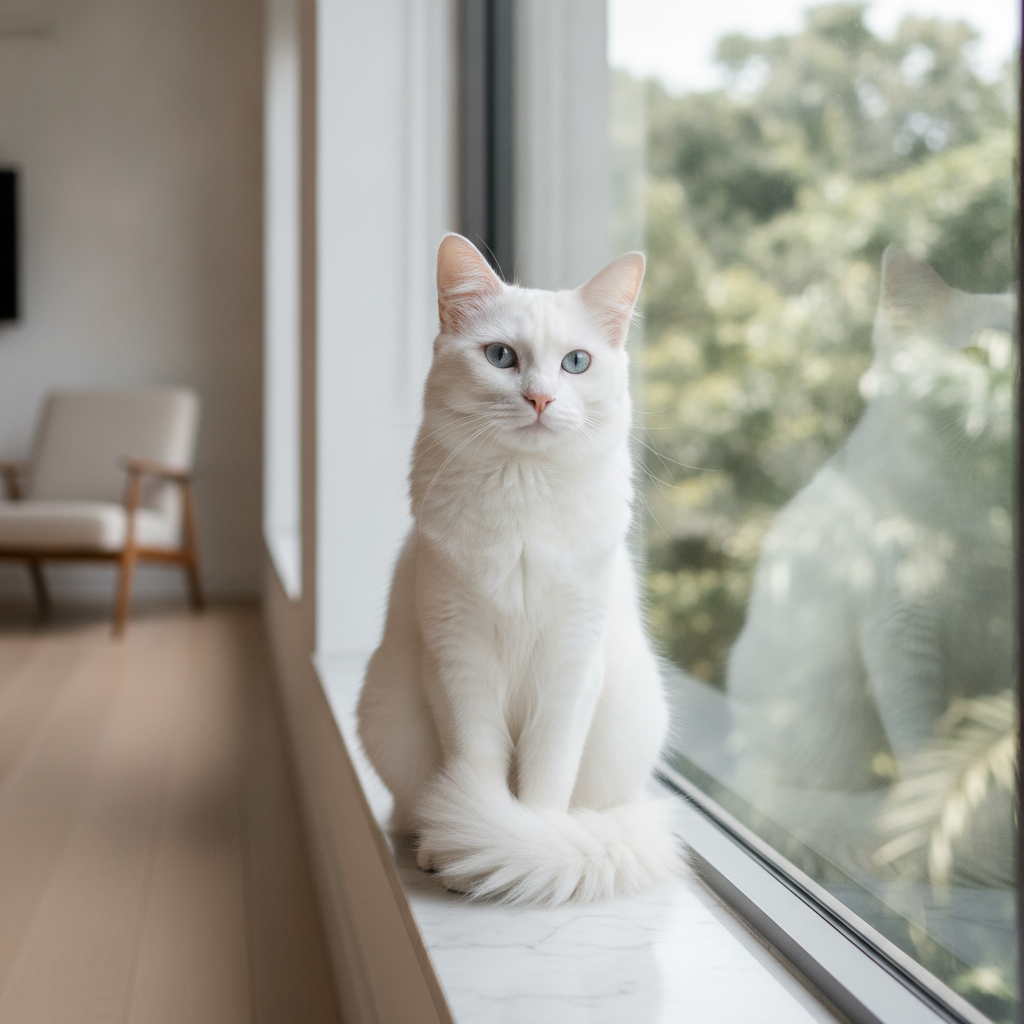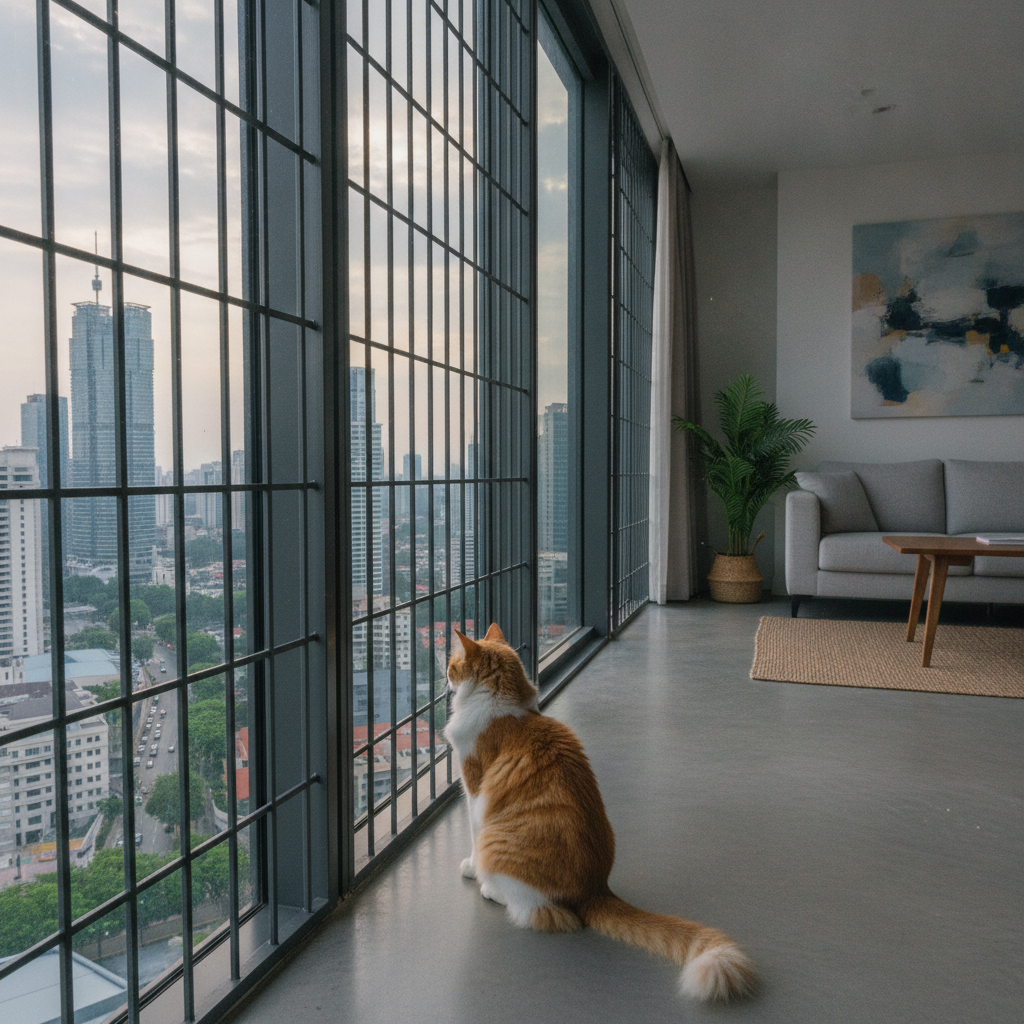
Here is a sentence no Malaysian cat parent wants to read, but every one of us living above the third floor needs to: a cat can step off a balcony or a windowsill in the time it takes you to answer the door. Most of us keep our cats in high-rise condos and flats, leave the windows open all year because of the heat, and quietly assume that cats are too graceful to fall. They are not. Veterinarians have a clinical name for what happens next, and it is common enough to have its own body of research.
This guide explains high-rise syndrome in plain language, what the veterinary data actually says about cats falling from height, and exactly how to secure your windows, grilles and balcony so your cat never becomes a statistic. It is the flagship piece in our cat home safety guide for Malaysian condos.
What Is High-Rise Syndrome (And Why It Matters in Malaysia)
High-rise syndrome is the veterinary term for the pattern of injuries a cat sustains after falling from two or more storeys, generally defined as a height of around 7 metres or more. The term was coined in the early 1980s by veterinarians at New York City's Animal Medical Center, who kept seeing the same predictable cluster of injuries in cats from the city's apartment towers. According to the Animal Medical Center, this was happening often enough to study formally.
In temperate countries, cases spike in the warm months when people throw their windows open. Malaysia does not have a "warm season" — we have warm all year. That single fact changes everything. A condo cat in Cheras or Mont Kiara lives next to an open window 365 days a year, which means the seasonal risk that vets describe overseas is, for us, a permanent one. It is not a coincidence that Universiti Putra Malaysia veterinary researchers have documented feline high-rise fall cases locally too. This is a Malaysian problem, not an imported scare story.
Why Cats Fall: It Is Instinct, Not Clumsiness
The most important thing to understand is that these falls are almost never deliberate. A cat's survival instinct is strong; it will not knowingly leap into empty air. Falls happen when normal feline behaviour goes unchecked next to an unsecured edge. As International Cat Care explains, the usual trigger is prey drive: a bird, a moth, or one of our ever-present geckos crosses the railing, the cat locks on, lunges, and misjudges the edge.
Three groups are especially at risk:
- Kittens and young cats — bottomless curiosity, boundless energy, and no real sense of danger. They are over-represented in fall cases.
- Nappers on the windowsill — a cat dozing on a sunny ledge can be startled by a sudden noise, or simply roll over in its sleep and slip off.
- Hunters — any cat fixated on moving prey near the edge.
The ASPCA adds an architectural twist that applies perfectly to our concrete-and-tile condos: smooth surfaces like painted concrete and ceramic-tiled ledges give a cat's claws almost nothing to grip if it does start to slip. Place a cat tree or shelf next to the window, and you have unintentionally built a staircase to the most dangerous spot in the house.
The Myth That Hurts Cats: "They Always Land on Their Feet"
Cats do have a remarkable righting reflex. Triggered by the vestibular system in the inner ear, and powered by an unusually flexible spine and the absence of a rigid collarbone, a falling cat can rotate its head toward the ground and twist the rest of its body to follow, often landing feet-first. As PetMD notes, this reflex needs roughly 30 to 90 centimetres of fall just to engage — and crucially, landing feet-first does not cancel the force of impact.
That force has to go somewhere. It travels up through the legs and jaw and into the chest. So the comforting image of a cat trotting away from a fall is a myth that gets cats killed, because it convinces owners that an open 15th-floor window is fine. It is not.
What Actually Happens When a Cat Falls
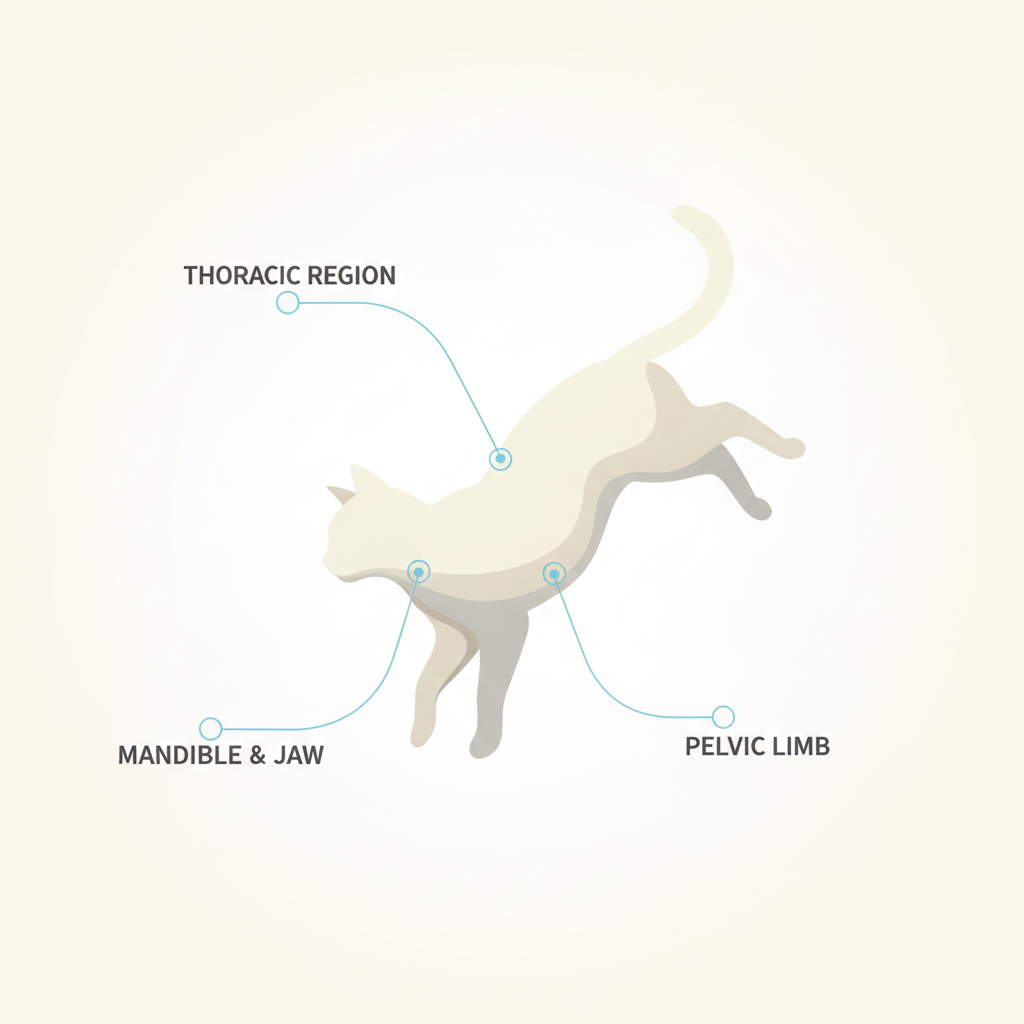
This is the part that changes minds. A large retrospective study of 1,125 high-rise fall cases, published on the US National Library of Medicine, found a brutally consistent "triad" of injuries:
- Chest trauma in 58.3% of cats — including bruised lungs (pulmonary contusions, 46.8%) and collapsed lungs (pneumothorax, 24.6%). These are the silent killers: a cat can look fine on the outside while struggling to breathe internally.
- Facial and jaw injuries in 51.1% — fractured lower jaws, split hard palates (the roof of the mouth), broken teeth and nosebleeds, because the chin takes the hit.
- Limb fractures in 47.2% — most often the hind legs.
The survival numbers are genuinely encouraging if the cat reaches a vet fast: that landmark 1987 study of 132 cats reported a 90% survival rate, and the larger modern study found 87%. But read that carefully — those figures only count cats that survived the impact and were brought in for treatment. A cat that looks unhurt after a fall can have life-threatening internal bleeding. Any fall from height is an emergency vet visit, full stop, even if your cat gets up and walks away. If you do not have a clinic saved in your phone, our cat first-aid guide for Malaysia is worth bookmarking now.
The Strange Fall-Height Paradox (And Why You Should Ignore It)
You may have heard that falling from a higher floor is somehow safer for a cat. This comes from the same 1987 study, which found injury severity rising up to about the seventh storey, then unexpectedly easing off above it. One cat famously survived a 32-storey fall with a chipped tooth and a mild collapsed lung. The proposed reason: after about five storeys a cat hits terminal velocity (around 97 km/h), stops accelerating, relaxes, and splays its legs like a flying squirrel to spread the impact.
It is a fascinating theory — and you should not bet your cat's life on it. As later analysis points out, the original study suffered from survivorship bias: cats that died on impact from the highest floors never made it to the clinic to be counted. A 2004 study of 119 cases found the opposite and more intuitive result — higher falls meant more severe injuries and more chest trauma. The honest takeaway is simple: every storey is dangerous, and the only safe height is a secured one.
Securing Windows, Screens and Grilles
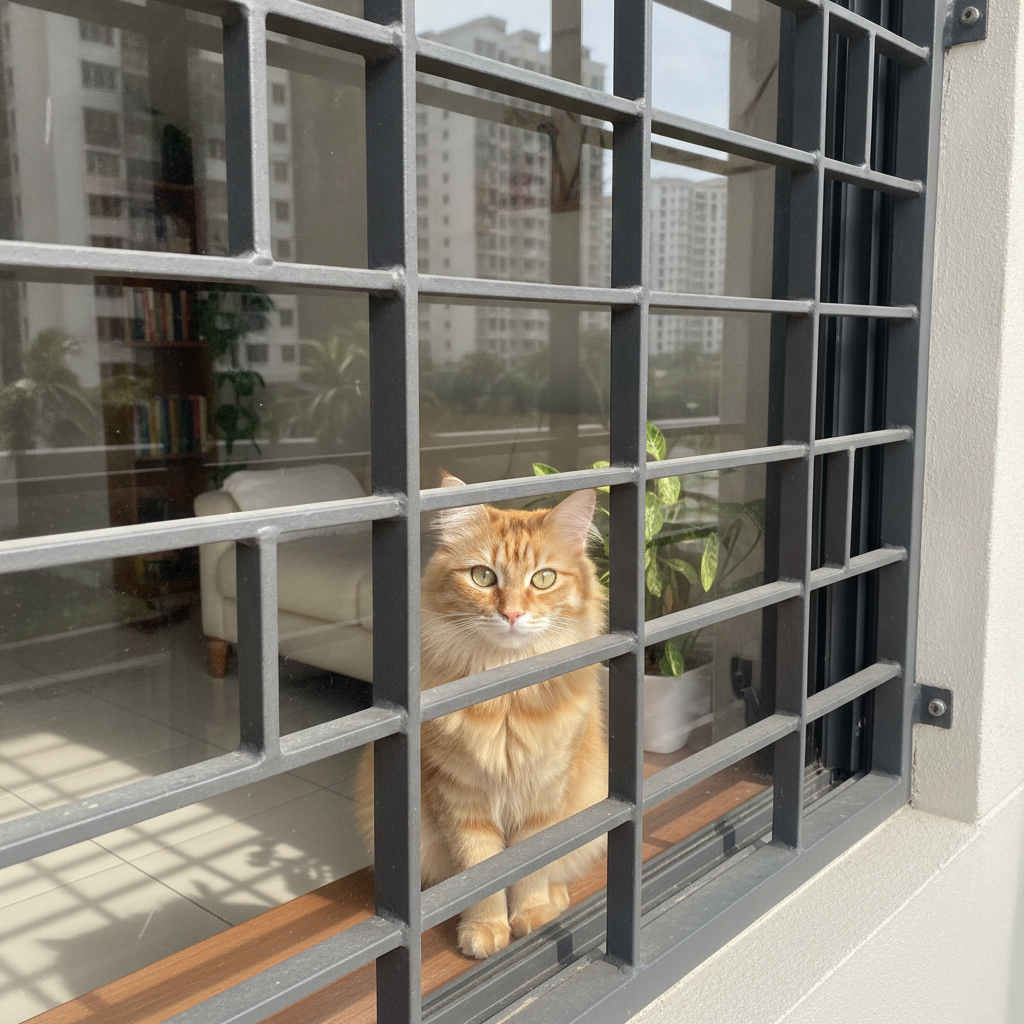
The single most common point of failure is the insect screen. Standard fibreglass or aluminium mesh — the kind on most Malaysian sliding windows — is designed to keep mosquitoes out, not to hold a determined cat in. A cat's weight against it, or a few claws, and it pops straight out of the track. The ASPCA is blunt about this, and so are we: an insect net is not cat-proofing.
What actually works:
- Keep the window grille closed. Many Malaysian flats already have steel security grilles — your best friend here. But check the bar spacing: a gap wider than about 5–6 cm can let a slim cat or kitten squeeze through. For wide gaps, line the grille with sturdy welded wire mesh or pet-rated netting zip-tied securely in place.
- Use window restrictors so a sliding window only opens a few centimetres — enough for a breeze, too narrow for a cat.
- Move the launch pads. Shift cat trees, shelves and chairs away from any window that opens.
Doors are the other escape route, and they deserve their own playbook — see our guide on stopping your cat escaping through doors, windows and grilles.
Securing Your Balcony (Without Buying a Catio)
Balconies are the highest-risk zone in a condo, and also the most rewarding to fix — a secured balcony becomes safe enrichment instead of a hazard. Start by removing anything near the railing a cat could climb, and inspect the railing itself: any gap wider than about 10 cm is enough for most cats to slip through. The most effective fix is full enclosure with durable, UV-stable netting running from floor to above the railing, with overlapping corners and an inward overhang at the top for the talented jumpers.
You do not need to buy an expensive ready-made enclosure to do this safely. We have a complete, renter-friendly walkthrough in how to cat-proof a balcony in a Malaysian condo, covering netting, no-drill tension systems and DIY barriers. (If you have decided you do want a proper built enclosure or catio, that is a separate project worth its own research.)
Keeping an Indoor Cat Happy and Safe
Here is the quiet truth behind all of this: a properly secured condo means your cat lives a fully indoor life — and the research is clear that indoor cats in Malaysia generally live longer, safer lives. But an indoor cat needs two things from you in return: enough stimulation, and a clean, reliable toilet. A bored cat is the one staring obsessively at the balcony in the first place, so invest in vertical space and play — our indoor enrichment guide has ideas that fit a small unit.
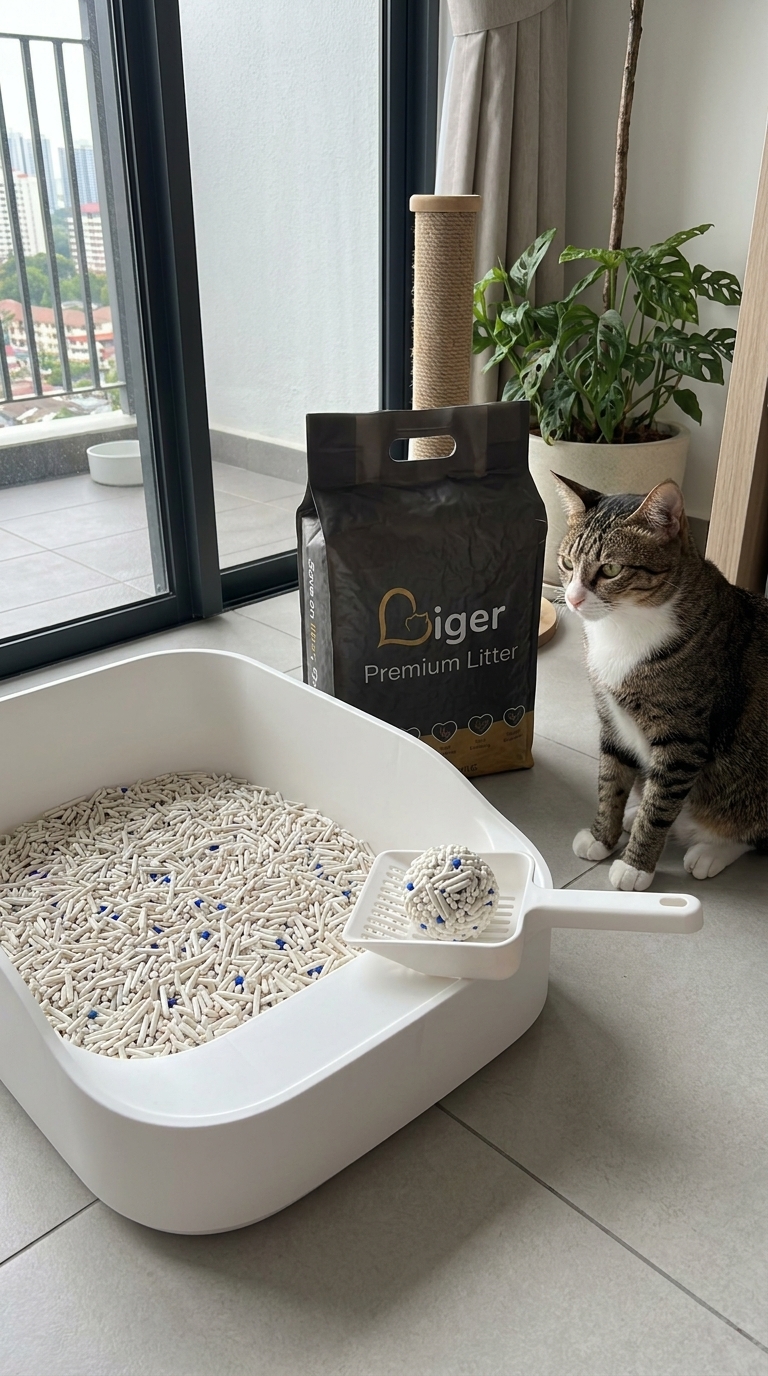
The toilet half matters more than people think. An indoor cat relies entirely on its litter box, so the litter you choose is part of the safe-home equation — especially in a small, enclosed condo where dust and odour have nowhere to go. We use Liger Premium Tofu Cat Litter for our own four cats: it is low-dust (kinder to feline lungs in a sealed apartment), naturally clumping, flushable, and carries a gentle milk scent that keeps a tight KL flat from smelling like a litter box. Pricing is honest and local — RM21.90 for a single 2 kg pack, down to RM169 for a 10-pack (20 kg), which works out to about RM8.45/kg, with free shipping in Peninsular Malaysia (current Liger pricing, as of May 2026). To work out how much your household actually needs, run the numbers through our litter calculator.
Secure the windows, net the balcony, enrich the space, keep the box clean — do those four things and your cat gets the best of high-rise living with none of the fall risk. For the full room-by-room version, head back to the home safety checklist.