Blink and you'll miss it. A kitten goes from a wobbly, blue-eyed weanling to a fully grown cat in roughly twelve months — the most compressed, dramatic year of growth your cat will ever have. Knowing what's supposed to happen, and roughly when, turns a confusing few months into a map: you'll know which weird behaviour is normal, when to switch food, when teeth should fall out, and when to book the spay or neuter.
This is your month-by-month field guide from weaning onward. (For the all-important behavioural side of these same weeks, pair it with our kitten socialisation guide, and for the bigger picture see the cat life-stage care guide.)
The First Year, in Fast-Forward
A kitten's first year is a finely tuned evolutionary sprint — cats descend from solitary hunters who had to become self-sufficient fast. Development falls into four overlapping stages, each with its own job:
| Stage | Age | Headline change |
|---|---|---|
| Weaning | 4–8 weeks | Milk to solid food; first teeth; first steps |
| Socialisation | 8–16 weeks | Eye colour sets; play peaks; confidence built |
| Juvenile | 4–6 months | Baby teeth out, adult teeth in; puberty begins |
| Adolescence | 6–12 months | Growth slows; the "teenage" cat; social maturity |
Want your kitten's age translated into human years at any point? The cat age calculator does it instantly.
Weaning to 8 Weeks: First Teeth, First Steps, First Litter Box
Weaning — the gradual swap from mum's milk to solid food — usually starts around four weeks, just as the first baby teeth break through. It begins as a soupy slurry of kitten food and warm water or milk replacer, thinning out until, by eight weeks, a kitten eats wet and dry kitten food and drinks water on its own. Our kitten feeding guide by age walks through the amounts.
Physically, this month is explosive. Weight roughly doubles from around 400 g at four weeks to near 900 g by eight weeks — a useful rule of thumb is about 100 g of gain per week, or roughly a pound a month. Weighing your kitten on a kitchen scale once or twice a week is the best early-warning system there is: steady gain means thriving, a stall means call the vet. Wobbly walking turns into running, pouncing and the first clumsy climbs, with full coordination arriving by eight weeks. Hearing, already good at four weeks, sharpens further; eyesight is essentially adult by five weeks; and the famous blue baby eyes — every kitten is born blue — begin shifting toward their permanent colour somewhere between three and eight weeks. International Cat Care stresses that these weeks are about far more than physical growth — the experiences a kitten banks now echo for life.
On the dental front, a kitten erupts a full set of 26 baby (deciduous) teeth by eight weeks — 12 incisors, 4 canines and 10 premolars (kittens have no baby molars). Those needle-sharp teeth are part of why this is the stage litter-box and chewing habits get set. And critically, this is when the litter box enters the picture: kittens can start using one from about four weeks old. For these tiny ones, veterinary sources advise a shallow, low-sided box and caution that very young kittens under 7–8 weeks may taste-test litter, so a non-clumping option is safest until they outgrow the habit — our safe litter by age guide explains exactly when to switch.
8 to 16 Weeks: Eyes Set and Play Peaks
This is the home stretch of the learning-sponge phase. A kitten's brain is still highly receptive, but a natural caution starts creeping in around eight weeks — which is exactly why positive, gentle experiences now matter so much (the full how-to is in our socialisation guide).
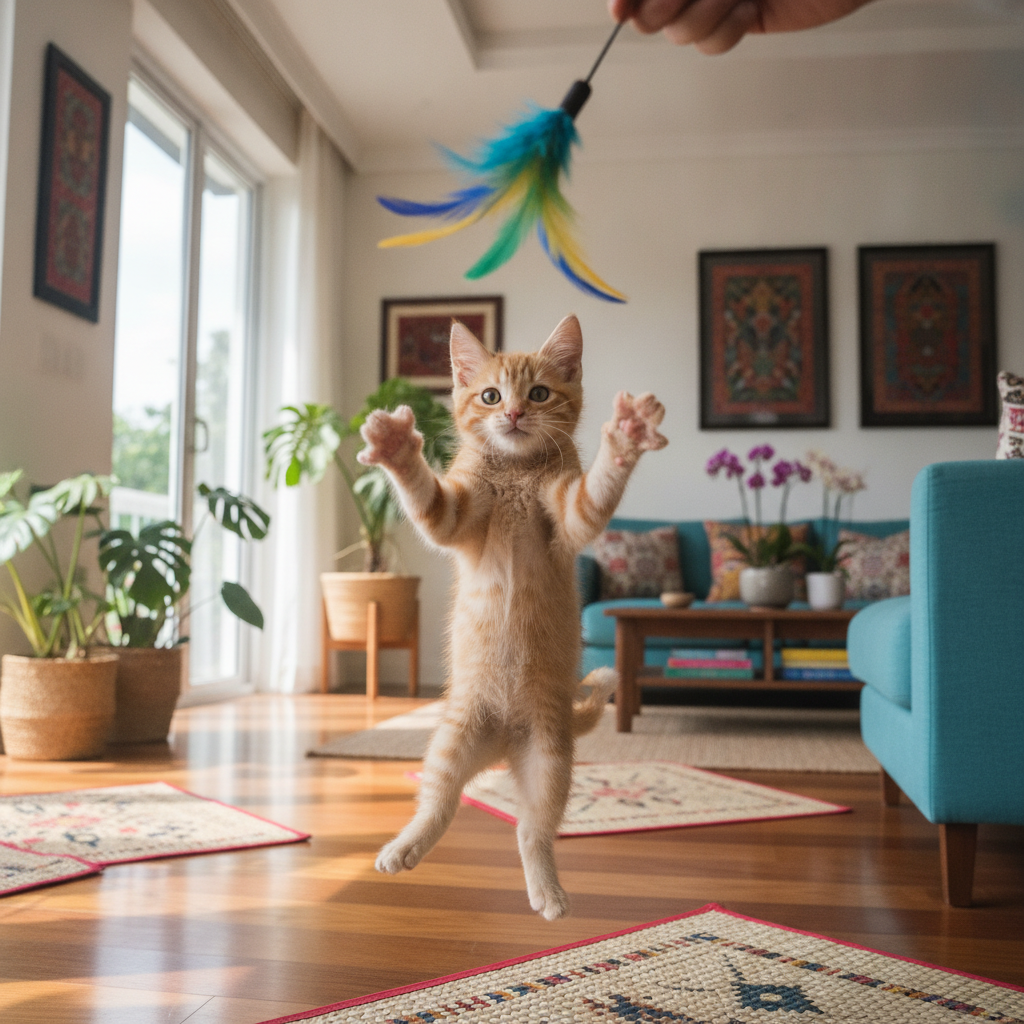
Two milestones stand out. First, permanent eye colour locks in by roughly 12 to 16 weeks — that gorgeous green, gold or copper is now set for life. Second, play peaks and then pivots. Rough social wrestling with littermates hits its high point around 12 weeks, teaching bite inhibition and body-language reading, before giving way to solitary object play: stalking, pouncing, the "kill bite" on a toy, and the triumphant toss. That shift from "play with siblings" to "hunt the feather wand" is your kitten rehearsing its inner predator — the full stalk-chase-pounce-bite sequence wired in by evolution. The practical upshot for you: give them an outlet. Short, daily wand-toy sessions that let a kitten "catch" the prey satisfy that drive and head off the redirected biting and ankle-ambushing that owners of under-stimulated kittens know all too well. Weight keeps climbing at about a pound a month, putting a four-month-old somewhere around 1.5–2.3 kg.
4 to 6 Months: Baby Teeth Out, Adult Teeth In, Adolescence Begins
The juvenile stage brings the most visible physical drama of the whole year: the great dental swap. Starting around three to four months, those 26 baby teeth loosen and fall out — incisors first — and are replaced by a complete set of 30 permanent adult teeth, usually done by around six to seven months. You may find tiny teeth on the floor, spot a little blood on a toy, or notice extra chewing. This is the chaotic "land shark" chapter, and our kitten teething survival guide is built for it. Occasionally a baby tooth refuses to budge while the adult erupts beside it (a "retained deciduous tooth") — worth flagging to your vet, since it can trap food and cause problems. It's also the perfect age to start a gentle tooth-brushing habit; the American Veterinary Medical Association notes home dental care started young pays off for the cat's whole life.
The other headline is hormones. Sexual maturity can arrive surprisingly early — female kittens can have their first heat cycle from as young as four months, and males aren't far behind. That means unwanted litters and behaviours like yowling, spraying and escape attempts can start before many owners expect. Most vets recommend planning spaying or neutering around this window; the timing and the rest of the first-year medical schedule live in our kitten first-year health timeline.
6 to 12 Months: The Teenage Cat

Welcome to adolescence — the feline equivalent of the teenage years, complete with boundary-testing, bursts of wild energy at 3am, and a body that's nearly adult-sized but not quite finished. Growth slows markedly after six months. Your kitten looks like a cat now, but is still filling out in muscle and frame.
Behaviourally, this is when your cat settles its permanent place in the household's social order and its adult personality crystallises. Channel that teenage energy with structured interactive play and plenty of vertical space — a bored adolescent invents its own (usually destructive) entertainment. Somewhere in this window, typically between 6 and 12 months, it's time to transition from kitten food to adult food, done gradually over 7–10 days to avoid an upset stomach, as advised by the Cornell Feline Health Center.
When Does a Kitten Stop Growing?
For most domestic cats, skeletal growth is essentially complete by the first birthday, and social maturity follows around the same time. There are exceptions: large breeds like the Maine Coon can keep filling out until three to four years of age. If you're curious how your kitten's eventual size and lifespan compare across breeds, see cat lifespan by breed. After twelve months, your cat officially graduates into the junior/young-adult stage of the life-stage guide — and the breakneck pace of change finally slows down.
Kitten Milestones at a Glance
Pin this to the fridge. If your kitten is tracking roughly to these markers, it's developing normally; if something is clearly off-schedule, it's worth a vet chat. As VCA Hospitals notes, every kitten varies a little, so treat ages as guides, not deadlines.
| Milestone | Typical age |
|---|---|
| Starts solid food (weaning begins) | 4 weeks |
| All 26 baby teeth in | By 8 weeks |
| Fully weaned and independent | 8 weeks |
| Eyesight fully developed | 5 weeks |
| Permanent eye colour set | 12–16 weeks |
| Social play with littermates peaks | ~12 weeks |
| Baby teeth replaced by 30 adult teeth | 3–7 months |
| Sexual maturity (first heat possible) | From 4 months |
| Skeletal growth essentially finished | ~12 months |
Litter for a Growing Kitten
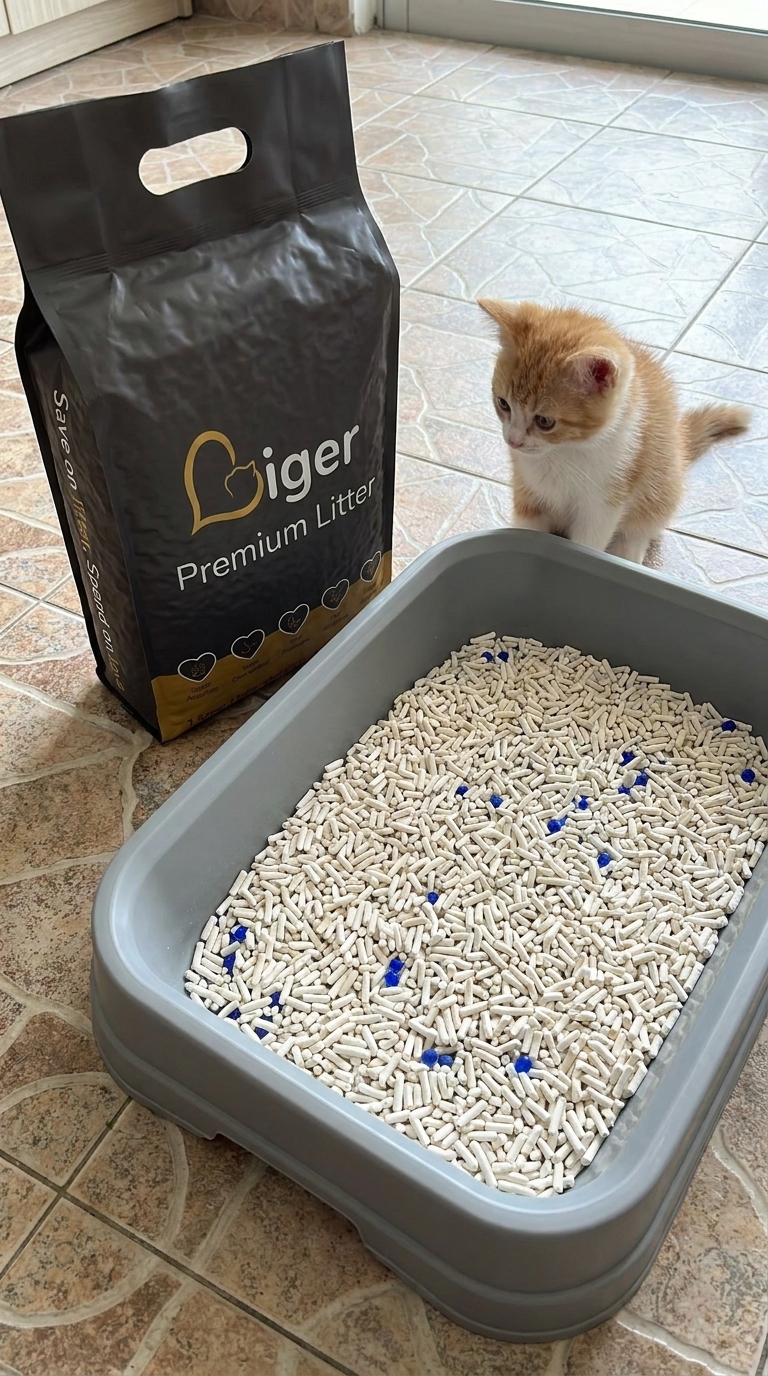
A kitten's litter needs change as fast as the rest of it. Under about 7–8 weeks, while they may still nibble, a non-clumping litter is the cautious choice. Once they're past the taste-testing stage, a low-dust, food-grade clumping litter is ideal — easier to keep clean, gentler on small developing airways, and safe around a curious digger.
That's the niche Liger Premium Tofu Cat Litter fills nicely once your kitten is ready: made from food-grade plant starch, it's low-dust, soft on little paws, and clumps firmly so a kitten's many small accidents are quick to scoop. It ranges from RM21.90 for a single 2 kg pack to RM169 for the 10-pack (about RM8.45/kg), with free shipping in Peninsular Malaysia (current Liger pricing, as of May 2026). A growing kitten gets through more than you'd think — estimate your monthly need with the litter calculator, and get the box and training right with our kitten litter training guide.